Facts
The petitioner challenged the respondent’s order dated 5 August 2026 under Section 74A of the Tamil Nadu Goods and Services Tax Act, contending that notices uploaded to the GST portal had not come to its authorised representative’s attention and that it had not been given a personal hearing before the order was passed.
Source reference: pp. 1–3, paras. 1, 4The petitioner offered to pay 10% of the disputed tax and sought an opportunity to present its case.
Source reference: p. 3, para. 5The respondent acknowledged that no personal hearing had been provided and agreed to remittal subject to payment of 10% of the disputed tax.
Source reference: p. 3, para. 6Issues
Whether, in the circumstances, portal-only service of notices followed by an ex parte order was sufficient, particularly where the taxpayer did not respond.
Source reference: pp. 3–4, paras. 8–10Whether the impugned order should be set aside and the matter remitted for fresh consideration, subject to conditions.
Source reference: p. 5, para. 11Law Applied
The Court referred to Section 169(1) of the GST Act, which recognises prescribed modes of service, and observed that uploading a notice to the GST portal is a sufficient mode of service.
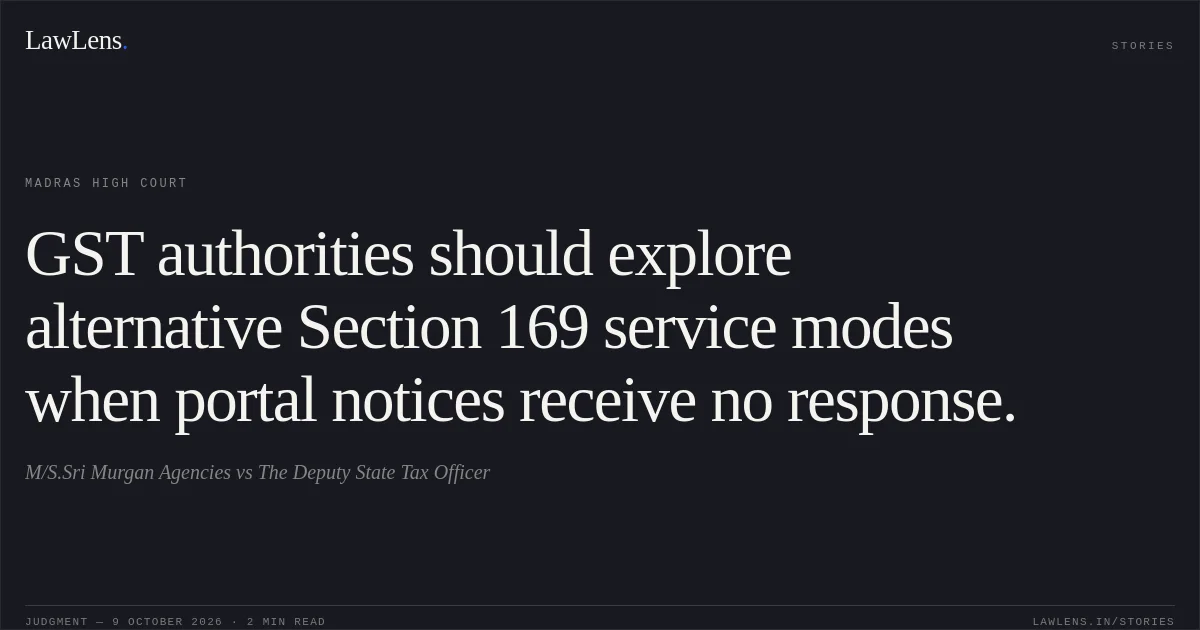
Source reference: p. 4, para. 9However, where a taxpayer does not respond to portal notices, the issuing officer should consider other available modes under Section 169(1), preferably registered post with acknowledgment due (RPAD), to effect service effectively.
Source reference: pp. 4–5, paras. 9–10The Court also treated the absence of a personal hearing as a relevant procedural deficiency in the circumstances of this case.
Source reference: pp. 3–4, paras. 6, 8Reasoning
Although portal service was legally sufficient, the Court considered that the absence of any response should have prompted the officer to explore another mode of service rather than proceed on the basis of portal notices alone.
Source reference: pp. 4–5, paras. 9–10The respondent also admitted that no personal hearing had been afforded before the order was passed.
Source reference: p. 3, para. 6In light of these circumstances and the petitioner’s offer to pay 10% of the disputed tax, the Court considered remittal appropriate.
Source reference: p. 5, para. 11Holding
The Court set aside the order dated 5 August 2026 and remitted the matter for fresh consideration, conditional on the petitioner paying 10% of the disputed tax within four weeks of receiving the order; the setting aside takes effect upon payment.
The petitioner must file its reply and supporting documents within three weeks of payment. The respondent must then give 14 clear days’ notice fixing a personal hearing and pass fresh orders on the merits and in accordance with law.
Source reference: p. 5, para. 11(ii)–(iii)Any attachment over the petitioner’s bank account is to be lifted, and the bank is directed to release the attachment and de-freeze the account upon production of the Court’s order and proof of payment.
Source reference: p. 6, para. 11(iv)The writ petition was disposed of without costs.
Source reference: p. 6, para. 12Acts & Sections Cited
2 provisions across 1 statute referred to in this judgment. Linked provisions open on LawLens.
Tamil Nadu Goods and Services Tax Act, 20172
Original Court PDF
M/S.Sri Murgan AgenciesvsThe Deputy State Tax Officer
Click to open original judgment
Original judgment, available to read, download and summarize on LawLens.in