Facts
The petitioner, a consignor, transported goods in vehicle No. TN-57-BR-9751.
Source reference: p.4, para. 3The vehicle was intercepted on 03.10.2025 at approximately 11:40 p.m., when the transporter possessed an e-way bill that did not display the vehicle number.
Source reference: p.4, paras. 3–4The petitioner stated that the omission resulted from a technical glitch and opted to pay the penalty for release of the goods and vehicle.
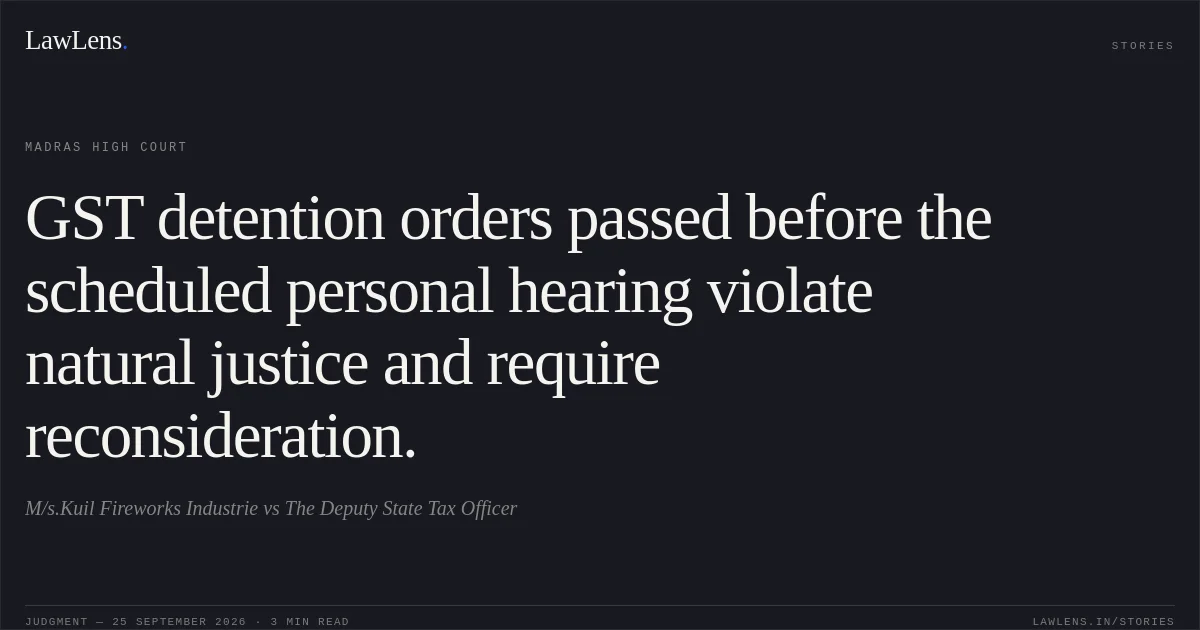
Source reference: p.4, para. 4A notice in Form GST MOV-07 was issued on 03.10.2025, scheduling personal hearing for 10.10.2025 at 11:00 a.m.; however, the adjudicating authority passed the detention/penalty order in Form GST MOV-09 on 06.10.2025, before the scheduled hearing.
Source reference: p.3, para. 6; p.4, para. 7The petitioner subsequently filed an appeal under Section 107 on 31.03.2026, which was dismissed as time-barred on 27.08.2026.
Source reference: p.3, para. 5The petitioner thereafter challenged the Form GST MOV-09 order under Article 226 of the Constitution.
Source reference: no citationIssues
Whether the Form GST MOV-09 order was vitiated by breach of natural justice because it was passed before the expiry of the time fixed for the petitioner’s personal hearing.
Source reference: p.3, para. 6; p.4, para. 7Whether, notwithstanding payment of the penalty under Section 129, the matter required reconsideration to determine whether the e-way bill was fabricated or was genuine but omitted the vehicle number due to a technical glitch.
Source reference: p.5, paras. 9–12Whether the High Court should quash the impugned order and remit the matter for fresh adjudication.
Source reference: p.5, paras. 11–13Law Applied
The Court applied Section 129 of the applicable GST enactments, under which goods transported in contravention of the statutory requirements may be detained and penalty proceedings initiated under Section 129(3), while Section 129(5) provides that payment of the amount under Section 129(1) ordinarily concludes the proceedings relating to the notice.
Source reference: p.4, para. 9The Court also applied the principles of natural justice, particularly the requirement that a person be afforded the hearing prescribed in the notice before an adverse adjudicatory order is passed.
Source reference: p.3, para. 6; p.4, para. 7The statutory appellate remedy under Section 107 and its limitation framework were also noted, as the petitioner’s delayed appeal had been dismissed.
Source reference: p.3, para. 5Reasoning
Although the respondents relied on the petitioner’s admission that the vehicle number was absent from the e-way bill and invoked Section 129(5) on the basis that the penalty had been paid, the Court found that the matter could not be conclusively determined on the existing record.
Source reference: p.4, paras. 8–9The e-way bill produced before the Court showed generation at 11:34 a.m., making the petitioner’s explanation appear implausible; nevertheless, the Court observed that it remained unclear how an e-way bill without the vehicle number had been generated in the system.
Source reference: p.5, para. 10That omission could have resulted either from a technical glitch or from deliberate fabrication, and the distinction required verification by the authority.
Source reference: p.5, para. 11The fact that the impugned order was passed on 06.10.2025, before the scheduled personal hearing on 10.10.2025, further supported reconsideration of the matter.
Source reference: p.3, para. 6; p.4, para. 7Accordingly, the Court exercised its writ jurisdiction to quash the order and remit the matter for fresh determination, while directing the authority to consider the payment already made and verify the authenticity and contents of the e-way bill.
Source reference: p.5, paras. 12–13Holding
The High Court allowed the writ petition by quashing the Form GST MOV-09 order dated 06.10.2025 and remitting the matter to the first respondent for a fresh order.
The fresh adjudication must specifically determine whether the e-way bill was fabricated or was a genuine e-way bill in which the vehicle number was omitted because of a technical glitch, while taking into account the petitioner’s payment of the amount.
Source reference: p.5, para. 12The authority was directed to complete the process expeditiously, preferably within three months from receipt of the order.
Source reference: p.6, para. 13The writ petition was disposed of without costs, and the connected miscellaneous petition was closed.
Source reference: p.6, para. 14Acts & Sections Cited
5 provisions across 1 statute referred to in this judgment. Linked provisions open on LawLens.
the respective GST enactments (alias, unresolved)5
Original Court PDF
M/s.Kuil Fireworks IndustrievsThe Deputy State Tax Officer
Click to open original judgment
Original judgment, available to read, download and summarize on LawLens.in