Facts
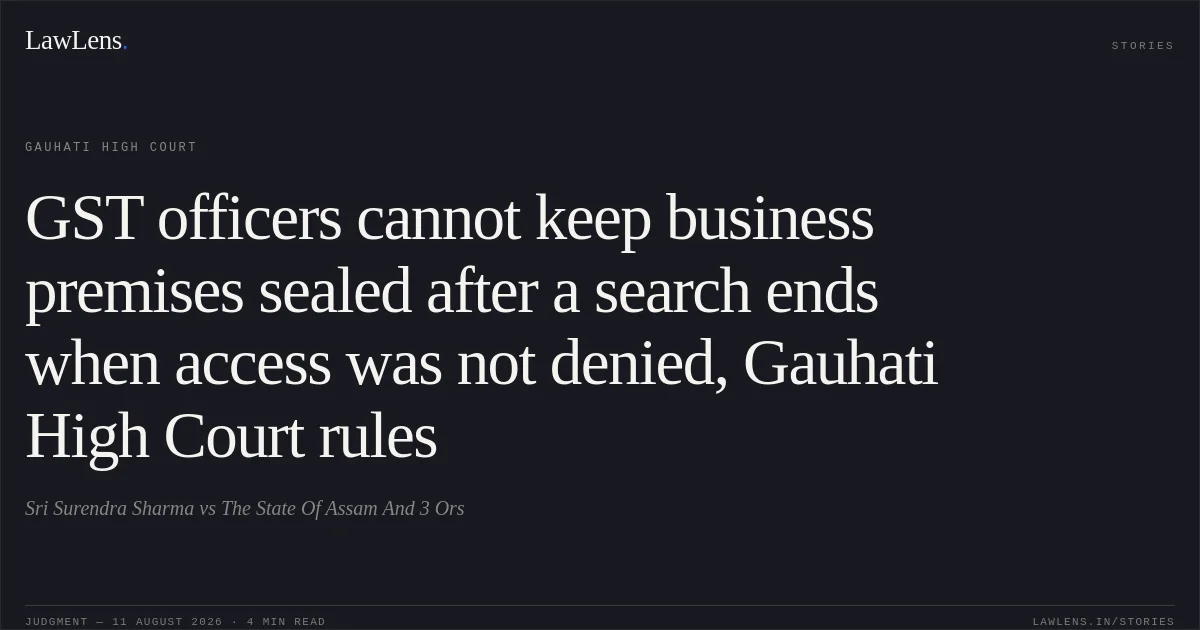
The petitioner, a tax consultant operating under the proprietorship name “M/s Sharma and Associates,” challenged the sealing of his office premises by the Assam State GST authorities under Section 67(4) of the Assam Goods and Services Tax Act, 2017 (“AGST Act”).
Source reference: p. 2–3On 1 April 2026, pursuant to a search authorization issued under Section 67(2), the authorities searched the petitioner’s office and seized documents, electronic devices and other items under Form GST INS-02.
Source reference: p. 3–4The seized items were subsequently handed back to the petitioner subject to a restriction against removal or dealing with them without permission.
Source reference: p. 4On the same date, the authorities issued Form GST INS-03 prohibiting dealings with two desktop computers, six laptops, 426 files, a printer, batteries, an inverter, air-conditioners and a refrigerator.
Source reference: p. 4–5The petitioner’s office was also sealed, and its keys were allegedly taken without acknowledgment.
Source reference: p. 5The petitioner was arrested on 2 April 2026 in connection with an alleged tax-evasion case and was granted bail on 8 April 2026.
Source reference: p. 5–6The petitioner thereafter sought release of the electronic devices, removal of the prohibition order and de-sealing of the office.
Source reference: p. 6–7The respondents opposed the petition, alleging fraudulent issuance of invoices, wrongful passing of input tax credit and alleged tax evasion of approximately Rs. 6.68 crore.
Source reference: p. 6–7They contended that the premises had been sealed to prevent tampering with evidence pending investigation.
Source reference: p. 6–7Issues
Whether the power under Section 67(4) of the AGST Act to seal premises could be exercised in the absence of denial of access to the premises or receptacles during the search?
Source reference: p. 20–23Whether the authorities could continue sealing the petitioner’s office after completion of the search and seizure proceedings, particularly for the purpose of retaining seized materials?
Source reference: p. 19–23Whether the items listed in Form GST INS-03, including office equipment, electronic devices and files, could validly be subjected to an order of prohibition as goods liable to confiscation?
Source reference: p. 16–20Whether the authorities were required to retain custody of seized books, documents and things, rather than hand them back to the petitioner while keeping the premises sealed?
Source reference: p. 17–23Law Applied
The Court primarily applied Section 67(2) of the AGST Act, which authorizes search and seizure of goods liable to confiscation and documents, books or things useful or relevant to proceedings under the Act.
Source reference: p. 11–15The first proviso to Section 67(2) permits an order prohibiting dealings with goods only where seizure of such goods is not practicable, while the second proviso requires seized documents, books and things to be retained only for as long as necessary for examination, inquiry or proceedings.
Source reference: p. 17–20Section 67(4) authorizes sealing or breaking open premises, almirahs, electronic devices, boxes or receptacles only where access to them is denied.
Source reference: p. 20–21The Court relied on the principle that a proviso qualifies and creates an exception to the main enactment, as explained in CIT v. Indo-Mercantile Bank Ltd., 1959 SCC OnLine SC 5.
Source reference: p. 17It further distinguished “goods,” “documents,” “books” and “things,” holding that “books” principally cover physical or electronic accounting records, while “things” operate as a residual category for relevant physical objects such as storage devices; ordinary office equipment is not thereby transformed into confiscable goods.
Source reference: p. 14–16Reasoning
The Court held that Section 67(4) is ancillary to the search-and-seizure power under Section 67(2), and is not an independent power to seal premises indefinitely or use them as storage for seized materials.
Source reference: p. 20–22Since the record contained no allegation that the petitioner had denied access to the office, electronic devices or receptacles, the statutory precondition for sealing was absent.
Source reference: p. 21The power under Section 67(4) could be exercised only during the continuing search and ceased once the search culminated in seizure.
Source reference: p. 22The Court further found that the authorities’ conduct was internally inconsistent: if the seized documents, books and things were still necessary for investigation, their custody should have remained with the officers under the second proviso to Section 67(2); handing them back to the petitioner suggested that they were no longer being retained as seized materials.
Source reference: p. 17–20Conversely, sealing the office merely to preserve or store those materials was not authorized by Section 67(4).
Source reference: p. 22The items covered by Form GST INS-03 were ordinary office assets and materials, and the authorities had not established that they were goods liable to confiscation.
Source reference: p. 16–20; p. 23Consequently, the prohibition order could not be sustained.
Source reference: p. 16–20; p. 23Holding
The writ petition was disposed of with the holding that sealing and continuing to seal the petitioner’s office was illegal, unauthorized and contrary to Section 67(4) of the AGST Act.
The respondents were directed to de-seal the premises and hand over possession to the petitioner forthwith, and in any event by 12 August 2026.
Source reference: p. 24At the time of de-sealing, the authorities were permitted to retake custody of Exhibits 1–105 if still necessary for investigation, subject to issuing a fresh seizure order relatable back to 1 April 2026.
Source reference: p. 24The petitioner was to be permitted copies or extracts of seized documents unless the authorities formed an opinion that doing so would prejudice the investigation.
Source reference: p. 25Form GST INS-03 dated 1 April 2026 was quashed, and no costs were awarded.
Source reference: p. 25Acts & Sections Cited
10 provisions across 4 statutes referred to in this judgment. Each provision opens on LawLens.
ASSAM GOODS AND SERVICES TAX ACT, 20177
Central Goods and Services Tax Act, 20171
Code of Criminal Procedure, 19731
Information Technology Act, 20001
Original Court PDF
Sri Surendra SharmavsThe State Of Assam And 3 Ors
Click to open original judgment
Original judgment, available to read, download and summarize on LawLens.in