Facts
The petitioner challenged two assessment orders in Form GST DRC-07, dated 9 and 24 December 2025, for assessment year 2021–2022.
Source reference: pp. 1–3The notices had been uploaded to the GST portal, but the petitioner said he was unaware of them and consequently did not submit replies.
Source reference: pp. 1–3The orders were passed without a personal hearing.
Source reference: pp. 1–3The petitioner sought an opportunity to present his case and offered to pay 25% of the disputed tax in each petition; the respondent acknowledged that no personal hearing had been provided and consented to remand subject to that payment.
Source reference: pp. 1–3Issues
1. Whether the assessment orders should be set aside where notices were uploaded to the GST portal but the petitioner did not respond and was not afforded a personal hearing.
Source reference: pp. 2–42. Whether remand for fresh consideration should be conditional on payment of 25% of the disputed tax in each petition.
Source reference: pp. 3, 5Law Applied
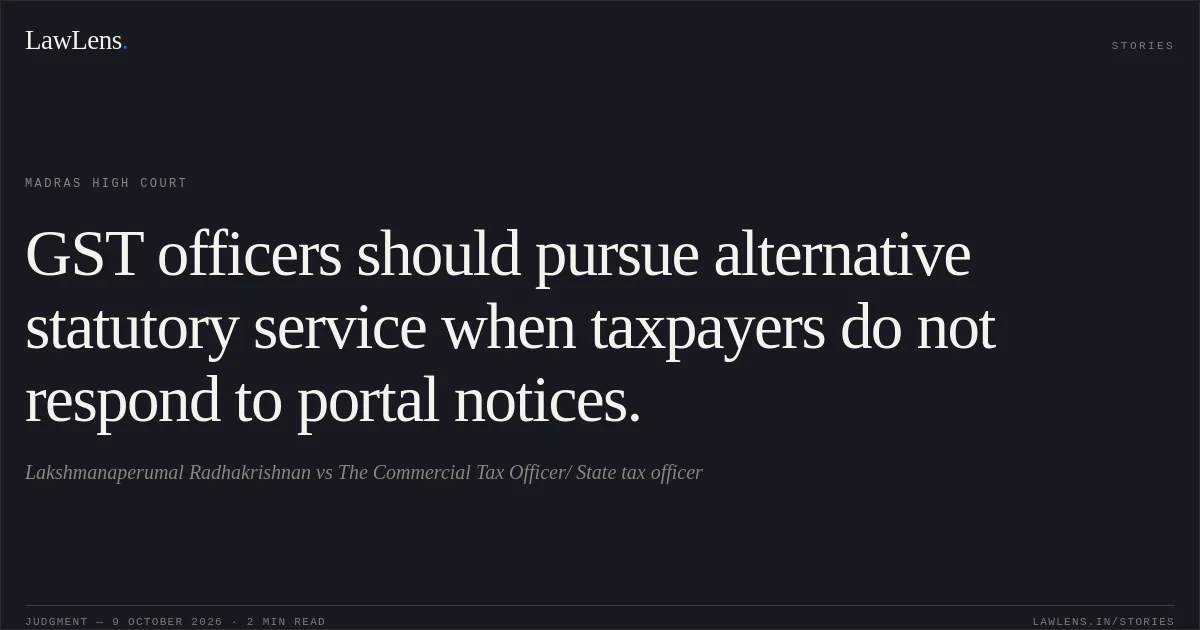
Section 169(1) of the GST Act recognises prescribed modes of service, including service through the GST portal and other authorised modes.
Source reference: pp. 3–4Although portal service is sufficient, where a taxpayer does not respond to notices sent through that mode, the authority should consider using another prescribed mode—preferably registered post with acknowledgment due (RPAD)—to make service effective.
Source reference: pp. 3–4The Court also applied the principle that an assessment should not be confirmed without affording the taxpayer an opportunity of personal hearing.
Source reference: pp. 3–4Reasoning
The Court accepted that uploading the show-cause notices on the GST portal constituted a valid mode of service.
Source reference: pp. 3–5However, given the petitioner’s non-response, the authority should have considered other modes under Section 169(1), rather than proceeding to confirm the proposals without a personal hearing.
Source reference: pp. 3–5The respondent admitted that no personal hearing had been given.
Source reference: pp. 3–5In these circumstances, and in light of the petitioner’s offer to pay 25% of the disputed tax, the Court considered remand appropriate on that condition.
Source reference: pp. 3–5Holding
The Court set aside both assessment orders and remanded the matters for fresh consideration, conditional on payment of 25% of the disputed tax in each petition within four weeks from receipt of the order.
The setting aside would take effect upon payment.
Source reference: p. 5The petitioner was directed to file replies and supporting documents within three weeks of payment; thereafter, the respondent must give 14 clear days’ notice fixing a personal hearing and pass fresh orders on the merits and in accordance with law.
Source reference: p. 5The writ petitions were disposed of without costs, and the connected miscellaneous petitions were closed.
Source reference: p. 6Acts & Sections Cited
1 provisions across 1 statute referred to in this judgment. Each provision opens on LawLens.
Central Goods and Services Tax Act, 20171
Original Court PDF
Lakshmanaperumal RadhakrishnanvsThe Commercial Tax Officer/ State tax officer
Click to open original judgment
Original judgment, available to read, download and summarize on LawLens.in