01Facts
The petitioner, a registered GST taxpayer providing manpower-supply services to government departments and public authorities, was subjected to inspection on 20 January 2024 based on alleged discrepancies between its GSTR-3B and GSTR-7 returns.
¶ 2–3The petitioner subsequently made payments through Form GST DRC-03, including ₹20,97,352 and ₹15,00,000 on 27 March 2024, and ₹18,00,000 on 14 May 2024; it contended that the payments were obtained under coercion and were not voluntary.
¶ 3–5The respondents later issued notices under Section 74 of the CGST/KGST Acts, followed by an adjudication order dated 6 February 2025.
¶ 6–8The petitioner applied for refund of ₹38,97,352 and ₹15,00,000, but the applications were rejected on 12 November 2024. Its statutory appeals were also dismissed by the Joint Commissioner on 28 August 2025.
¶ 7–902Issues
i.Whether the amounts paid by the petitioner through Form GST DRC-03 were voluntary payments under Section 73(5)/Section 74(5) of the CGST Act, or were recovered coercively during inspection and investigation.
¶ 10–16, 20ii.Whether the respondents’ failure to issue Form GST DRC-04 and their failure to establish any prior ascertainment or quantification of tax, interest and penalty invalidated the payments as voluntary statutory payments.
¶ 14–15, 20iii.Whether the petitioner was entitled to refund of ₹53,97,352 with interest and whether the appellate orders rejecting the refund claims were sustainable.
¶ 21–2303Law Applied
The Court applied Section 73(5) of the CGST Act, which permits payment before service of notice on the basis of the taxpayer’s own ascertainment or the proper officer’s ascertainment of tax, together with applicable interest.
¶ 12Section 74(5) similarly permits payment in cases involving alleged fraud, wilful misstatement or suppression, but the payment must comply with the statutory requirements, including interest and penalty.
¶ 20Rule 142(2) of the CGST Rules requires a person making such payment through Form GST DRC-03 to be issued an acknowledgment in Form GST DRC-04.
¶ 13–14The Court relied on the Commissioner’s Instruction dated 25 May 2022, which clarifies that tax recovery cannot be made during search, inspection or investigation without a lawful demand and adjudication, although a taxpayer may voluntarily pay an admitted or ascertained liability.
¶ 16It further relied on Union of India v. Bundl Technologies, which held that payment unsupported by self-ascertainment, written admission or proper statutory procedure cannot be treated as voluntary and may require refund.
¶ 17–18It further relied on Sri J. Ramesh Chand v. Union of India, which identified the absence of prior demand, quantification, DRC-04 acknowledgment and contemporaneous particulars as circumstances indicating involuntary payment.
¶ 19The Court also applied the constitutional principles under Articles 265 and 300A that tax must be collected only by authority of law and that property cannot be deprived without such authority.
¶ 1804Reasoning
The Court found no material showing that the amounts paid by the petitioner were based on its own ascertainment or on any prior ascertainment by the proper officer.
¶ 15, 20Although the respondents relied on Section 73(5)/Section 74(5), the payments were made without any prior demand or quantified liability, and the respondents did not issue the mandatory Form GST DRC-04 acknowledgment.
¶ 14–15The DRC-03 forms also did not reflect payment of interest or penalty, despite the respondents’ reliance on Section 74(5), which further undermined the claim that the payments were voluntary statutory payments.
¶ 20The Court considered the personal-appearance endorsement preceding the second payment particularly significant because it did not identify any statutory provision authorising the demand for appearance.
¶ 4, 20The subsequent initiation of adjudication proceedings could not retrospectively convert earlier coercive collections into voluntary payments; nor could proceedings under Section 79 establish voluntariness.
¶ 21–22Applying Bundl Technologies, J. Ramesh Chand and the 25 May 2022 departmental instruction, the Court concluded that the payments were not legally voluntary and that retention of the amounts lacked authority of law.
¶ 16–2005Holding
The Court allowed the writ petition and quashed the appellate orders dated 28 August 2025 rejecting the petitioner’s refund claims for financial years 2017–18 and 2018–19.
¶ 23(i)–(ii)It directed the respondents to refund ₹53,97,352 to the petitioner with interest at 6% per annum from the respective dates of payment until refund.
¶ 23(iii)The Court expressly left open all rival contentions concerning the tax liability in the pending show-cause and adjudication proceedings.
¶ 23(iv)Original Court PDF
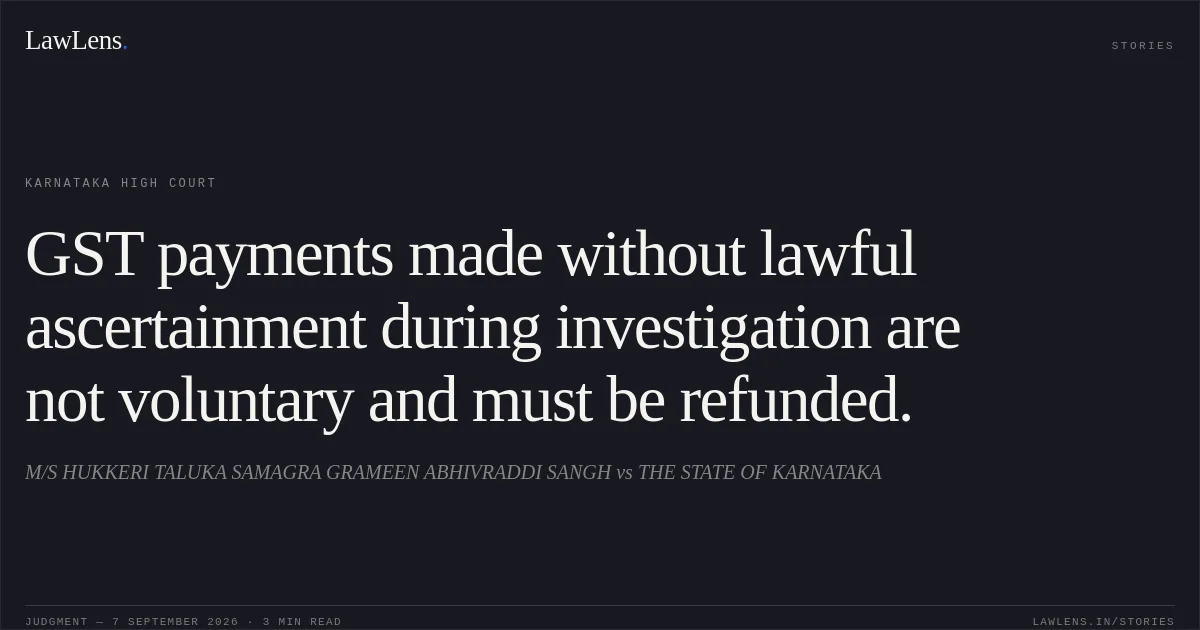
M/S HUKKERI TALUKA SAMAGRA GRAMEEN ABHIVRADDI SANGHvsTHE STATE OF KARNATAKA
Click to open original judgment
Original judgment, available to read, download and summarize on LawLens.in