Facts
The petitioner, a GST-registered private company engaged in works-contract services, executed sub-contract works for NCC Limited and claimed to have engaged eighteen registered sub-contractors during FY 2025–26.
Source reference: paras. 3–7It relied on work orders, invoices, measurement and completion records, bank payments, GSTR-2A/2B data, registration records and undertakings of the sub-contractors to establish the genuineness of the transactions.
Source reference: paras. 3–7The Department issued a show-cause notice dated 9 July 2026 under Section 74A of the CGST Act, proposing denial of input tax credit, recovery of tax and interest, and imposition of penalty.
Source reference: para. 8Instead of replying to the notice, the petitioner invoked Article 226 of the Constitution and challenged the notice on the grounds that Section 61 and Rule 99 had not been followed, the ingredients of fraud or wilful misstatement were absent, and the petitioner had otherwise complied with Section 16(2), including payment through banking channels and reflection of invoices in GSTR-2A.
Source reference: paras. 9–17Issues
Whether the show-cause notice under Section 74A was invalid for non-compliance with Section 61 of the CGST Act read with Rule 99 of the CGST Rules?
Source reference: para. 21(i)Whether invocation of Section 74A(5)(ii) was without jurisdiction because the show-cause notice did not establish fraud, wilful misstatement or suppression of facts?
Source reference: para. 21(ii)Whether the High Court should exercise its extraordinary jurisdiction under Article 226 to quash the show-cause notice at the threshold, despite the petitioner’s failure to submit a reply and the availability of statutory adjudication?
Source reference: para. 21(iii)Whether the petitioner’s challenge to the constitutional validity of Section 16(2)(c) of the CGST Act and the corresponding UPGST provision could be sustained?
Source reference: paras. 2, 11Law Applied
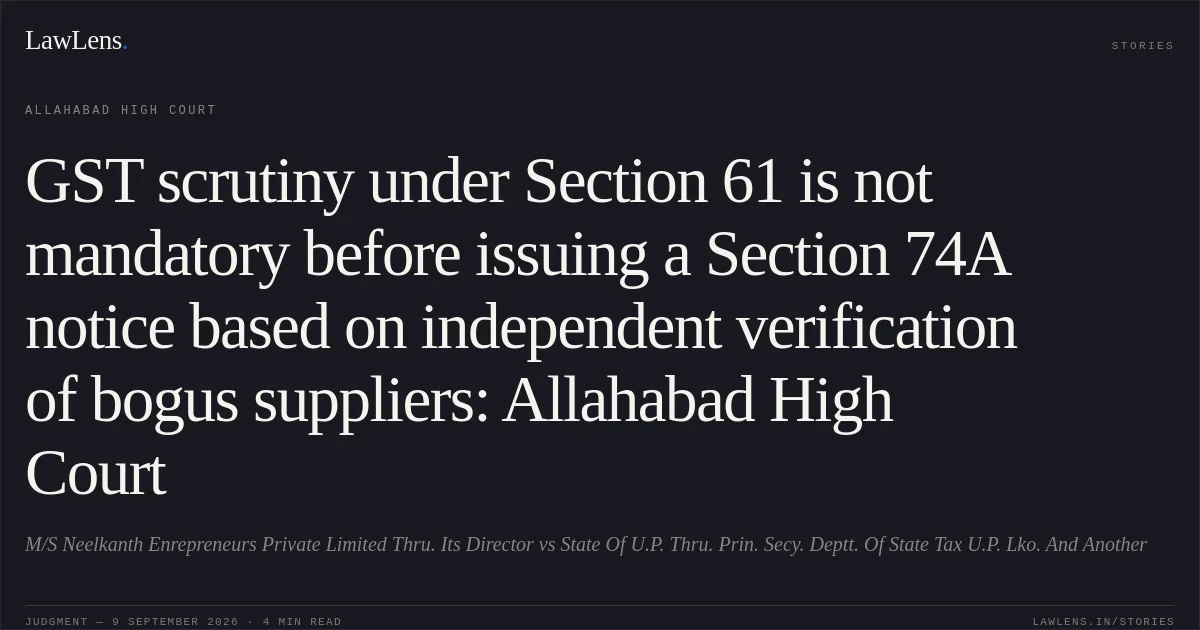
Section 61 of the CGST Act and Rule 99 of the CGST Rules provide a scrutiny mechanism for discrepancies noticed in returns; however, scrutiny under Section 61 is not an invariable or exclusive precondition for initiating proceedings under Sections 73 or 74A, particularly where the Department relies on independent verification or investigation.
Source reference: paras. 22–29, 35–37Section 74A permits issuance of a notice where it appears to the proper officer that tax has been short-paid or input tax credit has been wrongly availed or utilised by reason of fraud, wilful misstatement or suppression of facts; at the notice stage, the notice need only disclose prima facie foundational facts, while the truth of those allegations is for adjudication.
Source reference: paras. 28, 38–40The Court applied the rule that writ jurisdiction ordinarily should not be exercised against a show-cause notice unless the notice is wholly without jurisdiction, violates natural justice, or involves a recognised exception under Whirlpool Corporation v. Registrar of Trade Marks.
Source reference: paras. 41–43The Court also relied on Nagarjuna Agro Chemicals (P) Ltd. v. State of U.P. and Devi Traders v. State of Andhra Pradesh for the proposition that Section 61 proceedings and proceedings under Section 74/74A are distinct and independent.
Source reference: paras. 20, 35The constitutional challenge to Section 16(2)(c) was not pursued after the Supreme Court’s dismissal of the SLP in Bhandari Scrap Traders, affirming the validity of the provision and its conditional nature.
Source reference: para. 11Reasoning
The Court held that Section 61 was not a mandatory gateway to the impugned notice because the Department asserted that the petitioner’s returns had not been selected for scrutiny and that the notice arose from independent verification of the eighteen alleged sub-contractors, rather than merely from a return-based discrepancy.
Source reference: paras. 24–29Consequently, Rule 99 was not attracted.
Source reference: paras. 24–29The notice expressly alleged that the petitioner had used fake invoices and fictitious documents to generate and utilise ineligible input tax credit, which sufficiently disclosed the foundational allegations required for invoking Section 74A(5)(ii) at the initiation stage.
Source reference: paras. 38–40Whether the suppliers actually existed, whether the works were performed, whether tax was paid, and whether the petitioner acted bona fide were factual matters requiring examination of invoices, work orders, measurement records, bank statements, GST returns and other evidence by the adjudicating authority.
Source reference: paras. 39–40Since the petitioner had not filed a reply and had bypassed the statutory adjudicatory process, the Court found no exceptional circumstance warranting interference under Article 226.
Source reference: no citationThe Court further held that Suncraft Energy could not conclusively assist the petitioner at this stage because that case concerned an existing supplier’s alleged failure to deposit tax, whereas the present notice questioned the very existence and genuineness of the suppliers.
Source reference: para. 44Holding
The Court answered all three principal issues against the petitioner.
It held that Section 61 and Rule 99 were not mandatory preconditions in the circumstances of the case, that the show-cause notice disclosed sufficient prima facie grounds for invoking Section 74A(5)(ii), and that the disputed factual issues had to be raised before and decided by the adjudicating authority rather than in writ proceedings.
Source reference: paras. 37, 40, 44–46The constitutional challenge to Section 16(2)(c) was not pressed and therefore was not adjudicated on the merits.
Source reference: para. 11The writ petition was dismissed without costs.
Source reference: paras. 46–50The petitioner was permitted to file a detailed reply to the show-cause notice within four weeks, including all factual and legal objections and supporting documents.
Source reference: paras. 46–50The adjudicating authority was directed to consider the reply independently, afford an adequate opportunity of hearing, and remain uninfluenced by the observations made in the judgment.
Source reference: paras. 46–50Acts & Sections Cited
13 provisions across 2 statutes referred to in this judgment. Each provision opens on LawLens.
Central Goods and Services Tax Act, 2017
Rajasthan Goods and Services Tax, 20171
Original Court PDF
M/S Neelkanth Enrepreneurs Private Limited Thru. Its DirectorvsState Of U.P. Thru. Prin. Secy. Deptt. Of State Tax U.P. Lko. And Another
Click to open original judgment
Original judgment, available to read, download and summarize on LawLens.in