Facts
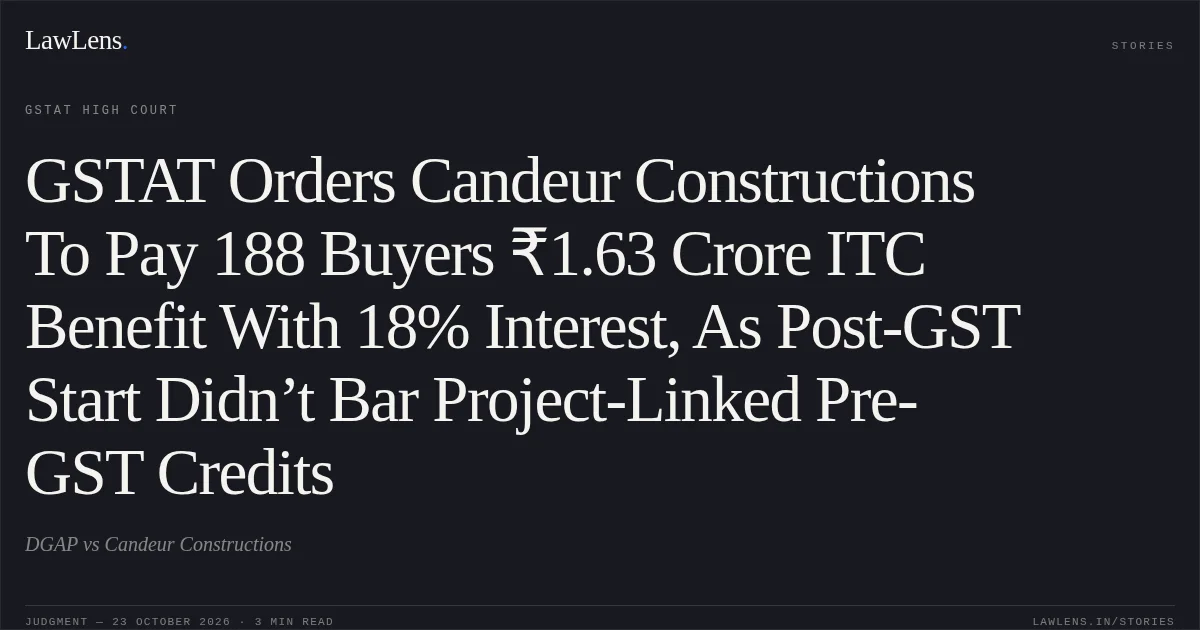
The proceedings arose from homebuyers’ complaint that Candeur Constructions had not passed on the benefit of additional input tax credit (ITC) following the introduction of GST for its “Candeur Carlisle” project in Bengaluru.
Source reference: pp. 2–3, paras. 1–3The DGAP’s original report calculated profiteering at ₹1,62,51,974, including GST, using a project area of 3,93,856 sq. ft.
Source reference: pp. 5–7, paras. 7.6–7.9After the respondent relied on the Occupancy Certificate recording a total area of approximately 5,36,891 sq. ft., the DGAP revised its computation, adopting an eligible sold area of 3,34,570 sq. ft. and determining total profiteering of ₹1,63,22,724, inclusive of GST.
Source reference: pp. 12–13, para. 16.1; pp. 31–32, paras. 54–55The respondent challenged the methodology, the use of pre-GST data given that the Commencement Certificate was issued on 4 September 2017, and the revised area-based calculation.
Source reference: pp. 14–16, paras. 17–19Issues
1. Whether the DGAP’s method of comparing pre-GST and post-GST credit against corresponding purchase values was legally and factually sustainable.
Source reference: p. 16, para. 21(i)2. Whether pre-GST purchase and credit data could be considered where the Commencement Certificate was issued after GST commenced.
Source reference: p. 16, para. 21(ii)3. Whether the DGAP’s revised computation, including the project area, eligible sold area, per-square-foot benefit and total profiteered amount, was sustainable.
Source reference: p. 16, para. 21(iii)Law Applied
Section 171 of the Central Goods and Services Tax Act, 2017 requires a supplier to pass on to recipients, by a commensurate reduction in price, any benefit arising from a reduction in tax rates or an additional availability of ITC.
Source reference: pp. 22–23, paras. 30–32Under Rule 133(3)(b) of the CGST Rules, 2017, the profiteered amount is to be passed on with applicable interest.
Source reference: p. 36, para. 66Section 171(3A) provides for a penalty of 10% of the profiteered amount, subject to the statutory proviso concerning deposit within thirty days.
Source reference: pp. 34–35, para. 63; p. 36, para. 67In Reckitt Benckiser India Pvt. Ltd. v. Union of India, the Delhi High Court held that no universal formula governs profiteering and that, in real estate, total project-level savings should be divided by project area to determine the per-square-foot benefit; it rejected reliance merely on an ITC-to-turnover comparison.
Source reference: pp. 17–21, paras. 24–27, 39LICHFL Care Homes Ltd. v. DGAP was relied on for the distinction between using purchase value to quantify project expenditure and using turnover as a proxy for buyer receipts.
Source reference: pp. 19–21, paras. 28–29Reasoning
The Tribunal held that the DGAP had not used turnover as a proxy for ITC accrual; it compared actual pre-GST Service Tax and VAT credit and post-GST GST ITC against corresponding purchase values, then allocated the resulting project-level saving by area, a method consistent with Reckitt Benckiser and LICHFL Care Homes.
Source reference: pp. 19–21, paras. 28–29It accepted the 1.70% differential as project-specific, rejecting the complainants’ reliance on a general CREDAI estimate as insufficient to determine this project’s benefit.
Source reference: pp. 23–24, paras. 33–36The post-GST Commencement Certificate did not, by itself, make pre-GST project-related purchases and credits irrelevant; the respondent had not shown that the statutory records and transactions relied on by the DGAP related to another project.
Source reference: pp. 27–29, paras. 42–48For the revised calculation, the Tribunal accepted the Occupancy Certificate area and the DGAP’s revised eligible sold area, notwithstanding the absence of a detailed reconciliation from the respondent, and accepted the resulting ₹43.56 per sq. ft. benefit.
Source reference: pp. 30–33, paras. 51–59Holding
The Tribunal upheld the DGAP’s revised computation of ₹1,45,73,861 before GST and ₹1,63,22,724 inclusive of GST.
It directed Candeur Constructions to pass on the total amount to the 188 eligible homebuyers in proportion to their respective units, with interest at 18% from the date each higher amount was collected until the corresponding benefit is passed on.
Source reference: p. 36, paras. 65–66The respondent was also held liable to a penalty under Section 171(3A), subject to the statutory proviso stated in the order.
Source reference: p. 36, para. 67Acts & Sections Cited
1 provisions across 1 statute referred to in this judgment. Each provision opens on LawLens.
Central Goods and Services Tax Act, 20171
Original Court PDF
DGAPvsCandeur Constructions
Click to open original judgment
Original judgment, available to read, download and summarize on LawLens.in