01Facts
The respondents’ execution petition, No. 50 of 2015, was pending before the Executing Court.
¶ 4–7 · pp. 2–5By an order dated 23 December 2021 in an earlier proceeding, the High Court had permitted the State to submit objections and calculations, but the State did not do so within the time allowed.
¶ 4–7 · pp. 2–5The State later applied below Exhibit 56 for permission to file objections and calculations; the Executing Court rejected that application on 3 January 2026.
¶ 4–7 · pp. 2–5The State challenged that rejection under Article 227 of the Constitution.
¶ 4 · p. 2During the writ proceedings, it deposited ₹2,20,771, which it described as the final amount payable.
¶ 4–7 · pp. 2–5The parties agreed that the State could receive one further opportunity, subject to costs; the respondents also sought permission to respond and submit a fresh calculation.
¶ 4–7 · pp. 2–502Issues
i.Whether the State should be granted a further opportunity to file objections and calculations in the pending execution proceedings, despite its failure to comply with the earlier opportunity granted by the High Court
¶ 5, 7–8 · pp. 2, 5–6ii.Whether that opportunity should be subject to costs and directions for timely completion of the execution proceedings
¶ 6.1–6.3, 8 · pp. 4–703Law Applied
The petition invoked the High Court’s supervisory jurisdiction under Article 227 of the Constitution.
¶ 4 · p. 2The judgment cited no statute, precedent, or distinct substantive legal test governing the application. The Court’s disposition rested on the parties’ broad consensus that the State could be given one final opportunity, subject to costs and fixed timelines, while the Executing Court was directed to decide the long-pending execution petition expeditiously.
¶ 8 · pp. 5–704Reasoning
The State had failed to use the opportunity previously granted by the High Court and sought further time only after the deadline had expired; the Executing Court had therefore rejected its application.
¶ 7 · p. 5However, both sides accepted that one further opportunity could be granted, with the respondents seeking costs and the ability to file their own response and fresh calculation.
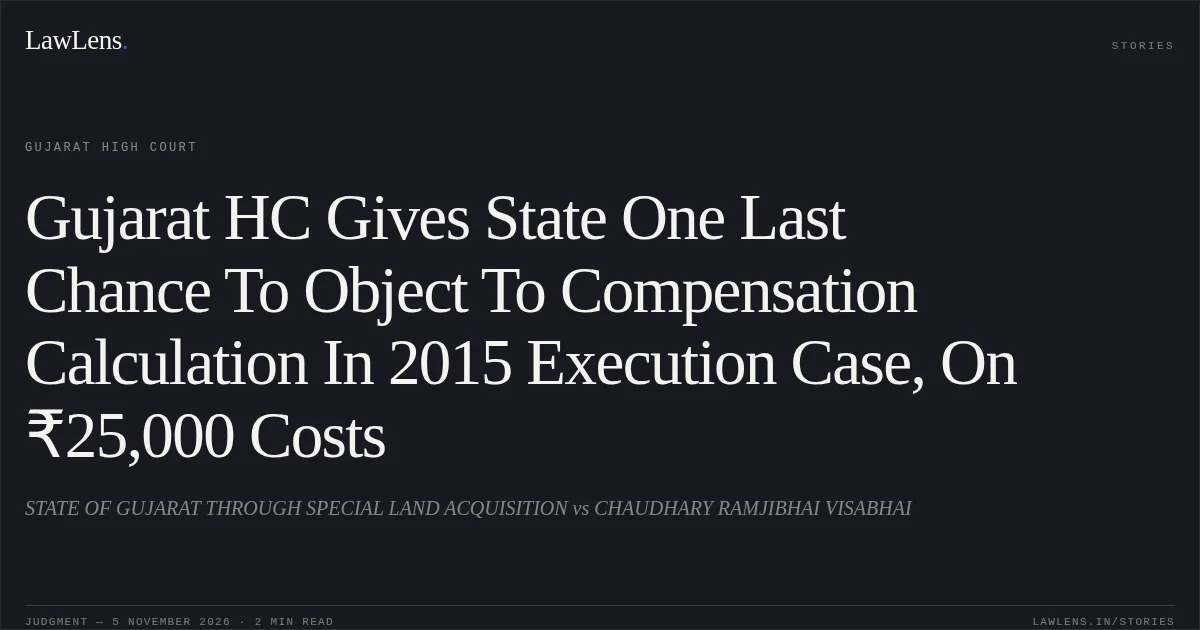
¶ 6.1–6.2, 8 · pp. 4–6In light of that consensus, the Court allowed the application subject to a cost of ₹25,000 and imposed deadlines for the State’s objections and calculations, the respondents’ response, and final determination of the execution petition.
¶ 8.1–8.5 · pp. 6–705Holding
The petition was partly allowed. The order rejecting the State’s Exhibit 56 application was quashed and set aside, and the application was allowed subject to payment of ₹25,000 in costs by 30 November 2026.
¶ 8.1–8.6, 9–10 · pp. 6–8The State was permitted to file objections and any calculation by 15 December 2026; the respondents could file a response and fresh calculation. The Executing Court was directed to decide the execution petition by 30 April 2027, and, upon verification, to disburse the deposited ₹2,20,771 to the respondents.
¶ 8.1–8.6, 9–10 · pp. 6–8If the State failed to pay costs or file its objections within the stipulated time, no further opportunity was to be granted, and the Executing Court was to decide the matter on the existing record.
¶ 8.1–8.6, 9–10 · pp. 6–8Original Court PDF
STATE OF GUJARAT THROUGH SPECIAL LAND ACQUISITIONvsCHAUDHARY RAMJIBHAI VISABHAI
Click to open original judgment
Original judgment, available to read, download and summarize on LawLens.in