01Facts
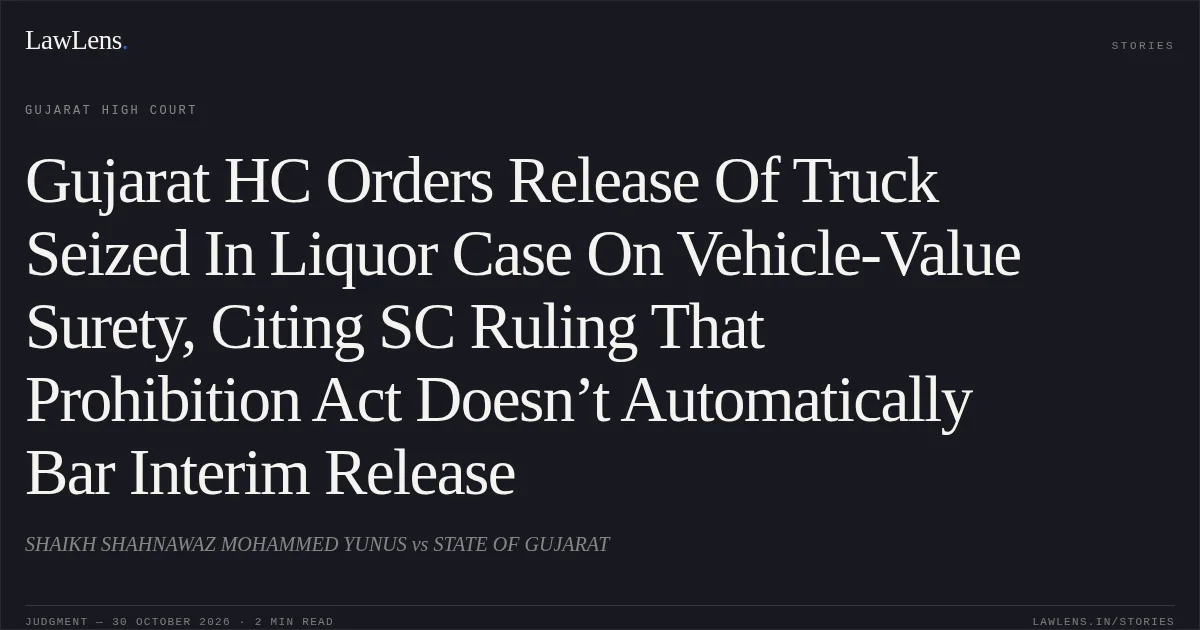
The petitioner sought interim release of a Tata Motors SFC 709 EX, registration No. GJ-17-XX-4525, seized after police allegedly found its driver carrying liquor without a pass or permit.
p. 1An FIR was registered at Katvara Police Station under the Gujarat Prohibition Act. The petitioner invoked Articles 226 and 227 of the Constitution and Sections 528 and 497 of the Bharatiya Nagarik Suraksha Sanhita, 2023, seeking release of the vehicle. The State opposed release by reference to the Prohibition Act’s confiscation provisions, while accepting that the Court could order release under Article 226.
pp. 1–202Issues
i.Whether the High Court could order interim release of a vehicle seized in a Gujarat Prohibition Act case despite the Act’s confiscation provisions
pp. 2–4ii.If so, whether the vehicle should be released to the petitioner subject to conditions securing its preservation and production
pp. 4–503Law Applied
Articles 226 and 227 of the Constitution confer the High Court with power to order release of seized property in appropriate cases.
pp. 2–3Section 497 of the BNSS, corresponding to Section 451 of the Code of Criminal Procedure, permits the Court to make appropriate orders for the custody of property pending trial; Section 98(2) of the Gujarat Prohibition Act does not create an absolute bar to interim release of a seized vehicle.
p. 4In Sunderbhai Ambalal Desai v. State of Gujarat, the Supreme Court stressed that seized vehicles should not be left to deteriorate in police-station premises and may be released on appropriate bonds, guarantees and security.
pp. 2–3The Court also relied on Musa Khan Jat v. State of Gujarat, in which a coordinate bench had released a vehicle in an analogous case, and M/s ABC Express v. State of Gujarat, which recognised the Court’s power to order interim custody notwithstanding Section 98(2).
pp. 3–4Provisions in the judgment · 4 · Linked ones open on LawLens
Bharatiya Nagarik Suraksha Sanhita, 2023 Section 528Section 497
Gujarat Prohibition Act, 1949. Section 98
Code of Criminal Procedure, 1973 Section 451
04Reasoning
The Court considered the vehicle’s continued detention in light of the risk that seized vehicles may deteriorate, as recognised in Sunderbhai Ambalal Desai.
pp. 2–3It further relied on the coordinate-bench decision in Musa Khan Jat and the Supreme Court’s ruling in M/s ABC Express, which clarified that Section 98(2) is not an absolute impediment to interim release and that a court may order proper custody under Section 497 of the BNSS.
pp. 3–4Accordingly, the Court found release appropriate, subject to safeguards ensuring the vehicle’s availability and preventing its transfer during trial.
p. 405Holding
The petition was allowed, and the concerned trial court or authority was directed to release the vehicle upon the petitioner furnishing solvent surety equivalent to the vehicle’s price stated in the FIR, undertaking not to transfer it until final disposal of the trial, and producing it when directed; the order further provided that the vehicle would stand confiscated in the event of a subsequent offence.
p. 4Before release, police were directed to photograph the vehicle and prepare a panchanama at the petitioner’s cost, to be included with the charge-sheet papers. A copy of the order was also to be sent to the concerned RTO to record the restraint on transfer, subject to any subsequent order of the trial court.
p. 5Rule was made absolute.
p. 5Original Court PDF
SHAIKH SHAHNAWAZ MOHAMMED YUNUSvsSTATE OF GUJARAT
Click to open original judgment
Original judgment, available to read, download and summarize on LawLens.in