01Facts
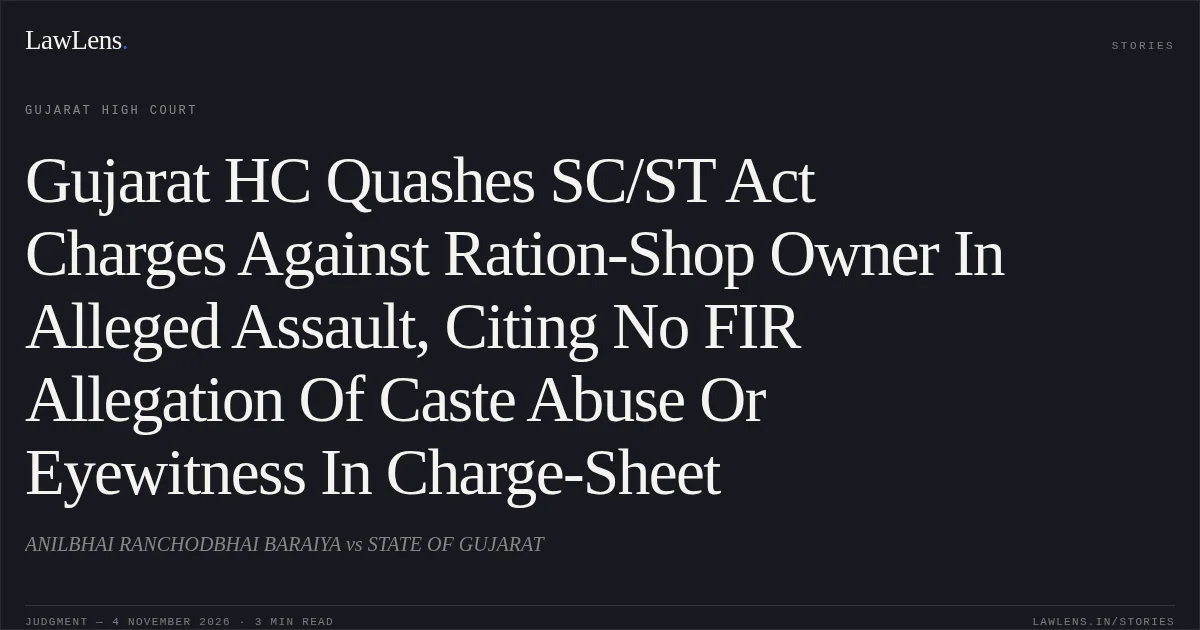
The complainant alleged that, after he had complained to the Mamlatdar and Collector about receiving insufficient ration, the petitioners assaulted him and his son at a fair-price shop on 12 September 2025 and threatened them against making further complaints.
pp. 2–4The FIR, lodged the next day, alleged assault and abuse but did not specifically allege caste-based words or an offence under the Scheduled Castes and Scheduled Tribes (Prevention of Atrocities) Act, 1989 (“Atrocities Act”); those provisions were added after the complainant’s further statement.
pp. 2–4The investigation resulted in a charge-sheet. The petitioners sought quashing of the Atrocities Act charges; they did not press the application in respect of the other offences, with liberty to file afresh.
pp. 5–6, 7–802Issues
i.1. Whether the FIR and investigation material disclosed the ingredients of offences under Sections 3(1)(r) and 3(1)(s) of the Atrocities Act, including caste-directed insult or abuse in a place within public view.
pp. 3–4, 7–10ii.2. Whether continuation of proceedings under Sections 3(1)(r), 3(1)(s) and 3(2)(v-a) of the Atrocities Act, on the material collected, amounted to an abuse of process warranting quashing.
pp. 10–1403Law Applied
Sections 3(1)(r) and 3(1)(s) of the Atrocities Act require, respectively, intentional insult or intimidation with intent to humiliate a member of a Scheduled Caste or Scheduled Tribe in a place within public view, and abuse by caste name in a place within public view; an insult is not actionable under these provisions merely because the person insulted belongs to a protected caste, absent the requisite caste-related intent or words.
pp. 8–9, 10–13Section 3(2)(v-a) applies where an accused commits a scheduled offence against a person or property, knowing the person or property has the specified caste status.
p. 9Relying on Hitesh Verma v. State of Uttarakhand, (2020) 10 SCC 710, and Ramesh Chandra Vaishya v. State of U.P., (2023) 17 SCC 615, the Court applied the requirements of public view and caste-directed conduct.
pp. 9–14The Court also applied the principle in State of Haryana v. Bhajan Lal, AIR 1992 SC 604, that proceedings may be quashed where their continuation would amount to abuse of process.
pp. 9–14Provisions in the judgment · 7 · Linked ones open on LawLens
Bharatiya Nagarik Suraksha Sanhita, 2023 Section 528
Scheduled Castes and the Scheduled Tribes (Prevention of Atrocities) Act, 1989 Section 3Section 18
Indian Penal Code, 1860 Section 323Section 504
Code of Criminal Procedure, 1973 Section 482Section 438
04Reasoning
The Court found that the FIR, lodged the day after the incident, described the alleged assault as retaliation for the complainant’s ration-related complaints but contained no specific allegation of caste-based insult or abuse.
pp. 7–8The allegation of caste-related abusive words appeared only in the complainant’s further statement, which the Court considered an attempt to fill the gap in the original account.
pp. 7–8The FIR identified Mansukhbhai Patel as a witness, but his statement was not part of the investigation papers; the other two witnesses relied on by the investigating officer had not witnessed the incident and learned of it from the complainant.
pp. 7–8The Court therefore concluded that the material did not establish the necessary ingredients of the Atrocities Act offences, including the requirement of conduct in public view, and that continuing those proceedings would be an abuse of process.
pp. 10–1405Holding
The Court allowed the petition to the limited extent of quashing the impugned FIR and proceedings insofar as they concerned Sections 3(1)(r), 3(1)(s) and 3(2)(v-a) of the Atrocities Act.
p. 14The application was not pressed in respect of the other offences, with liberty to file afresh; the Rule was made absolute to the stated extent.
pp. 3–4, 14Original Court PDF
ANILBHAI RANCHODBHAI BARAIYAvsSTATE OF GUJARAT
Click to open original judgment
Original judgment, available to read, download and summarize on LawLens.in