01Facts
The petitioner claimed to have occupied a residential premises on Government land in Revenue Survey No. 10, Village Moti Khavadi, since 1995 and to have paid local taxes.
¶ 2–3 · pp. 1–2After an eviction notice dated 22 August 2024 was issued, he sought its quashing and requested consideration of his application to regularise the occupation.
¶ 2–3 · pp. 1–2The authorities stated that the total unauthorised occupation measured approximately 718.88 square metres and included 14 rooms let to others; the regularisation application concerned 200 square metres comprising the residence.
¶ 7.1 · p. 8During the proceedings, the authority assessed the premium for regularising that 200-square-metre area at Rs. 35,00,000, based on a market value of Rs. 7,000 per square metre and a 2.5 multiplier.
¶ 7.1 · pp. 8–10The petitioner challenged the amount and sought protection from eviction.
¶ 5–6 · pp. 3–602Issues
i.Whether the petitioner was entitled to relief under Article 226 against the eviction action, having regard to his long-standing occupation and request for regularisation.
¶ 7.2–7.4 · pp. 10–12ii.Whether the Court should direct reconsideration of the Rs. 35,00,000 premium determined for regularisation.
¶ 5–7.2 · pp. 3–1003Law Applied
Section 62 of the Gujarat Land Revenue Code, 1879, was identified as conferring on the Collector power to consider regularisation of land occupation.
¶ 7 · p. 7The Court applied the principle that unauthorised occupants have no legal right to occupy Government land, and that long possession or payment of local taxes does not by itself confer title or an enforceable right to remain.
¶ 7.2 · p. 11Regularisation is not claimable as of right and is governed by the applicable State policy and its conditions: the Court relied on Joginder v. State of Haryana, (2021) 3 SCC 300, which also cites State of Odisha v. Bichitrananda Das, (2020) 12 SCC 649.
¶ 7.3 · pp. 11–12The Court also noted the Supreme Court’s direction in the petitioner’s earlier proceedings to consider his regularisation application sympathetically and in accordance with law, while maintaining status quo regarding demolition pending that consideration.
¶ 7 · pp. 7–8For valuation, the authority relied on the Government Resolution dated 11 September 2018 and the Resolution dated 8 January 1980, applying a 2.5 multiplier to the determined market value.
¶ 7.1 · pp. 9–10Provisions in the judgment · 2
Gujarat Land Grabbing (Prohibition) Act, 2020 Section 62
Government Resolution dated 11.09.2018 Section 1.1
04Reasoning
The authority had considered the petitioner’s application, confined its assessment to the 200-square-metre residential area sought to be regularised, and explained the valuation method and premium calculation in its affidavit.
¶ 7.1 · pp. 8–10The Court found no basis to order further reconsideration merely because the petitioner could not or would not pay the assessed premium.
¶ 7.2 · p. 11Long residence and payment of taxes did not create a legal right to Government land, and the petitioner could not claim regularisation as of right or equitable protection against eviction under Article 226.
¶ 7.2–7.4 · pp. 11–1205Holding
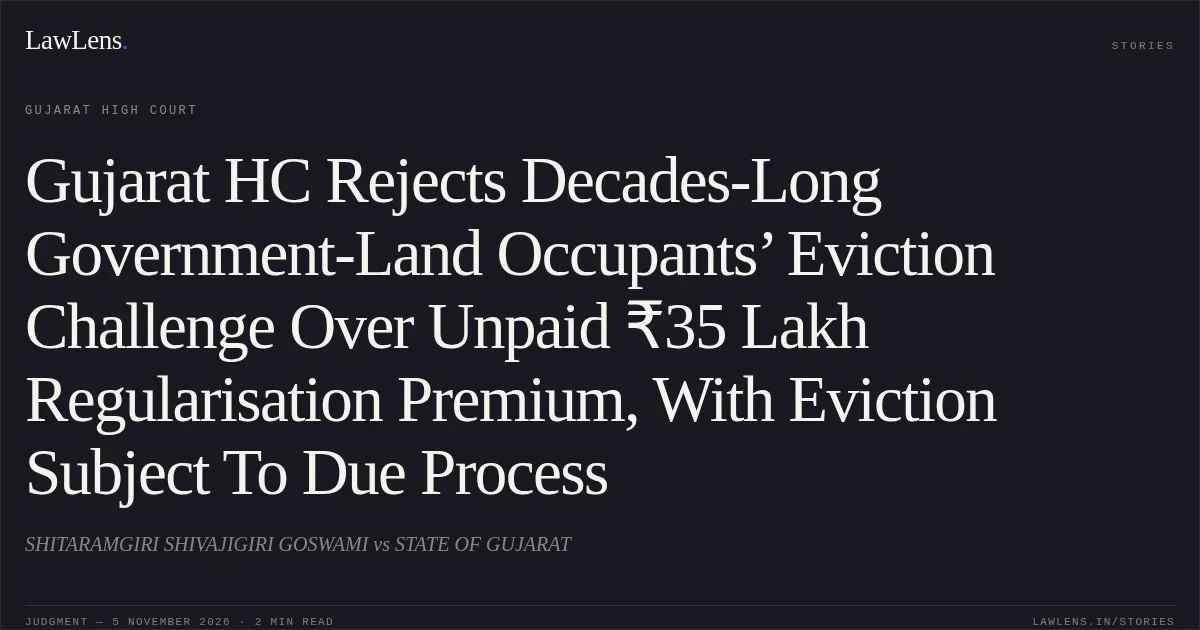
The petition was dismissed, and the Court declined to grant further relief concerning regularisation or the premium assessment.
¶ 8 · p. 13It clarified, however, that the authorities must follow the procedure prescribed by applicable law before taking steps to evict the petitioner.
¶ 9 · p. 13Original Court PDF
SHITARAMGIRI SHIVAJIGIRI GOSWAMIvsSTATE OF GUJARAT
Click to open original judgment
Original judgment, available to read, download and summarize on LawLens.in