01Facts
The workman was engaged as an apprentice in 1993 and later appointed as a helper/lineman.
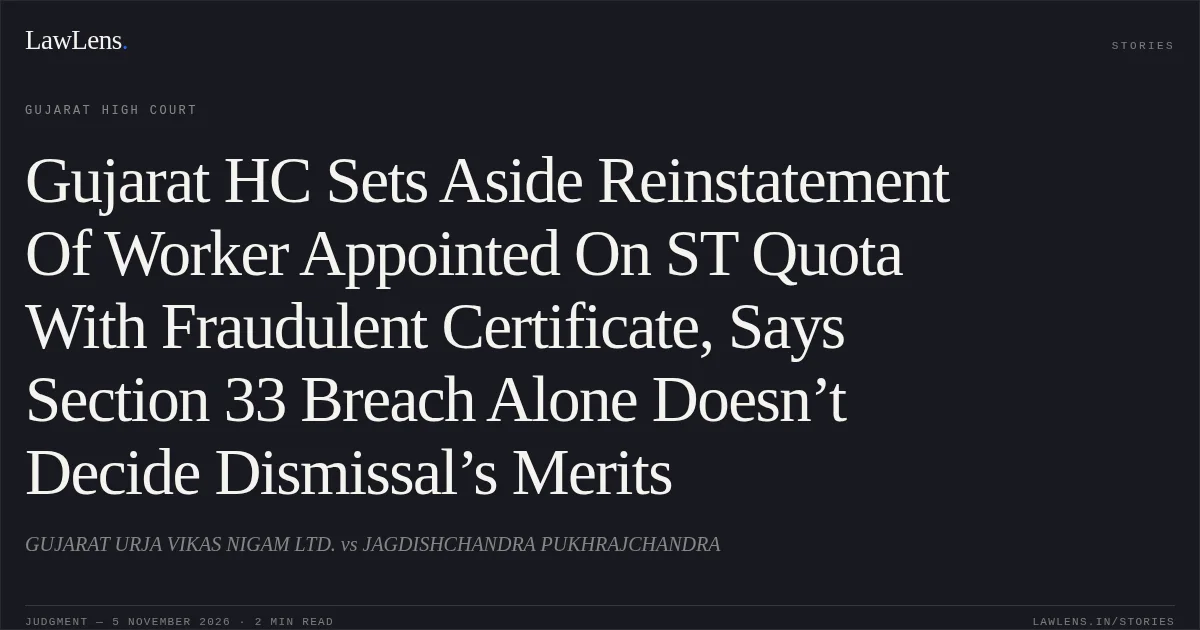
¶ 2–4, 11–13The employer alleged that he had secured appointment against a Scheduled Tribe vacancy using an altered school-leaving certificate.
¶ 2–4, 11–13After an initial termination was quashed by the High Court, the employer conducted a departmental inquiry and dismissed him.
¶ 2–4, 11–13The workman challenged the later dismissal by a complaint under Section 33A of the Industrial Disputes Act, 1947, alleging that it was made during the pendency of a reference without the required approval.
¶ 2–4, 11–13The Industrial Tribunal ordered reinstatement with 50% back-wages.
¶ 2–4, 11–13The employer challenged that award by writ application.
¶ 2–4, 11–1302Issues
i.Whether the Tribunal had jurisdiction to entertain the Section 33A complaint alleging contravention of Section 33 during the pendency of an industrial dispute.
¶ 16ii.If so, whether the Tribunal was required to determine the merits of the dismissal, and whether its failure to assess the evidence justified setting aside the award.
¶ 16, 35–3603Law Applied
Section 33A of the Industrial Disputes Act permits an employee to complain of an employer’s contravention of Section 33 during pending proceedings; the Tribunal must adjudicate the complaint as if it were a dispute referred under Section 10.
¶ 27The judgment applies the two-stage approach described in Punjab National Bank Ltd. v. All-India Punjab National Bank Employees Federation and Equitable Coal Co. Ltd. v. Algu Singh: determine first whether Section 33 was contravened, and then adjudicate the merits of the dismissal, giving the employer an opportunity to justify it.
¶ 42, 45It also relies on Jaipur Zila Sahakari Bhoomi Vikas Bank Ltd. v. Ram Gopal Sharma for the mandatory nature of the approval requirement under Section 33(2)(b) and the consequences of non-compliance.
¶ 31–34On caste-based appointment, the judgment applies Chairman & Managing Director, FCI v. Jagdish Balaram Bahira and R. Vishwanatha Pillai v. State of Kerala: where an appointment is obtained on the basis of a false reserved-category claim, invalidation of that claim may render the appointment void or non est.
¶ 20–25Provisions in the judgment · 3 · Linked ones open on LawLens
Gujarat Scheduled Castes, Scheduled Tribes and Other Backward Classes (Regulation of Issuance and Verification of Caste Certificates) Act, 2018 Section 6Section 10Section 11
04Reasoning
The Court held that the employer had failed to comply with Section 33 and that the Tribunal was entitled to entertain the complaint.
¶ 34But the Tribunal could not treat that breach as automatically requiring reinstatement: Section 33A required it also to examine the substantive basis for dismissal.
¶ 37–39The High Court found that the Tribunal had failed to consider material documents which, in its view, showed that the workman had been appointed against an ST vacancy and that the caste certificate had been cancelled by the competent authority, with that cancellation left unchallenged.
¶ 37–39Because the Tribunal had overlooked this evidence and had not properly adjudicated the merits, its reinstatement award was unsustainable.
¶ 42–48, 5205Holding
The Court answered the jurisdiction issue in the affirmative but held that the Tribunal had failed to follow the required Section 33A adjudicative process.
¶ 34, 52–53It allowed the writ application and quashed and set aside the Tribunal’s order dated 18 January 2007 granting reinstatement with 50% back-wages.
¶ 34, 52–53Original Court PDF
GUJARAT URJA VIKAS NIGAM LTD.vsJAGDISHCHANDRA PUKHRAJCHANDRA
Click to open original judgment
Original judgment, available to read, download and summarize on LawLens.in