01Facts
The prosecution alleged that Bhaumik, the deceased, had business and financial dealings with the accused.
pp. 2–3 · ¶ 2.1–2.2After he went missing, his car was found abandoned with bloodstains; his decomposed body was later recovered from an industrial wastewater canal and identified by physical features and tattoos.
pp. 2–3 · ¶ 2.1–2.2The accused were charged with offences under Sections 302, 201 and 120-B of the Indian Penal Code and Sections 25(1-B)(a) and 27(2) of the Arms Act.
p. 1 · ¶ 1The Sessions Court acquitted them, finding the prosecution had not proved its case beyond reasonable doubt.
pp. 3–4 · ¶ 3–6The State appealed against that acquittal under Section 419 of the Bharatiya Nagarik Suraksha Sanhita, 2023.
p. 1 · ¶ 1 · pp. 3–4 · ¶ 3–602Issues
i.Whether the prosecution proved a complete chain of circumstantial evidence establishing the accused’s involvement in the alleged murder and conspiracy
pp. 6–8 · ¶ 8–11ii.Whether the Sessions Court’s acquittal was perverse or otherwise subject to interference in an appeal against acquittal
pp. 8–10 · ¶ 12–1403Law Applied
The appeal was brought under Section 419 of the BNSS.
p. 1 · ¶ 1The charged offences were under Sections 302, 201 and 120-B of the IPC and Sections 25(1-B)(a) and 27(2) of the Arms Act.
p. 1 · ¶ 1In a case resting on circumstantial evidence, the circumstances relied upon must be proved and form a complete chain pointing to guilt while excluding other reasonable conclusions.
pp. 7–8 · ¶ 10–11On appeal against acquittal, where two reasonable views are possible, the appellate court should not disturb the trial court’s view; interference is warranted where, among other things, the acquittal is perverse, clearly unreasonable, or based on a material misreading or omission of evidence.
pp. 8–10 · ¶ 12–14The Court relied on Tulasareddi @ Mudakappa & Anr. v. State of Karnataka & Ors., 2026 INSC 67.
pp. 8–10 · ¶ 12–14The judgment also noted that a certificate under Section 65-B of the Evidence Act may establish admissibility of electronic footage, but admissibility is distinct from probative value.
p. 7 · ¶ 9Provisions in the judgment · 7 · Linked ones open on LawLens
Bharatiya Nagarik Suraksha Sanhita, 2023 Section 419
Indian Penal Code, 1860 Section 302Section 201
Arms Act, 1959 Section 25Section 27
Code of Criminal Procedure, 1973 Section 209Section 313
04Reasoning
The High Court found no proved link connecting the accused to the deceased during the critical period between when he was last seen alive and when the car and body were discovered; the allegation that the accused had called him out and taken him away was unproved.
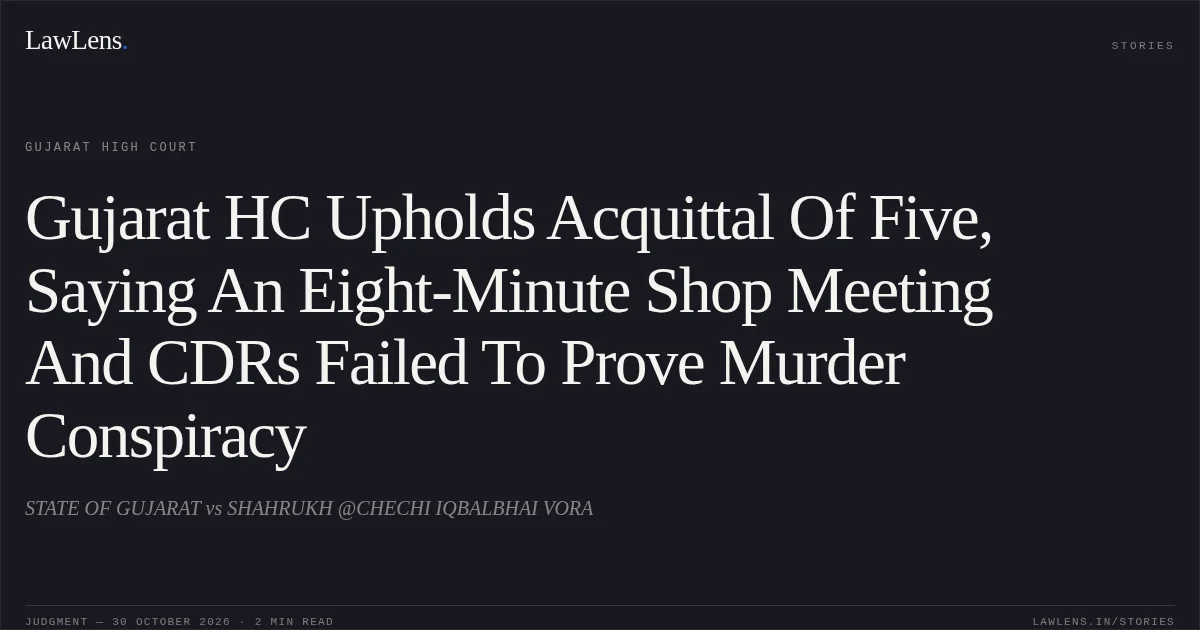
pp. 6–7 · ¶ 8The footage showed, at most, accused No. 4 at accused No. 1’s business premises on the preceding day. Without evidence of the conversation’s contents, that presence and the associated call-detail evidence did not establish conspiracy.
p. 7 · ¶ 9The Court considered the prosecution’s asserted circumstances—including motive, last-seen evidence and recovery—but concluded that the chain remained incomplete.
pp. 7–8 · ¶ 10–11It further held that the State had not shown the Sessions Court’s findings to be perverse or demonstrably unsustainable, and that the trial court’s view was a possible one.
pp. 8–10 · ¶ 12–1405Holding
The High Court answered the first issue in the negative: the prosecution had not proved a complete circumstantial chain establishing the accused’s guilt.
p. 10 · ¶ 14–15It also found no basis to interfere with the acquittal.
p. 10 · ¶ 14–15The State’s appeal was dismissed, and the Sessions Court’s acquittal was left undisturbed.
p. 10 · ¶ 14–15Original Court PDF
STATE OF GUJARATvsSHAHRUKH @CHECHI IQBALBHAI VORA
Click to open original judgment
Original judgment, available to read, download and summarize on LawLens.in