01Facts
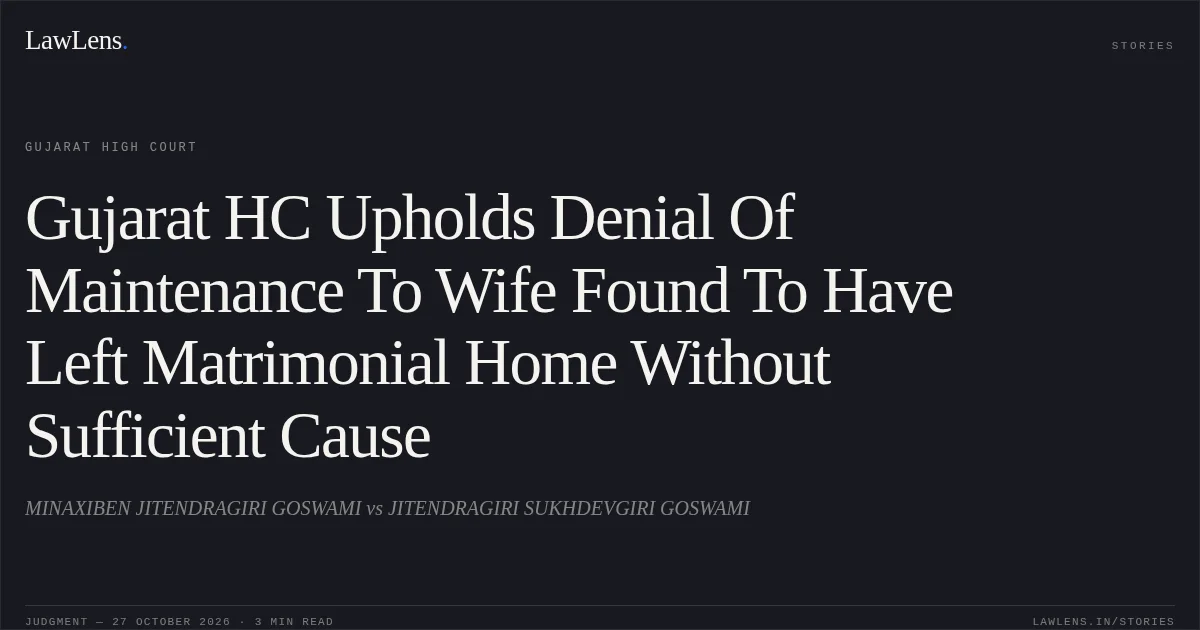
The wife sought maintenance under Section 125 of the Code of Criminal Procedure, 1973, alleging cruelty and that she had been driven from the matrimonial home.
¶ 1–5, 7–8The husband denied the allegations and maintained that she had left voluntarily without sufficient cause.
¶ 1–5, 7–8An ex parte order granting her maintenance of Rs.10,000 per month was recalled, and the Family Court, after rehearing the matter, rejected her maintenance application and cancelled the earlier maintenance order.
¶ 1–5, 7–8It found that she had voluntarily withdrawn from the husband’s society and had not established cruelty or sufficient cause to live separately.
¶ 1–5, 7–8The wife challenged that decision in revision; her counsel was absent at the hearing before the High Court.
¶ 1–5, 7–802Issues
i.1. Whether the Family Court’s finding that the wife had withdrawn from the husband’s society without sufficient cause was perverse or otherwise warranted interference in revision.
¶ 9–11ii.2. Whether the wife was entitled to maintenance, or to enhancement of the earlier interim amount, under Section 125 of the Code.
¶ 1003Law Applied
Sections 397 and 401 of the Code confer supervisory revisional jurisdiction; that jurisdiction is not equivalent to appellate or second-appellate jurisdiction, and ordinarily does not permit fresh reappreciation of evidence unless a glaring feature indicates a gross miscarriage of justice.
¶ 9.1–9.2The High Court relied on State of Kerala v. Puttumana Illath Jathavedan Namboodiri, (1999) 2 SCC 452, on the limited scope of revision, and Amit Kapoor v. Ramesh Chander, (2012) 9 SCC 460, on intervention for palpable error, illegality, complete error, or arbitrary exercise of discretion.
¶ 9.1–9.2Under Section 125, as applied by the Family Court and accepted by the High Court, a wife who voluntarily withdraws from her husband’s society without sufficient or reasonable cause is not entitled to maintenance.
¶ 5The judgment also records the Family Court’s reliance on Vanitaben Natvarlal v. Naranbhai Raghavbhai Makwana, 1991 (2) GLR 101; Sunita Kachwaha v. Anil Kachwaha, Criminal Appeal No. 2310 of 2014, decided 28 October 2014; Debnarayan Halder v. Smt. Anushri Halder, Criminal Appeal No. 1069 of 2003, decided 26 August 2003; and Meena Dinesh Parmar v. Dinesh Hastimal Parmar, AIR 2005 Bom 288.
¶ 5Provisions in the judgment · 3 · Linked ones open on LawLens
Code of Criminal Procedure, 1973 Section 397Section 401Section 125
04Reasoning
The High Court found that the Family Court’s conclusion was based on the parties’ oral evidence and the record of the earlier criminal proceedings, in which the wife’s allegations of cruelty and dowry demand had not been accepted and the accused had been acquitted.
¶ 10–11It also noted the evidence that the wife had been residing at her parental home since 2008 and had not satisfactorily explained her failure to return despite efforts by the husband’s family.
¶ 10–11The High Court held that the Family Court’s finding was a plausible view supported by the record, and that no ignored material, inadmissible evidence, perversity, or other revisional error had been shown.
¶ 10–11Since the finding was that the wife had withdrawn without sufficient cause, the question of granting or enhancing maintenance did not arise.
¶ 10–1105Holding
The High Court held that no perversity, illegality, jurisdictional error, or material irregularity had been established to justify interference under Sections 397 and 401 of the Code.
¶ 12–14It dismissed the revision application and confirmed the Family Court’s order rejecting the maintenance application and cancelling the earlier maintenance order.
¶ 12–14The Rule was discharged and any interim relief vacated.
¶ 12–14Original Court PDF
MINAXIBEN JITENDRAGIRI GOSWAMIvsJITENDRAGIRI SUKHDEVGIRI GOSWAMI
Click to open original judgment
Original judgment, available to read, download and summarize on LawLens.in