01Facts
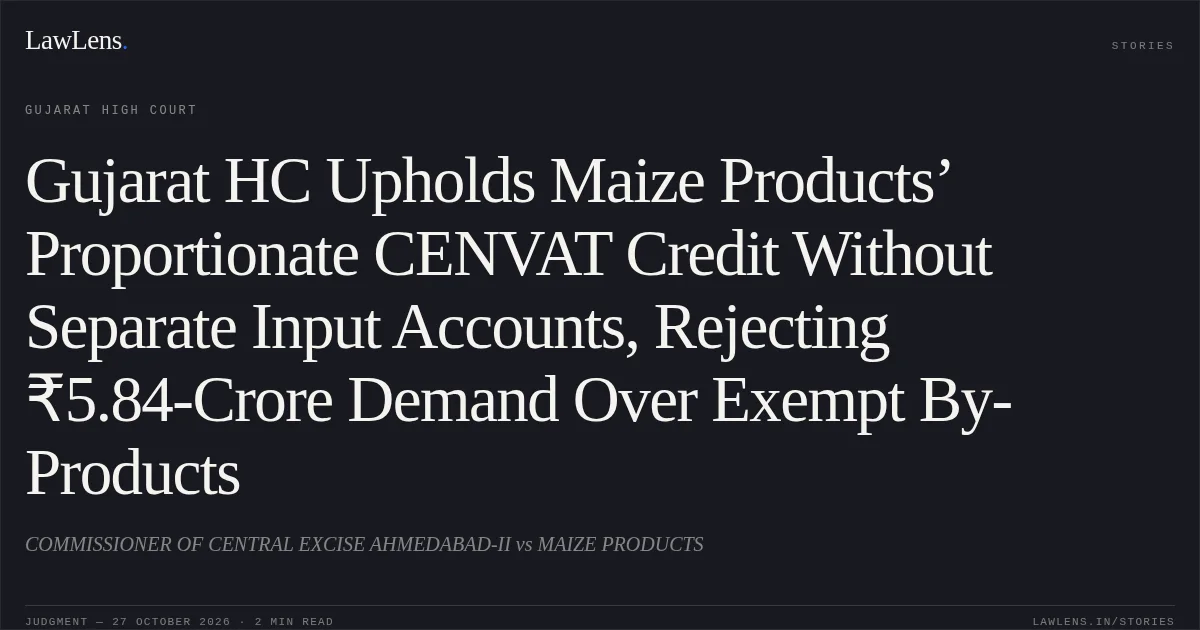
The respondent manufactured dutiable goods and exempted by-products using common inputs, including hydrochloric acid, caustic soda lye and furnace oil.
¶ 2, 4–9It claimed CENVAT credit proportionate to the inputs attributable to dutiable products.
¶ 2, 4–9The Revenue alleged that the respondent had not maintained separate accounts as required by Rule 6 and demanded 10% of the value of the exempted goods, with interest and penalty.
¶ 2, 4–9The adjudicating authority confirmed the demand of ₹5,84,59,071 and imposed a penalty; the CESTAT allowed the respondent’s appeal, holding that proportionate credit on dutiable products amounted to not taking credit on the exempted by-products.
¶ 2, 4–9The Revenue appealed under Section 35G of the Central Excise Act, 1944
¶ 2, 4–902Issues
i.1. Whether an assessee may follow a method different from that prescribed by the Rules and still claim the benefit of the Rules
¶ 3ii.2. Whether the CESTAT was justified in holding that the respondent’s method of availing proportionate CENVAT credit was valid
¶ 303Law Applied
Rule 6 of the CENVAT Credit Rules, 2004 governs credit on inputs used in dutiable and exempted goods: Rule 6(1) disallows credit on inputs used in exempted goods, Rule 6(2) requires separate accounts where common inputs are used, and Rule 6(3)(b) prescribes payment of an amount equal to 10% of the price of exempted goods where separate accounts are not maintained.
¶ 20–21The Court applied *Sterling Gelatin*, which held that where the entire input is used to manufacture a dutiable final product and an exempted by-product emerges in the process, Rule 6 does not require separate accounts or payment on the by-product; it also held that taking credit only for inputs attributable to dutiable goods avoids the application of Rule 6(2).
¶ 21The Court also relied on the by-product principles discussed in *Union of India v. Hindustan Zinc Ltd.* and the Gujarat High Court’s decision in *Hindalco Industries Ltd.*
¶ 18–19Provisions in the judgment · 2 · Linked ones open on LawLens
Central Excise Act, 1944 Section 35Section 11
04Reasoning
The Court considered the respondent’s proportionate-credit method in light of the rule that Rule 6 is not attracted merely because an exempted by-product emerges from the manufacturing process.
¶ 19, 21, 24It concluded that the respondent had taken credit only in proportion to the dutiable products, and that the exempted by-products could not, on the facts and settled authorities, be treated as products for which the common inputs were separately used.
¶ 19, 21, 24Accordingly, the absence of separate accounts did not justify the 10% demand under Rule 6(3)(b).
¶ 19, 21, 24Although the CESTAT had given brief reasons, the Court declined to remand the matter because the result accorded with the subsequent decisions of the Supreme Court and the Gujarat High Court
¶ 19, 21, 2405Holding
The Court answered both substantial questions in favour of the respondent and against the Revenue, holding that the CESTAT was justified in accepting the respondent’s proportionate-credit method.
¶ 24–25The Revenue’s appeal was dismissed
¶ 24–25Original Court PDF
COMMISSIONER OF CENTRAL EXCISE AHMEDABAD-IIvsMAIZE PRODUCTS
Click to open original judgment
Original judgment, available to read, download and summarize on LawLens.in