Facts
During a second appeal concerning the transportation of Arvind Kejriwal’s Electoral Photo Identity Card, the Central Information Commission (CIC) treated his letter requesting information about Prime Minister Narendra Modi’s educational qualifications as an RTI application and directed Delhi University and Gujarat University to search for and provide the degree information.
Source reference: paras. 18–21; pp. 15–16Gujarat University challenged that direction by writ petition.
Source reference: para. 1; p. 2The learned Single Judge allowed the petition, quashed the CIC order and imposed costs of ₹25,000 on Kejriwal.
Source reference: para. 1; p. 2In this appeal, Kejriwal initially confined his challenge to the remarks about his conduct and the costs; the University urged the Division Bench to decide the merits of the CIC’s order as well.
Source reference: paras. 2, 10; pp. 2, 7Issues
1. Whether the CIC could treat Kejriwal’s letter or submissions in an unrelated second appeal as an RTI application and direct disclosure without an application under Section 6(1) to the relevant Public Information Officer.
Source reference: paras. 33(iii), 34–37; pp. 22–242. Whether an individual’s educational qualifications, degrees and related records are protected from disclosure under Sections 8(1)(e) and 8(1)(j), and whether the public-interest exception justified disclosure in this case.
Source reference: paras. 33(i)–(ii), 44–46, 68–76; pp. 22, 26–27, 46–503. Whether the observations concerning Kejriwal’s conduct and the consequential costs imposed by the Single Judge should be set aside.
Source reference: paras. 2–3, 14–16, 24–25; pp. 2–3, 8–10, 17–18Law Applied
The Court applied the RTI Act, 2005, including Sections 3, 4, 6, 8, 18–20 and 11.
Source reference: paras. 29–37; pp. 19–24Section 6(1) requires a person seeking information to make a prescribed request to the concerned Public Information Officer; the CIC’s appellate and complaint functions do not authorise it to initiate an information request on a person’s behalf in an unrelated proceeding.
Source reference: paras. 29–37; pp. 19–24Under Sections 8(1)(e) and 8(1)(j), information held in a fiduciary relationship and personal information may be withheld, subject to the applicable public-interest test.
Source reference: paras. 48–55, 56–64; pp. 28–35, 36–42Relying on CBSE v. Aditya Bandopadhyay, ICAI v. Shaunak H. Satya and the Constitution Bench decision in CPIO, Supreme Court of India v. Subhash Chandra Agarwal, the Court treated educational and professional records as personal information and explained that disclosure requires a case-specific assessment of the competing interests.
Source reference: paras. 48–55, 56–64; pp. 28–35, 36–42The Court also relied on K.S. Puttaswamy v. Union of India concerning privacy as an aspect of liberty and dignity.
Source reference: paras. 62, 69; pp. 39–40, 46–47It stated that the amended Section 8(1)(j) exempts information relating to personal information.
Source reference: paras. 32, 73; pp. 21, 49Reasoning
The CIC had received no Section 6(1) application directed to the University; it instead converted a letter and submissions made in another matter into an RTI application and issued directions on its own initiative.
Source reference: paras. 34–37; pp. 22–24The Court held that this was outside the CIC’s statutory authority.
Source reference: paras. 34–37; pp. 22–24On disclosure, it held that educational records are personal information and that the University holds such information in a fiduciary capacity; the CIC had not given reasons establishing that larger public interest justified disclosure.
Source reference: paras. 68–72; pp. 46–48The Prime Minister’s public office, general public curiosity, and the fact that degree information was said to be in the public domain did not, by themselves, establish the required public interest under the RTI Act.
Source reference: paras. 71–77; pp. 47–51The Court also declined to expunge the Single Judge’s observations or set aside the costs, considering the circumstances in which Kejriwal’s request was raised and pursued.
Source reference: paras. 17, 24–25; pp. 10, 17–18Holding
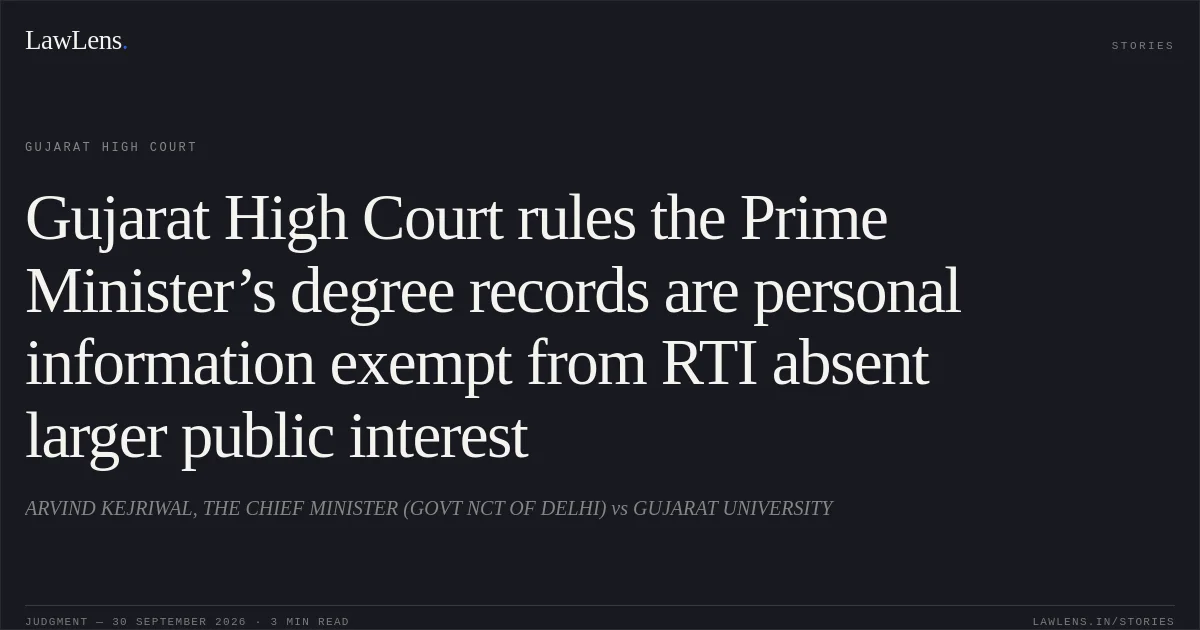
The Court held that the CIC lacked jurisdiction to issue the disclosure directions without a proper Section 6(1) application and that the requested educational information was protected under Sections 8(1)(e) and 8(1)(j), with no larger public interest shown to warrant disclosure.
It dismissed the appeal, left the Single Judge’s judgment and ₹25,000 costs undisturbed, and made no further order as to costs; the stay application was disposed of.
Source reference: para. 79; p. 52Acts & Sections Cited
17 provisions across 4 statutes referred to in this judgment. Each provision opens on LawLens.
Right to Information Act, 2005
Digital Personal Data Protection Act, 2023.1
Indian Trust Act, 18821
Guardians and Wards Act, 18901
Original Court PDF
ARVIND KEJRIWAL, THE CHIEF MINISTER (GOVT NCT OF DELHI)vsGUJARAT UNIVERSITY
Click to open original judgment
Original judgment, available to read, download and summarize on LawLens.in