Facts
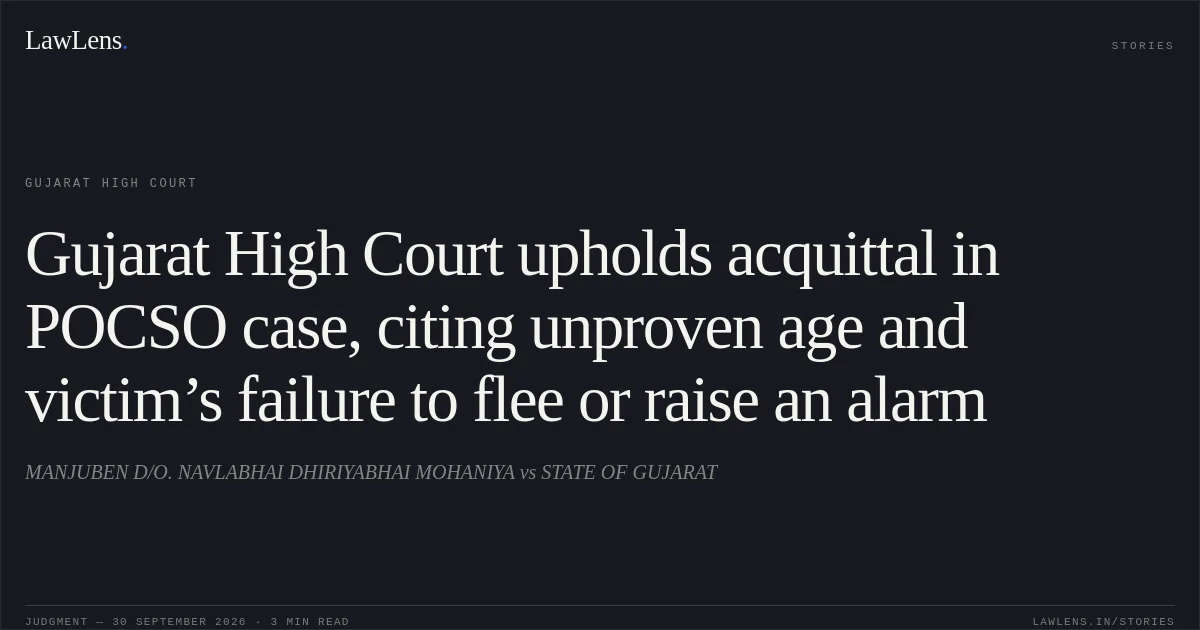
The complainant appealed under Section 413 of the Bharatiya Nagarik Suraksha Sanhita, 2023, against the acquittal of three accused in Special (POCSO) Case No. 39 of 2019.
Source reference: paras. 1–4, pp. 1–3The prosecution alleged that the victim, said to be 17 years and 4 months old, was abducted on 24 June 2019, taken to Dholka, confined for about a month, and sexually assaulted by one accused.
Source reference: paras. 1–4, pp. 1–3The trial court acquitted the accused, finding that the victim’s minority had not been proved and that the prosecution’s account of non-consensual sexual intercourse was not reliable.
Source reference: para. 8, pp. 3–4The complainant challenged that decision, relying on the victim’s testimony, school records, and the statutory presumptions under the POCSO Act.
Source reference: paras. 9–11, pp. 5–6Issues
1. Whether the prosecution proved that the victim was below 18 years of age on the date of the incident, including through the school records.
Source reference: paras. 15–17, pp. 7–82. Whether the trial court was justified in finding the allegations of confinement and non-consensual sexual assault unproved, and in declining to apply the statutory presumptions.
Source reference: paras. 18–20, pp. 8–103. Whether the acquittal disclosed perversity or another basis for appellate interference.
Source reference: paras. 12–14, pp. 6–7Law Applied
Under Section 413 of the BNSS, corresponding to Section 372 of the Code of Criminal Procedure, an appeal against acquittal is subject to the established appellate restraint: the acquittal reinforces the presumption of innocence, and interference is warranted in exceptional cases, including where the judgment is perverse.
Source reference: para. 14, p. 6The Court applied Section 35 of the Indian Evidence Act, 1872, observing that admissibility of an official or school record is distinct from the probative value of its contents; the entry’s evidentiary weight depends on proof of authenticity and the source of the underlying information.
Source reference: para. 16, p. 7It relied on Birka Shiva v. State of Telangana, 2025 INSC 863, and the authorities discussed there, including Narbada Devi Gupta v. Narendrakumar Jaiswal, Biradmal Singhvi v. Anandmal Purohit and State of Chhattisgarh v. Lekhram.
Source reference: para. 16, p. 7The Court further held that the presumptions under Sections 29 and 30 of the POCSO Act could not be invoked once the victim’s minority was not proved, and that the record did not establish a basis for the presumption under Section 114A of the Evidence Act.
Source reference: para. 19, p. 9Reasoning
The Court found that the school register and school-leaving certificate recorded the victim’s date of birth, but the testifying school principal had no personal knowledge of who supplied that information or its source; the victim’s parents, who could have addressed that source, were not examined.
Source reference: paras. 15–17, pp. 7–8It therefore upheld the finding that minority was not proved.
Source reference: paras. 15–17, pp. 7–8Considering the victim’s stay at the accused’s residence, the Court reasoned that the circumstances did not support her account of being confined and concluded that the evidence did not establish non-consensual intercourse or penetrative sexual assault.
Source reference: para. 18, p. 8Because minority and the necessary foundational facts were not established, it rejected the claimed POCSO and Evidence Act presumptions.
Source reference: para. 19, p. 9Applying the restrained standard for appeals against acquittal, it found no perversity warranting intervention.
Source reference: paras. 14, 20, pp. 6, 9–10Holding
The High Court held that the prosecution had failed to prove the charges beyond reasonable doubt and that the trial court’s acquittal was based on a proper appreciation of the evidence, with no perversity warranting appellate interference.
The complainant’s appeal was dismissed at the admission stage.
Source reference: para. 21, p. 10Acts & Sections Cited
12 provisions across 4 statutes referred to in this judgment. Each provision opens on LawLens.
Bharatiya Nagarik Suraksha Sanhita, 20231
Code of Criminal Procedure, 19733
Indian Penal Code, 18604
Protection of Children from Sexual Offences Act, 20124
Original Court PDF
MANJUBEN D/O. NAVLABHAI DHIRIYABHAI MOHANIYAvsSTATE OF GUJARAT
Click to open original judgment
Original judgment, available to read, download and summarize on LawLens.in