Facts
The petitioner filed a petition under Article 226 of the Constitution seeking a writ of habeas corpus for production and release of Gomti, described as his legally wedded wife, from the alleged illegal custody of respondent Nos. 4 and 5.
Source reference: para. 1Respondent No. 4, her father, reported that his 21-year-old daughter had gone missing on 10.01.2026, leading to registration of FIR No. 16 dated 12.01.2026 under Section 127(6) of the Bharatiya Nyaya Sanhita, 2023.
Source reference: para. 2After investigation, a challan was presented against the petitioner under Sections 137(2) and 87 of the BNS and Section 10 of the POCSO Act.
Source reference: para. 2The detenue was recovered on 02.02.2026, and her statement was recorded on 03.02.2026 in the presence of legal-aid counsel, with videography through the E-Sakshya App.
Source reference: para. 3She stated that she knew the petitioner, had a relationship with him, and wished to marry him.
Source reference: para. 3The petitioner relied upon documents showing her date of birth as 01.01.2004 and asserted that they married on 27.02.2026 at Arya Samaj Mandir, Kanpur, according to Hindu rites.
Source reference: para. 3During the criminal proceedings, the detenue was examined before the Trial Court on 05.05.2026 and did not support the prosecution case; the petitioner was subsequently granted regular bail by the High Court on 17.08.2026.
Source reference: para. 3.1Issues
Whether a writ of habeas corpus could be issued for the alleged release of the detenue when the questions concerning her custody, voluntariness, age and relationship with the petitioner were disputed factual matters forming part of a pending criminal prosecution?
Source reference: paras. 5–6.2Whether the petitioner could use the extraordinary jurisdiction under Article 226 to obtain, through collateral proceedings, an adjudication on the very factual controversy pending before the Trial Court?
Source reference: paras. 6.1–6.2Law Applied
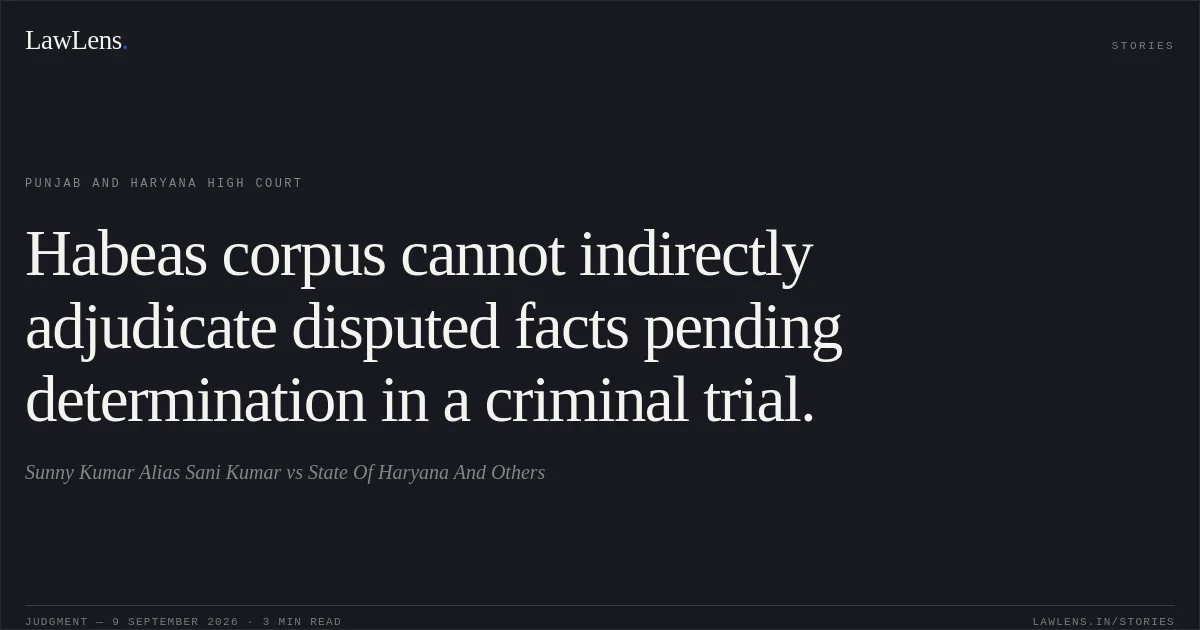
The Court applied Article 226 of the Constitution and the extraordinary remedy of habeas corpus, which is intended to protect against unlawful detention but cannot ordinarily be used to decide disputed questions of fact or to bypass an ongoing adjudicatory process.
Source reference: paras. 6–6.2The Court held that where a criminal prosecution arising from the same occurrence is pending, and the central questions—such as abduction, voluntary accompaniment, age and legality of the accused’s conduct—are matters for determination on evidence, the High Court should not adjudicate those issues collaterally in habeas corpus proceedings.
Source reference: paras. 6–6.2The Court also noted the relevance of the pending prosecution under Sections 137(2) and 87 of the BNS and Section 10 of the POCSO Act, but did not determine the merits of those charges.
Source reference: para. 2Reasoning
The Court found that the petition substantially sought a determination of whether the detenue had voluntarily accompanied the petitioner or had been abducted, which was the pivotal issue in the pending criminal case.
Source reference: para. 6Although the petitioner relied on the detenue’s earlier statement, the alleged marriage, her age-related documents and her testimony before the Trial Court, consideration of these matters in the habeas corpus petition would require examination of disputed evidence and could influence or prejudice the criminal trial.
Source reference: paras. 3–3.1, 6–6.1The Court therefore held that the habeas corpus jurisdiction could not be converted into a collateral forum for deciding issues directly pending before the Trial Court, nor could the petitioner achieve indirectly what could not properly be secured without affecting the criminal adjudication.
Source reference: paras. 6.1–6.2Holding
The Court declined to exercise its extraordinary jurisdiction and dismissed the habeas corpus petition, without expressing any opinion on the merits of the criminal prosecution or the parties’ competing factual claims.
The petitioner was left at liberty to approach the Trial Court for appropriate relief.
Source reference: para. 6.2The Trial Court was directed to decide the criminal case independently, strictly in accordance with law and on the evidence brought on record.
Source reference: para. 6.3All pending interlocutory and ancillary applications were disposed of as having become infructuous.
Source reference: para. 7Acts & Sections Cited
4 provisions across 2 statutes referred to in this judgment. Each provision opens on LawLens.
Bharatiya Nyaya Sanhita, 20233
Protection of Children from Sexual Offences Act, 20121
Original Court PDF
Sunny Kumar Alias Sani KumarvsState Of Haryana And Others
Click to open original judgment
Original judgment, available to read, download and summarize on LawLens.in