Facts
The petitioner, Arvind Kumar, filed a habeas corpus petition seeking custody of his wife, Deeksha (the corpus), alleging she was being held in illegal custody at Rajkiya Bal Grah (Balika), Vrindavan, Mathura
Source reference: para. 1The State (Respondent) contended that the corpus was a minor at the time of the alleged marriage and was placed in the protection home pursuant to a judicial order passed by the Child Welfare Committee (CWC), Sambhal, on 18.12.2025 under the Juvenile Justice (Care and Protection of Children) Act, 2015
Source reference: para. 2, 8The State argued that detention resulting from a judicial order cannot be termed "illegal," rendering the writ petition non-maintainable
Source reference: para. 2Issues
1. Whether a writ of habeas corpus is maintainable against a judicial order passed by a Magistrate or a Child Welfare Committee sending a person to a protection home
Source reference: para. 4/Question No. 12. Whether the detention of a corpus in a care facility pursuant to a judicial order can be termed "illegal detention" based on the merits or alleged irregularities of such an order
Source reference: para. 4/Question No. 2Law Applied
Full Bench decision in Rachna v. State of UP, which established that orders passed by a CWC under the Juvenile Justice (JJ) Act, 2015, are judicial orders and cannot be assailed via habeas corpus
Source reference: para. 4Sections 27, 30, and 37 of the JJ Act, 2015, which vest the CWC with the powers of a Metropolitan Magistrate or Judicial Magistrate First Class for the care and protection of children
Source reference: para. 6Nirmala v. Kulwant Singh, which held that habeas corpus is an extraordinary remedy and is not maintainable when efficacious alternative remedies—such as Appeal under Section 101 or Revision under Section 102 of the JJ Act—are available
Source reference: para. 6, 7Reasoning
The court reasoned that since the CWC functions as a Bench with the powers of a Judicial Magistrate, any order passed by it for the placement of a "child in need of care and protection" is a judicial order
Source reference: para. 6The court noted that "illegal detention" is a prerequisite for a writ of habeas corpus; however, detention pursuant to a judicial order, even if the order is perceived as irregular or improper, is legally authorized and does not constitute illegal confinement
Source reference: para. 4, 6Applying this to the present facts, the court found that the corpus was sent to the Rajkiya Bal Grah by a competent authority (CWC Sambhal) under Section 27(9) of the JJ Act
Source reference: para. 8Therefore, the petitioner’s remedy lay in filing a statutory appeal or revision against the CWC’s order rather than seeking a prerogative writ
Source reference: para. 6, 7Holding
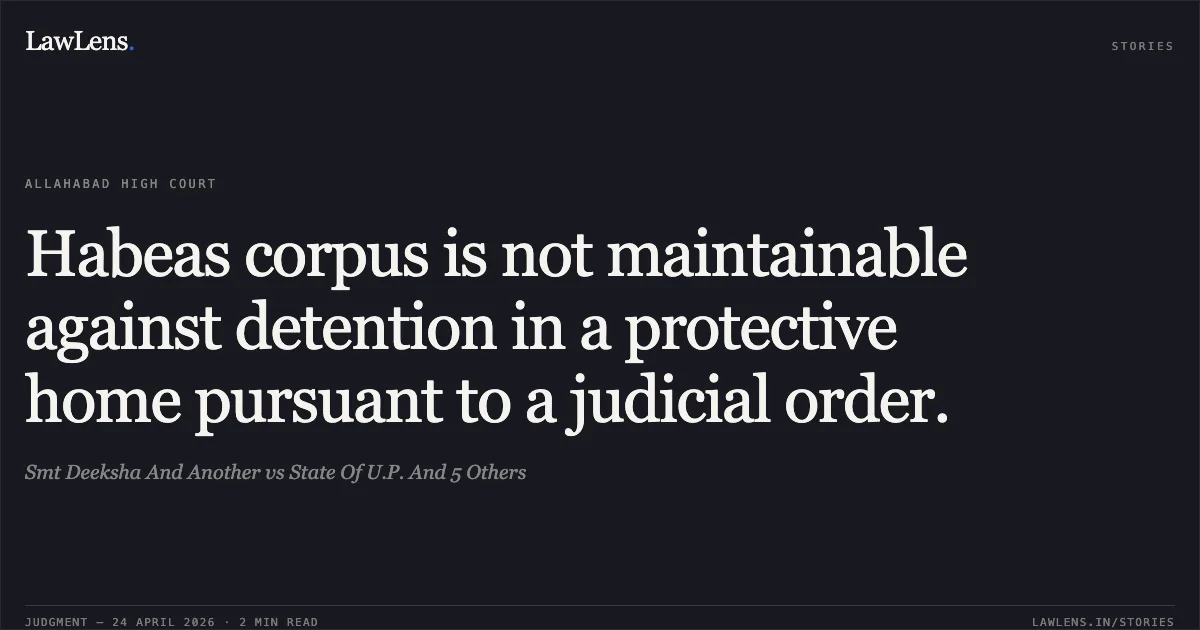
The court answered that a writ of habeas corpus is not maintainable against a judicial order passed by the Child Welfare Committee
It held that the detention of the corpus is lawful as it was executed under a judicial order dated 18.12.2025
Source reference: para. 8, 9The petition was dismissed as not maintainable, with the observation that the petitioner is at liberty to pursue statutory remedies under Sections 101 and 102 of the JJ Act
Source reference: para. 6, 9Acts & Sections Cited
8 provisions across 2 statutes referred to in this judgment. Each provision opens on LawLens.
Juvenile Justice (Care and Protection of Children) Act, 2015.7
Code of Criminal Procedure, 19731
Original Court PDF
Smt Deeksha And AnothervsState Of U.P. And 5 Others
Click to open original judgment
Original judgment, available to read, download and summarize on LawLens.in


