Facts
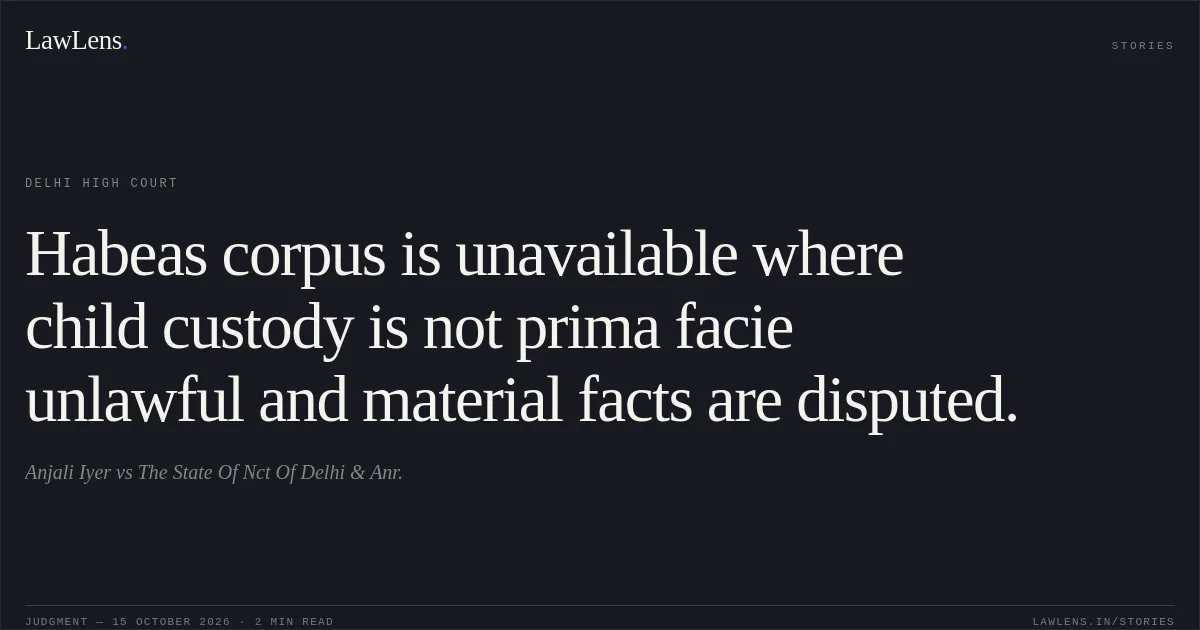
The petitioner sought a writ of habeas corpus for production of her nine-year-old daughter, who was living with respondent no. 2, the child’s father
Source reference: p.1, para. 1The petitioner said the father had taken the child from Bhopal on an assurance that she would be returned before her school examinations; the father denied this and relied on a WhatsApp message in which the petitioner asked him to take the child because she and her father could not manage her
Source reference: pp.2–3, paras. 2–7The petitioner did not file a rejoinder, and the father’s account therefore remained uncontroverted in the proceedings
Source reference: p.3, para. 8The Court referred the parties to mediation, interacted with them and the child, and made interim visitation arrangements, but the parties did not settle their dispute
Source reference: p.3, paras. 9–11Issues
Whether the child’s custody with respondent no. 2 was unlawful so as to warrant habeas corpus relief under Article 226
Source reference: pp.4–6, paras. 12–16Whether the disputed circumstances of the transfer of custody and the child’s welfare could be determined in the writ proceedings, or should be considered by a competent court in ordinary custody proceedings
Source reference: pp.6–7, paras. 17–19Law Applied
Under Article 226, habeas corpus may be available in child-custody matters where a minor is detained by a person not entitled to legal custody; however, the remedy is extraordinary and ordinarily lies only where the detention is unlawful or without authority of law.
Source reference: pp.4–6, para. 15The ordinary remedies in child-custody matters are under the Hindu Minority and Guardianship Act, 1956, or the Guardians and Wards Act, 1890.
Source reference: pp.4–6, para. 15The child’s welfare is the paramount consideration, but where a detailed inquiry is required, a writ court may decline to determine custody on affidavits and direct the parties to the competent civil court.
Source reference: pp.4–6, para. 15These principles were drawn from *Tejaswini Gaud v. Shekhar Jagdish Prasad Tewari*, (2019) 7 SCC 42
Source reference: pp.4–6, para. 15Reasoning
The Court found, prima facie, that the petitioner had voluntarily handed the child to respondent no. 2, and that he had since admitted her to a school in Delhi
Source reference: p.6, para. 16The parties disputed whether the custody transfer was temporary and whether the father’s mother had promised to return the child after three days
Source reference: pp.6–7, paras. 17–18Because those factual disputes and the child’s welfare required consideration of evidence, the Court held that they could not appropriately be resolved through the summary writ process on the parties’ affidavits
Source reference: p.7, para. 18Holding
The Court declined to exercise its extraordinary jurisdiction and left the petitioner to pursue remedies before a competent court
It directed that any such proceedings be decided without influence from the observations or interim orders in the writ petition.
Source reference: p.7, para. 20The parties were to continue following the interim visitation arrangements recorded in the orders dated 5 December 2025 and 7 May 2026, including arranging between themselves the time and neutral place for handover of the child
Source reference: pp.7–8, paras. 21–23The petition was disposed of on those terms
Source reference: p.8, para. 24Acts & Sections Cited
1 provisions across 1 statute referred to in this judgment. Each provision opens on LawLens.
Bharatiya Nagarik Suraksha Sanhita, 20231
Original Court PDF
Anjali IyervsThe State Of Nct Of Delhi & Anr.
Click to open original judgment
Original judgment, available to read, download and summarize on LawLens.in