Facts
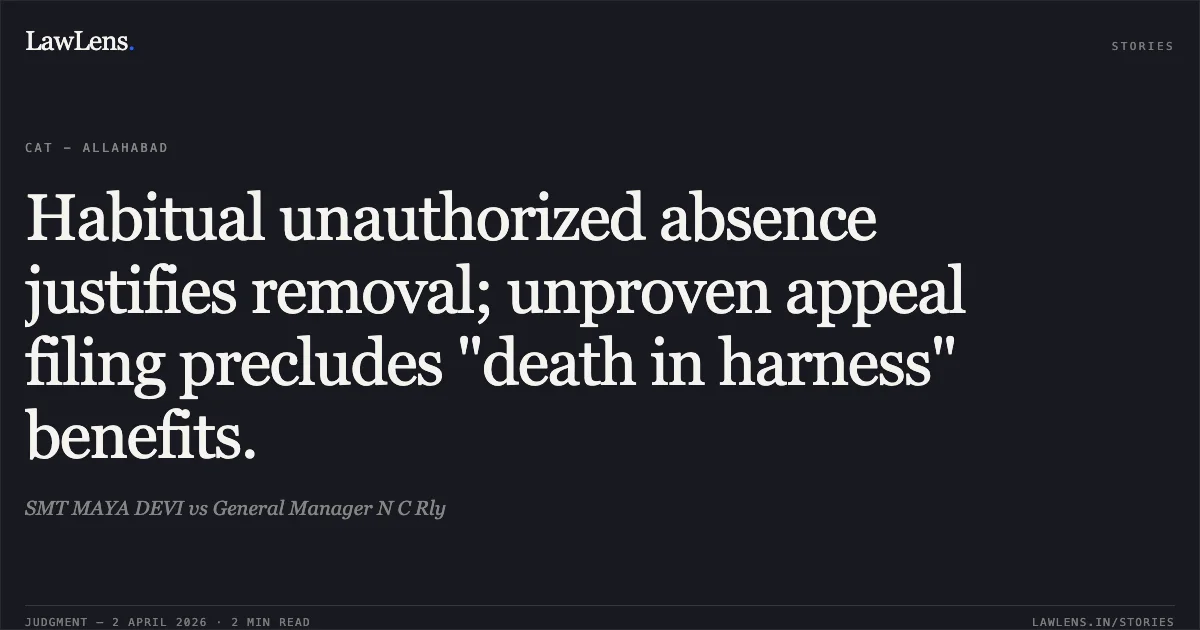
The applicant, Smt. Maya Devi, challenged the removal from service of her deceased husband, Late Nand Kishore, who served as a Bearer in the Railway Canteen, Jhansi
Source reference: p. 1The husband was allegedly absent without authorization from 08.07.2009 to 06.11.2009
Source reference: p. 2Disciplinary proceedings were initiated via a charge-sheet dated 19.03.2010, citing a history of habitual absence totaling 1,734 days over his service period
Source reference: p. 7Following an ex parte inquiry, the Disciplinary Authority (DA) imposed the penalty of removal from service with a compassionate allowance on 17.04.2014
Source reference: p. 1, 12The employee died on 03.11.2014
Source reference: p. 2The applicant contended that a departmental appeal had been filed on 28.05.2014 and remained pending at the time of death; however, the respondents denied receiving any such appeal and rejected subsequent representations as time-barred
Source reference: p. 2-3The applicant sought to treat the death as "in harness" to claim retiral benefits and family pension
Source reference: p. 2Issues
1. Whether the disciplinary proceedings and the subsequent ex parte inquiry violated the principles of natural justice
Source reference: p. 3-42. Whether the production of medical certificates automatically regularizes a period of prolonged absence under the relevant service rules
Source reference: p. 4-53. Whether the applicant's husband can be deemed to have died in harness due to the alleged pendency of a departmental appeal
Source reference: p. 2, 12Law Applied
Rule 3.1 (ii) and (iii) of the Railway Services (Conduct) Rules, 1966, regarding maintainance of devotion to duty and integrity
Source reference: p. 5Rule 538 of the Indian Railway Medical Manual (IRMM), 2000, which mandates that an employee unable to attend duty due to sickness must submit a medical certificate within 48 hours to the competent authority
Source reference: p. 7-8Rules 18 and 19 of the Railway Servants (Discipline and Appeal) Rules concerning the timeframe and methodology for filing appeals
Source reference: p. 12Reasoning
The Tribunal found that the inquiry was conducted ex parte only after the delinquent employee failed to participate despite multiple notices and extensions granted between 2010 and 2012; thus, there was no violation of natural justice
Source reference: p. 9-11Regarding the medical grounds, the Tribunal noted that under Rule 538 of the IRMM, mere possession of a certificate is insufficient; the employee failed to provide timely intimation to the department
Source reference: p. 7-8The evidence of habitual misconduct—specifically 1,734 days of unauthorized absence—justified the severity of the penalty
Source reference: p. 7On the issue of the pending appeal, the Tribunal examined the respondents' internal investigation, which revealed that the alleged appeal was not recorded in the Receipt and Dispatch (R&D) registers and the signature on the applicant's stamped copy did not match office staff
Source reference: p. 12-13Consequently, the Tribunal determined that the burden of proof regarding the filing of the appeal was not discharged, meaning the removal had attained finality before the employee's death
Source reference: p. 12, 15Holding
The Tribunal answered the issues in the negative, holding that the disciplinary proceedings were procedurally sound and the penalty was proportionate to the established habitual misconduct
It held that the employee did not die in harness as no valid appeal was proven to be pending at the time of death
Source reference: p. 15The Original Application was dismissed, and the impugned orders of the Disciplinary, Appellate, and Revisional Authorities were upheld
Source reference: p. 15No order as to costs was made
Source reference: p. 15Acts & Sections Cited
1 provisions across 1 statute referred to in this judgment. Each provision opens on LawLens.
Administrative Tribunals Act, 19851
Original Court PDF
SMT MAYA DEVIvsGeneral Manager N C Rly
Click to open original judgment
Original judgment, available to read, download and summarize on LawLens.in