01Facts
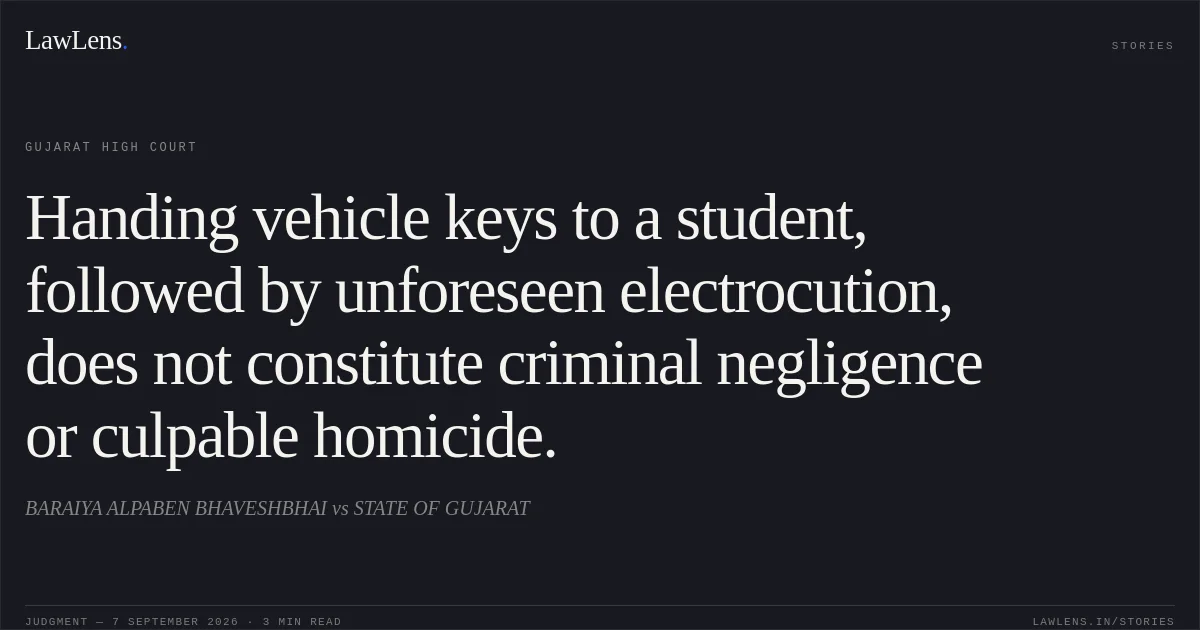
On 10 June 2013, after the reopening of school, 15-year-old Hardik, son of the de facto complainant, allegedly received the keys of a two-wheeler from the applicant, a school teacher, and was asked to park it under a tree because it was raining.
p. 2While doing so, Hardik came into contact with a live electric wire connected to an electricity pole and was fatally electrocuted. He was declared dead at the hospital.
p. 2The FIR, registered as C.R. No. I-115 of 2013 at ‘A’ Division Police Station, Bhavnagar, initially invoked Sections 304A IPC and 3(2)(v) of the Scheduled Castes and Scheduled Tribes (Prevention of Atrocities) Act, 1989; the subsequent charge-sheet invoked Sections 304 IPC and 3(2)(v) of the Atrocities Act.
pp. 2–3The applicant sought quashing of the FIR, charge-sheet, and consequential proceedings under Section 482 CrPC.
p. 102Issues
i.1. Whether the applicant’s act of permitting the deceased student to leave the classroom and handing over the two-wheeler keys constituted a rash or negligent act that was the direct, proximate, and efficient cause of death under Section 304A IPC?
pp. 6–8ii.2. Whether the material on record disclosed the requisite intention or knowledge to constitute culpable homicide under Section 304, particularly Section 304 Part II, IPC?
pp. 8–10iii.3. Whether the offence under Section 3(2)(v) of the Atrocities Act could survive when the underlying IPC offences under Sections 304 or 304A were not prima facie established?
p. 1003Law Applied
The Court exercised its inherent jurisdiction under Section 482 CrPC to prevent abuse of process where the allegations and investigation material did not disclose the ingredients of the alleged offences.
p. 1Section 304A IPC requires that death be the direct result of a rash or negligent act and that the act be the proximate and efficient cause of death, without the intervention of another person’s negligence; mere negligence is insufficient unless it amounts to criminal rashness or criminal negligence.
pp. 5–8Sections 299 and 304 IPC require intention to cause death or bodily injury likely to cause death, or knowledge that the act is likely to cause death; Section 304 Part II specifically requires knowledge, without intention, that the act is likely to cause death.
pp. 8–10The Court relied on Yunusbhai Anwarbhai Karodia v. State of Gujarat, 2018 (0) AIJEL-HC 238752, for the principle that the accused’s act must be the proximate and efficient cause of death and must involve criminal rashness or negligence.
pp. 3, 5–6Since Section 3(2)(v) of the Atrocities Act depended upon the commission of an underlying IPC offence, that provision could not apply in the absence of a prima facie case under Sections 304 or 304A IPC.
p. 10Provisions in the judgment · 5 · Linked ones open on LawLens
Code of Criminal Procedure, 1973 Section 482
Indian Penal Code, 1860 Section 304Section 299Section 300
Scheduled Castes and the Scheduled Tribes (Prevention of Atrocities) Act, 1989 Section 3
04Reasoning
The Court held that handing over the two-wheeler keys and asking the deceased to park the vehicle under a tree was not, by itself, a rash or negligent act having a direct and proximate causal connection with the death.
pp. 6–8The immediate cause of death was electrocution from a live electric wire, an intervening circumstance that the applicant could not reasonably have foreseen.
pp. 6–8The alleged conduct did not demonstrate the degree of recklessness, indifference, or conscious risk-taking required for criminal negligence under Section 304A IPC.
pp. 6–8The Court further found no material showing that the applicant intended to cause death or possessed knowledge that asking the student to park the vehicle would likely result in death, as required for Section 304 Part II IPC.
pp. 8–10Consequently, the essential ingredients of both Sections 304A and 304 IPC were absent, and the consequential charge under Section 3(2)(v) of the Atrocities Act could not stand.
p. 1005Holding
The Court answered all issues in favour of the applicant.
It held that neither Section 304A nor Section 304 IPC was prima facie made out against her, and therefore the offence under Section 3(2)(v) of the Atrocities Act also could not be sustained.
pp. 8–10The application under Section 482 CrPC was allowed, and FIR C.R. No. I-115 of 2013, the charge-sheet, and all consequential proceedings were quashed and set aside qua the applicant.
p. 11The Court clarified that any compensation received by the de facto complainant under the Atrocities Act would not affect the quashing order.
p. 11Original Court PDF
BARAIYA ALPABEN BHAVESHBHAIvsSTATE OF GUJARAT
Click to open original judgment
Original judgment, available to read, download and summarize on LawLens.in