01Facts
The deceased, Sanjay alias Banti Garg, committed suicide on 15.09.2023
¶ 2Two suicide notes were recovered; the first implicated a government officer for bribery/harassment, and the second implicated the applicants, alleging they collected monthly investment deposits from 2017 to 2022 but had not returned the promised sum of ₹3,00,000
¶ 3.2Based on these notes, an FIR was registered under Section 306 of the IPC
¶ 3.3The applicants filed an application for discharge under Section 227 of the Cr.P.C., which was rejected by the First Additional Sessions Judge, Ashok Nagar, on 24.09.2024, leading to the framing of charges
¶ 2The applicants challenged these orders, noting that a co-accused (Monika Jain) had already been discharged by the High Court in a separate revision
¶ 402Issues
i.1. Whether the allegations in the suicide note and the material in the charge sheet satisfy the ingredients of "abetment" as defined under Section 107 of the IPC to sustain a charge under Section 306 of the IPC
¶ 4, 9ii.2. Whether the trial court was justified in rejecting the discharge application of the applicants
¶ 14, 1503Law Applied
Section 306 of the IPC, which penalizes the abetment of suicide
¶ 10Section 107 of the IPC, which defines abetment through instigation, conspiracy, or intentional aid
¶ 11The precedent of S.S. Chheena v. Vijay Kumar Mahajan and Another (2010), which holds that a conviction under Section 306 cannot be sustained without credible evidence of active incitement or instigation, and framing charges without such material is a travesty of justice
¶ 13Provisions in the judgment · 5 · Linked ones open on LawLens
Code of Criminal Procedure, 1973 Section 227Section 397Section 401
Indian Penal Code, 1860 Section 107Section 306
04Reasoning
The Court scrutinized the second suicide note and observed that it merely described a financial transaction/investment and requested that the money be paid to the deceased’s family after his death
¶ 8, 14The Court reasoned that for an offense under Section 306 IPC, there must be evidence of instigation, conspiracy, or intentional aid
¶ 12Merely being named as a "reason" for suicide due to financial disputes does not constitute abetment, as the deceased had legal remedies available for the non-refund of money and the applicants' actions could not be construed as instigating the act of suicide
¶ 14The Court noted that the co-accused had already been discharged on similar grounds, and the applicants' case stood on a similar or better footing
¶ 4, 1405Holding
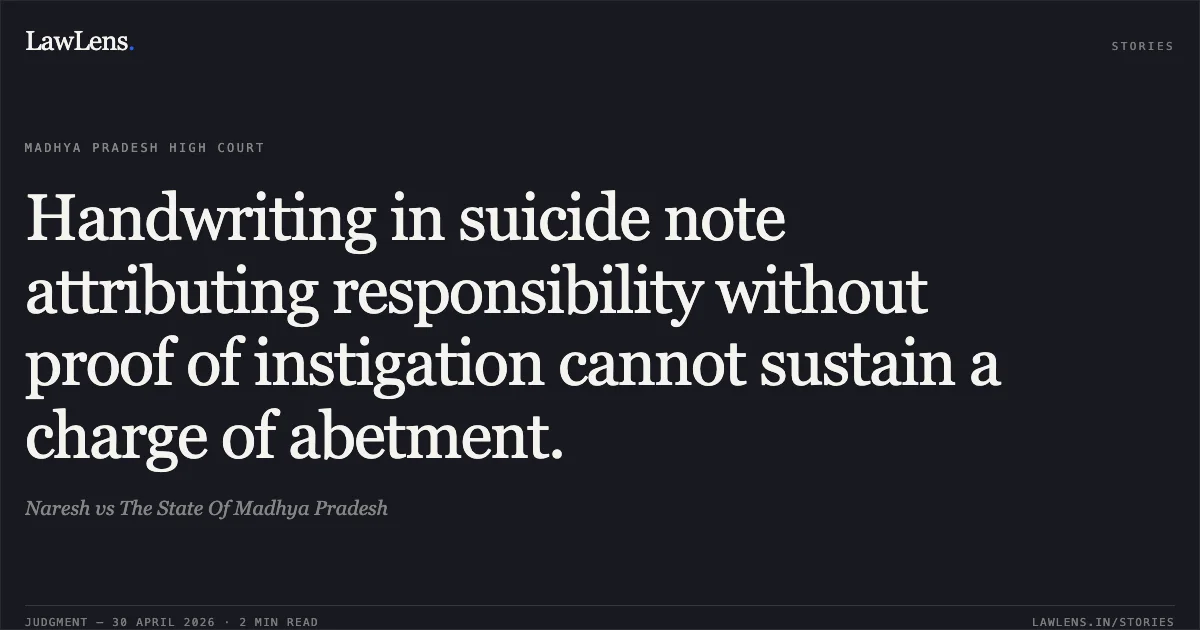
The Court held that the charge under Section 306 IPC was not tenable in law because the essential ingredients of abetment were missing from the evidence
¶ 14, 15The Court allowed the revision petition and set aside the orders dated 24/09/2024 passed by the trial court. Consequently, the applicants were discharged from the offense
¶ 15, 16Original Court PDF
NareshvsThe State Of Madhya Pradesh
Click to open original judgment
Original judgment, available to read, download and summarize on LawLens.in