01Facts
The appellants, three senior Professors at Bharathiar University, had served as Heads of Department (HoD) for approximately ten years
¶ 9In October 2025, the University issued proceedings appointing other Professors as the new HoDs, effectively replacing the appellants
¶ 2-4The appellants challenged these appointments via writ petitions, which were dismissed by the writ court on November 11, 2025
¶ 1, 12The appellants then filed these writ appeals, contending that as the senior-most Professors, they were entitled to continue in their positions
¶ 902Issues
i.1. Whether the appointment of a Head of Department under the Bharathiar University Act is a permanent tenure for the senior-most Professor or subject to a three-year rotational term
¶ 6, 11ii.2. Whether University Grants Commission (UGC) regulations regarding the rotation of HoD positions prevail over state university practices
¶ 1503Law Applied
Section 45 of the Bharathiar University Act, 1981, which stipulates that the term for an HoD is three years, with eligibility for reappointment
¶ 5-6Ordinance 2001 of the University and Ordinance 4(IV) of the University Grants Commission, the latter of which explicitly mandates that where multiple Professors exist in a department, the Vice-Chancellor shall appoint the HoD by observing the principle of rotation based on seniority for a three-year term
¶ 7, 10The principle of federal supremacy, noting that the University Grants Commission Act, 1956, as an Act of Parliament, prevails over conflicting State Acts or practices
¶ 15Provisions in the judgment · 2
Letters Patent Section 15
Bharathiar University Act, 1981 Section 45
04Reasoning
The Court reasoned that a conjoint reading of the University Act and the UGC Ordinances necessitates a rotational system
¶ 11While the appellants argued that their seniority granted them a right to remain HoD, the Court clarified that "seniority" must be read alongside the "principle of rotation"
¶ 11The Court found that the objective of this scheme is to ensure equal opportunity among all senior Professors and prevent the monopolization of administrative roles, which ultimately benefits students through diverse academic leadership
¶ 14Since the appellants had already served nearly ten years—well beyond the statutory three-year term—the University was justified in rotating the position to the next senior-most Professor in line with the UGC mandate
¶ 9, 13, 1605Holding
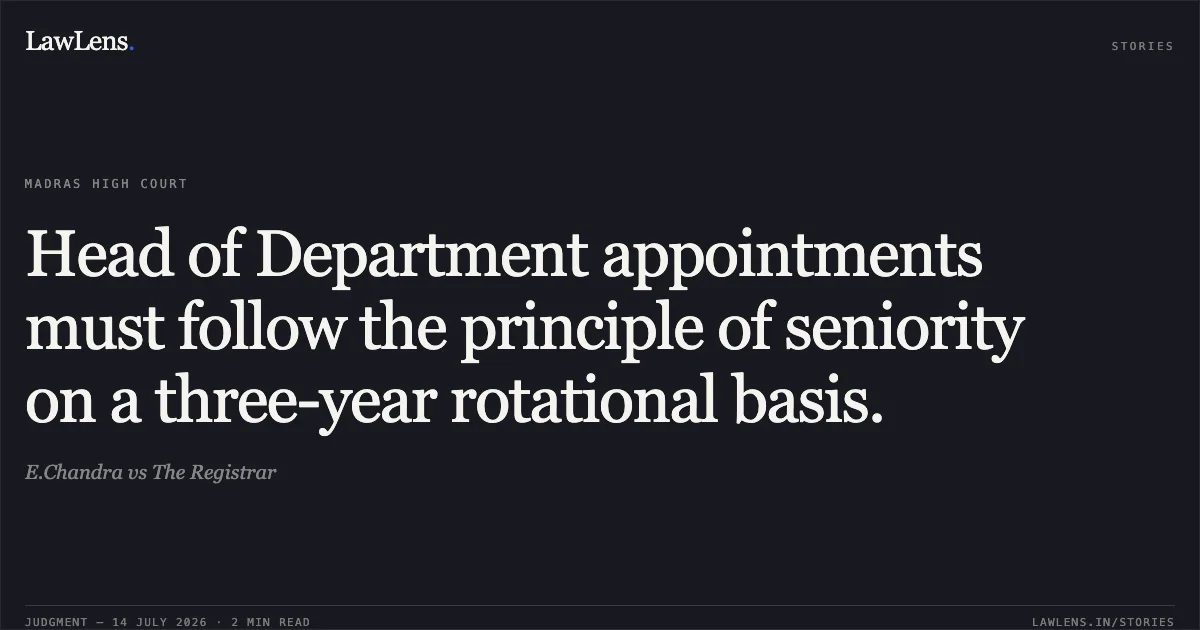
The tenure for the post of Head of Department is strictly three years and must be filled on a rotational basis among eligible senior Professors
¶ 13The Court dismissed the writ appeals and confirmed the orders of the writ court
¶ 17The University’s decision to appoint new HoDs was upheld as being in accordance with both the Bharathiar University Act and the prevailing UGC Regulations
¶ 16Original Court PDF
E.ChandravsThe Registrar
Click to open original judgment
Original judgment, available to read, download and summarize on LawLens.in