Facts
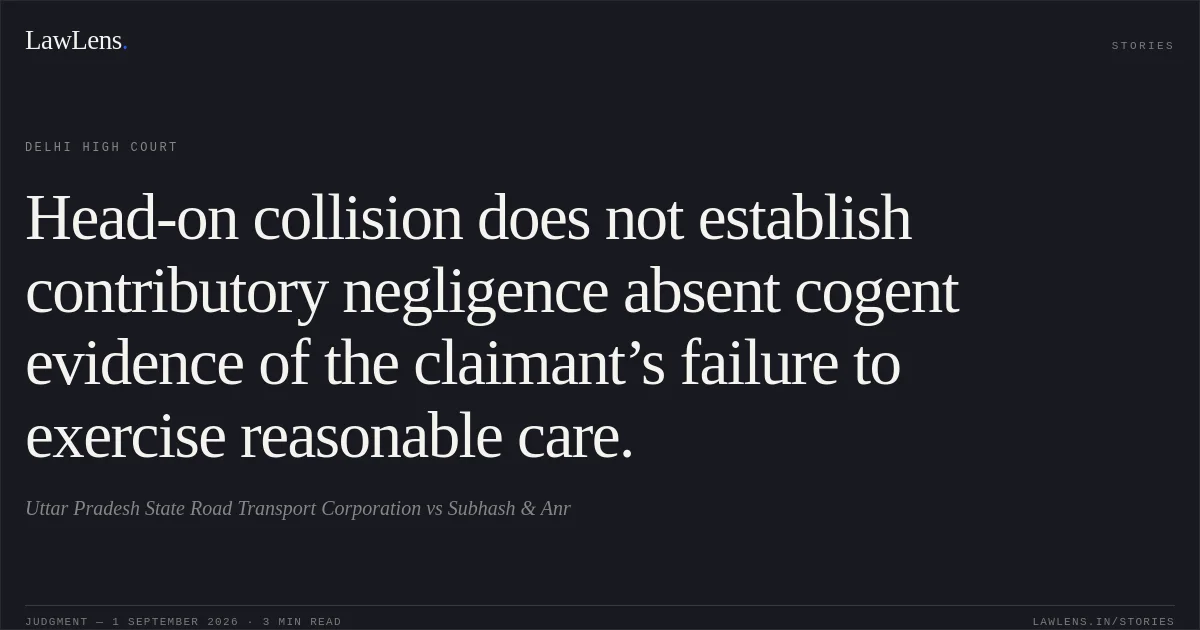
On 19 May 2007 at approximately 4:00 a.m., Subhash, his wife Manisha, and their daughter Kajal were travelling from Aligarh to Delhi in an Indica car. Near Darau More, the car collided with a bus owned by the Uttar Pradesh State Road Transport Corporation (UPSRTC). Manisha died in the accident and Kajal sustained grievous injuries.
Source reference: p.1–2Subhash testified that the bus was being driven at high speed and in a zigzag manner before it rammed into the car. An FIR was registered and a charge-sheet was filed against the bus driver.
Source reference: p.12–13The Motor Accident Claims Tribunal, Rohini Courts, awarded compensation of ₹9,29,116 with interest at 7.5% per annum by award dated 3 August 2013. UPSRTC appealed, contending principally that, since the accident was a head-on collision, contributory negligence ought to have been attributed to the car driver or deceased occupants.
Source reference: p.1–2Issues
Whether a head-on collision between the bus and the Indica car, by itself, justified a finding of contributory negligence or an automatic apportionment of liability at 50:50?
Source reference: p.2, p.11–12Whether UPSRTC established, by cogent evidence, any negligent act or omission on the part of the deceased Manisha or the occupants of the car which materially contributed to the accident?
Source reference: p.4–5, p.12–13Whether the Tribunal was justified, on the standard of preponderance of probabilities, in fastening liability upon the UPSRTC bus driver?
Source reference: p.12–13Law Applied
Contributory negligence requires proof that the claimant or victim failed to exercise reasonable care and that such failure materially contributed to the accident or resulting harm; it cannot be presumed merely from the occurrence of a head-on collision.
Source reference: p.2–4, p.11–12Under Municipal Corporation of Greater Bombay v. Laxman Iyer, contributory negligence concerns the claimant’s own negligent conduct and permits a just and equitable apportionment only where such negligence is established.
Source reference: p.2–4T.O. Anthony v. Karvarnan distinguishes contributory negligence from composite negligence and holds that liability cannot automatically be divided equally between the vehicles.
Source reference: p.5–6Usha Rajkhowa v. Paramount Industries places the burden of proving contributory negligence on the party alleging it.
Source reference: p.6–8Jiju Kuruvila v. Kunjujamma Mohan holds that the post-accident position of vehicles, without direct or corroborative evidence, cannot establish negligence in a head-on collision.
Source reference: p.8–9Kiran v. Sajjan Singh similarly rejects an assumption of contributory negligence where there is no evidentiary proof of negligence by the claimant.
Source reference: p.10The Court also relied on Yashwant Krishna Kumbar v. Divisional Manager, United India Insurance Co. Ltd., reiterating that the party alleging contributory negligence must establish it through cogent material.
Source reference: p.4–5Negligence before the MACT is determined on the touchstone of preponderance of probabilities.
Source reference: p.11–13Reasoning
The Court held that the UPSRTC’s reliance on Bijoy Kumar Dugar v. Bidyadhar Dutta was misplaced because that decision did not create a rule that every head-on collision entails equal contributory negligence; it merely upheld an evidence-based finding on the facts of that case.
Source reference: p.11Here, Subhash’s testimony specifically attributed rash and negligent driving to the bus driver, stating that the bus was driven in a zigzag manner and struck the car with such force that it was completely bent.
Source reference: p.12UPSRTC did not cross-examine Subhash despite having the opportunity to do so, and the FIR and subsequent charge-sheet implicated the bus driver.
Source reference: p.12–13Although the bus driver offered a contrary version that the car had come onto the wrong side of the road, UPSRTC produced no cogent evidence establishing negligence by Manisha or the car occupants.
Source reference: p.11–13Applying the evidentiary burden governing contributory negligence, the Court found that a mere head-on collision and the competing version of the bus driver were insufficient to justify any deduction or apportionment of liability.
Source reference: p.11–13Holding
The High Court dismissed the appeal and upheld the Tribunal’s finding that the accident resulted from the negligence of the UPSRTC bus driver.
It held that UPSRTC failed to prove contributory negligence on the part of the deceased or the car occupants, and therefore no reduction in compensation was warranted.
Source reference: p.13The compensation award of ₹9,29,116 with interest at 7.5% per annum was maintained.
Source reference: p.13The balance amount deposited with the Registrar General, after release of 70% pursuant to the earlier interim order, was directed to be released to the claimants as a lump sum upon liquidation of the FDRs.
Source reference: p.13–14Acts & Sections Cited
2 provisions across 1 statute referred to in this judgment. Each provision opens on LawLens.
Indian Penal Code, 18602
Original Court PDF
Uttar Pradesh State Road Transport CorporationvsSubhash & Anr
Click to open original judgment
Original judgment, available to read, download and summarize on LawLens.in