Facts
The Appellant was intercepted by Excise Officers on 29.05.2023 near Rayagada Railway Station while carrying a sack containing 30.3 kg of Ganja.
Source reference: p. 2He was arrested and subsequently convicted by the Special Judge (NDPS), Rayagada, on 18.03.2024 under Section 20(b)(ii)(C) of the NDPS Act, receiving a sentence of 10 years rigorous imprisonment and a ₹1,00,000 fine.
Source reference: p. 3The Prosecution relied on four witnesses, including an RPF Constable (P.W. 3) projected as an independent witness.
Source reference: p. 5, 11The Appellant challenged the conviction on grounds of non-compliance with mandatory search procedures, lack of genuine independent witnesses, and failure to produce the contraband in court.
Source reference: p. 4-10Issues
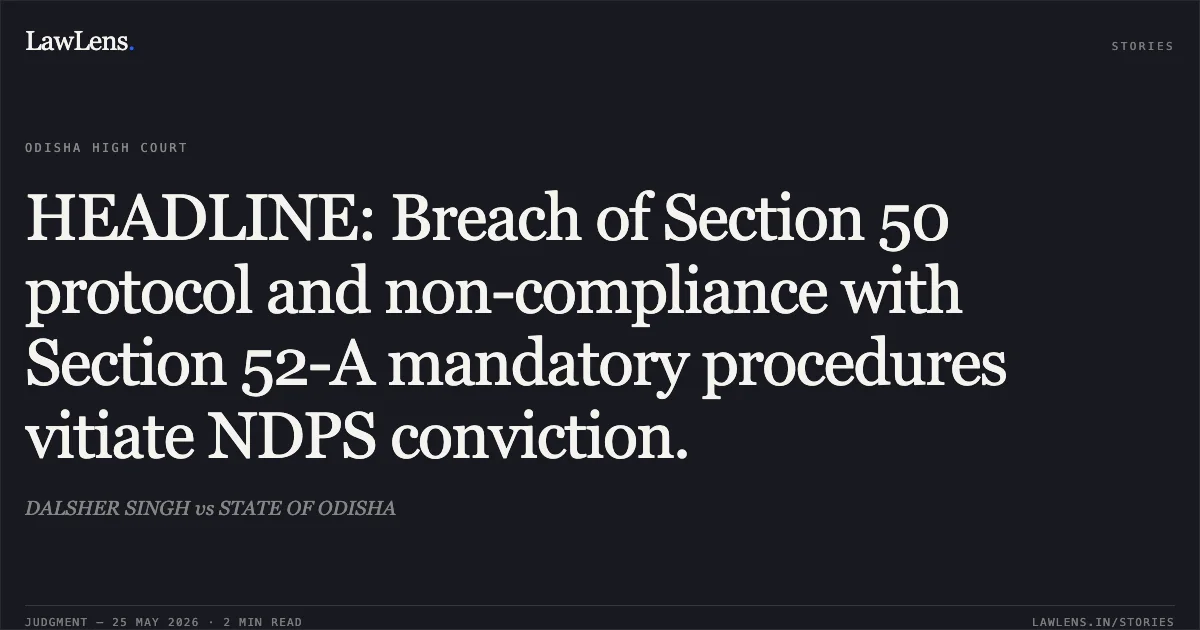
1. Whether the search of the Appellant arose from a pre-planned raid or a chance recovery, and consequently, whether the mandatory requirements of Section 50 of the NDPS Act were applicable.
Source reference: p. 152. Whether the non-production of the seized contraband and non-compliance with Section 52-A regarding inventory and disposal vitiated the trial.
Source reference: p. 253. Whether the prosecution established the foundational facts of the case to trigger statutory presumptions against the accused.
Source reference: p. 29Law Applied
The Court applied Sections 42, 43, and 50 of the NDPS Act regarding search and seizure, noting that Section 50 is a mandatory procedural safeguard for personal searches.
Source reference: p. 16-17It relied on State of Punjab v. Baldev Singh, which established that failure to inform an accused of their right to be searched before a Magistrate/Gazetted Officer vitiates the conviction if based solely on recovered illicit articles.
Source reference: p. 19-21Regarding disposal, the court applied Section 52-A of the NDPS Act and the principles from Bharat Aambale v. State of Chhattisgarh and Mangilal v. State of M.P., which hold that while non-compliance with Section 52-A may be an irregularity, the total absence of primary physical evidence allows the court to draw a negative inference under Section 114(g) of the Evidence Act.
Source reference: p. 25-28Reasoning
The Court found that despite the prosecution’s claim of "chance recovery," the Forwarding Letter (Ext. P-12) and Command Certificate (Ext. P-8) indicated the officers were "acting on information" or "assisting in a raid," thereby necessitating compliance with Section 50.
Source reference: p. 22-23No such compliance was proved, rendering the search tainted.
Source reference: p. 23Furthermore, the lack of an independent witness was compounded by the RPF Constable (P.W. 3) arriving after the arrest and failing to verify the search details.
Source reference: p. 24Critically, the prosecution failed to produce the contraband in court or provide evidence of a Magistrate-certified inventory/sampling under Section 52-A, effectively destroying the primary evidence.
Source reference: p. 27-28Other infirmities included an unverified weighing machine and the non-examination of the Chemical Examiner to prove the forensic report.
Source reference: p. 28-29Holding
The Court held that the prosecution failed to discharge its initial burden of establishing foundational facts, meaning the reverse burden of proof under Sections 35 and 54 could not be invoked.
The Court answered the issues in favor of the Appellant, holding the conviction unsustainable due to cumulative procedural lapses and the lack of primary evidence.
Source reference: p. 29-30The judgment of the Special Judge was set aside, the appeal was allowed, and the Appellant was ordered to be set at liberty forthwith.
Source reference: p. 30Acts & Sections Cited
11 provisions across 2 statutes referred to in this judgment. Each provision opens on LawLens.
Code of Criminal Procedure, 19732
Narcotic Drugs and Psychotropic Substances Act, 1985
Original Court PDF
DALSHER SINGHvsSTATE OF ODISHA
Click to open original judgment
Original judgment, available to read, download and summarize on LawLens.in


