Facts
The Respondent (TPDDL) established the Rithala Combined Cycle Power Plant as a temporary measure to meet peak power demand for the 2010 Commonwealth Games
Source reference: para. 3The project was initially proposed with an operational tenure limited to 5-6 years, after which the land was to revert to the DDA
Source reference: para. 3While the plant had a technical useful life of 15 years, the Commission (Appellant), via its order dated 31.08.2017, approved the Power Purchase Agreement (PPA) and operational framework only until March 2018 (6 years)
Source reference: para. 5-6TPDDL did not challenge this 2017 order. In subsequent true-up proceedings, the Commission allowed depreciation only up to FY 2017-18
Source reference: para. 7TPDDL appealed to the APTEL, which set aside the Commission’s order, directing that the entire capital cost be recovered through depreciation over the 15-year technical life
Source reference: para. 8Issues
1. Whether depreciation must be allowed over the entire technical useful life of an asset regardless of the period it was actually used for supply?
Source reference: para. 13(i)2. Whether Regulation 6.32 of the 2011 Regulations confers an absolute right to recover capital costs even after electricity supply ceases?
Source reference: para. 13(ii)3. Whether APTEL erred in disregarding the regulatory framework and approval conditions that limited the recovery period to six years?
Source reference: para. 13(iii)Law Applied
Section 61(d) of the Electricity Act, 2003, which mandates that tariff determination must safeguard consumer interests while ensuring reasonable cost recovery
Source reference: para. 15Regulation 6.32 of the DERC (Generation Tariff) Regulations, 2011, which provides for straight-line depreciation over the "useful life" of an asset
Source reference: para. 17Regulation 4.1, which stipulates that tariffs are governed by the PPA or arrangements approved by the Commission
Source reference: para. 18Principle of Finality of Orders, noting that a regulatory framework accepted by a party cannot be reopened in true-up proceedings
Source reference: para. 22Reasoning
The Court reasoned that tariff determination is a balancing act where consumer welfare is central under Section 61(d)
Source reference: para. 15, 21It held that consumers cannot be burdened with charges for a period beyond March 2018, during which no electricity was supplied
Source reference: para. 20The Court found that Regulation 6.32 (depreciation) cannot be read in isolation; it must be harmonized with Regulation 4.1, which binds tariff recovery to the duration approved in the PPA
Source reference: para. 21Furthermore, because TPDDL accepted the 2017 order limiting the operational life to six years, that order attained finality
Source reference: para. 22The Court observed that TPDDL remained free to operate as a "merchant generator" to recover remaining costs from other sources, but it could not pass those costs onto Delhi’s retail consumers after the approved supply period ended
Source reference: para. 20Holding
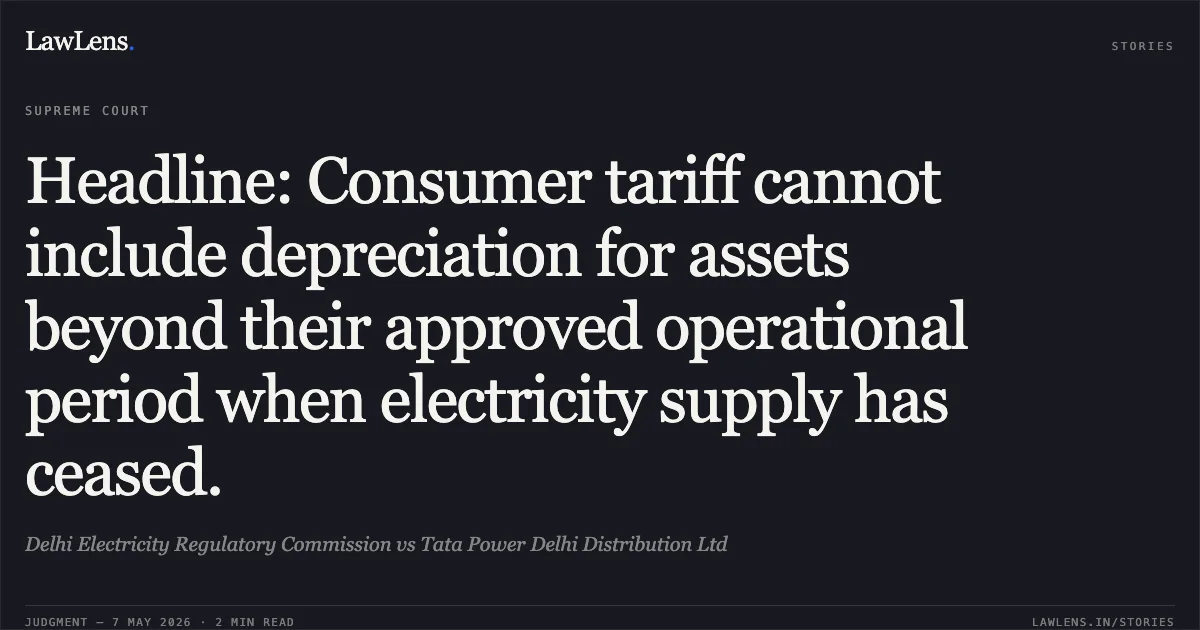
The Supreme Court answered all issues in favor of the Commission, holding that depreciation recovery is tied to the period of actual utilization and regulatory approval
The Court held that Reg. 6.32 does not grant an absolute right to recover costs for an idle plant
Source reference: para. 21The judgment of APTEL was set aside, and the Commission's order dated 11.11.2019, which restricted depreciation to the 6-year operational period, was restored
Source reference: para. 23-24Acts & Sections Cited
5 provisions across 2 statutes referred to in this judgment. Each provision opens on LawLens.
Electricity Act, 20034
Code of Civil Procedure, 19081
Original Court PDF
Delhi Electricity Regulatory CommissionvsTata Power Delhi Distribution Ltd
Click to open original judgment
Original judgment, available to read, download and summarize on LawLens.in


![Subsequent exoneration does not retrospectively invalidate a finalized promotion select list.. UNNIKRISHNAN M vs M/o Environment And Forests. CAT - ['Ernakulam']. LawLens](/stories/thumbnails/subsequent-exoneration-does-not-retrospectively-invalidate-a-finalized-promotion-select-li-ce80a0e84f2f4887857271e8b4341c42.webp)