Facts
The Appellant participated in a tender process (Notice No. 27/2024-2025) issued by the Latur City Municipal Corporation for construction work
Source reference: para. 1.8Clause XII of the tender mandated "Geo-Tagging," requiring bidders to visit the site and obtain an authenticated certificate/signature from the competent authority
Source reference: para. 1.4The Appellant’s technical bid was rejected for failure to produce the authenticated geo-tagging certificate
Source reference: para. 1.3The Appellant alleged that he applied for the signature well in time, but the authorities deliberately withheld it to favor other bidders
Source reference: para. 1.7Though the specific work in question had already been executed by a third party since October 2024, the Supreme Court admitted the petition to address the systematic misuse of geo-tagging clauses
Source reference: para. 2.5Issues
1. Whether the failure to produce a geo-tagging certificate constitutes a valid ground for disqualification if the delay is attributable to the tendering authority rather than the bidder.
Source reference: para. 62. Whether minor technical deviations in GPS coordinates or metadata are sufficient grounds for rejecting a technical bid.
Source reference: para. 73. What is the scope of judicial review under Writ Jurisdiction concerning technical evaluations involving geo-tagging requirements?
Source reference: para. 12Law Applied
The Court emphasized the principles of transparency and fairness in public procurement, asserting that technical conditions must serve a public purpose rather than acting as tools for arbitrary exclusion
Source reference: para. 5It applied the doctrine of "curable defects," suggesting that if a bidder has performed their duty but a certificate is pending with the state, the defect is not fatal
Source reference: para. 6Furthermore, the Court relied on the principle of "substantial compliance," wherein minor technical deviations (GPS coordinates or timestamps) should not lead to disqualification in public interest
Source reference: para. 7Reasoning
The Court observed that while geo-tagging is intended to enhance accountability by ensuring site visits (e.g., in schemes like PMAY or Swachh Bharat Mission), it is being applied in an "overly technical and arbitrary manner"
Source reference: para. 5-6The Court reasoned that a geo-tagging certificate is not entirely within the bidder’s control; if a bidder applies in time, the failure of the authority to sign it becomes a "curable defect"
Source reference: para. 6The Court identified that such clauses grant "excessive discretion" to authorities, facilitating favoritism
Source reference: para. 10By treating timestamp differences or lack of specific guidance on which mobile application to use as "significant defects," authorities knock out genuine bidders on "flimsy grounds"
Source reference: para. 7-12Consequently, the Court held that judicial review must look "in between the lines" to prevent technical requirements from masking mala fide intentions
Source reference: para. 12Holding
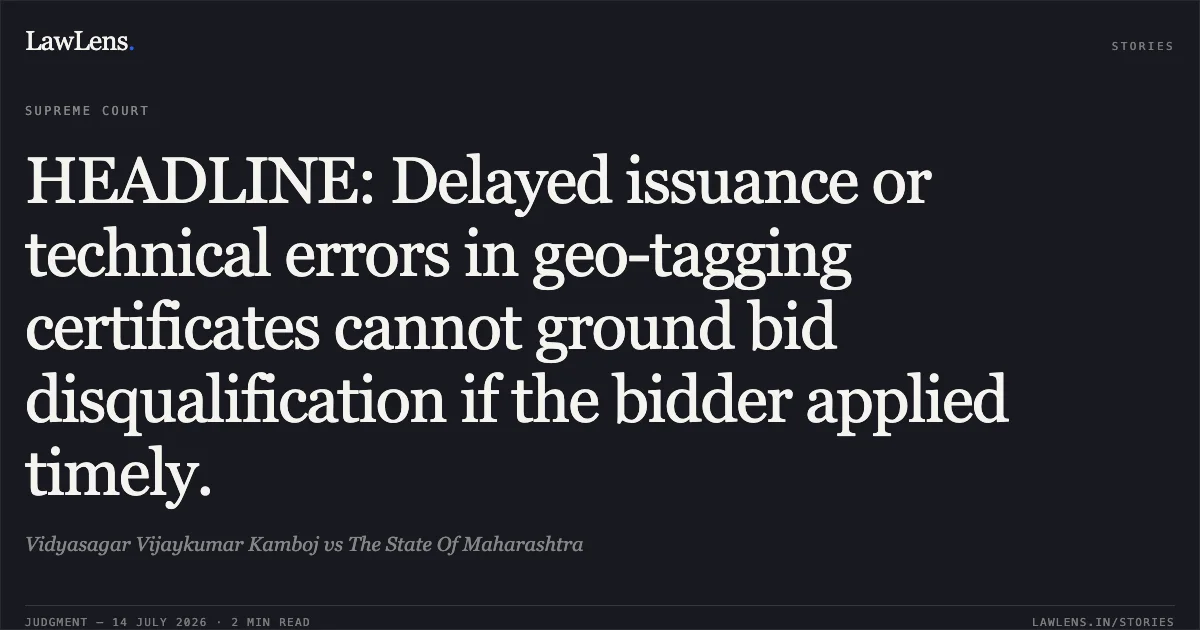
The Court held that a bid cannot be rejected for non-submission of a geo-tagging certificate if the bidder applied for it within the stipulated time
Minor deviations in GPS coordinates or metadata are not valid grounds for disqualification
Source reference: para. 7-8Any disqualification based on an authority’s intentional delay in signing verification reports is invalid
Source reference: para. 8While the specific appeal was disposed of as the work was completed, the Court issued a general directive to all High Courts to remain "vigilant" against the misuse of geo-tagging clauses in technical evaluations
Source reference: para. 12-13The Registry was directed to forward the order to all High Courts for compliance
Source reference: para. 15Original Court PDF
Vidyasagar Vijaykumar KambojvsThe State Of Maharashtra
Click to open original judgment
Original judgment, available to read, download and summarize on LawLens.in


![Subsequent exoneration does not retrospectively invalidate a finalized promotion select list.. UNNIKRISHNAN M vs M/o Environment And Forests. CAT - ['Ernakulam']. LawLens](/stories/thumbnails/subsequent-exoneration-does-not-retrospectively-invalidate-a-finalized-promotion-select-li-ce80a0e84f2f4887857271e8b4341c42.webp)