Facts
The appellant was convicted by the Sessions Court under Section 302 IPC for the alleged murder of his cousin Prabhu on 10.05.2016.
Source reference: para. 1-2The prosecution alleged that the appellant had illicit relations with the deceased’s wife, leading to an altercation where the appellant fatally assaulted the deceased with an axe.
Source reference: para. 3The First Information Report (FIR) was lodged by the deceased's father (P.W.-1), and the prosecution relied on the ocular testimonies of P.W.-1, P.W.-2 (step-brother), and P.W.-3 (mother).
Source reference: para. 8, 29-32The trial court awarded a life sentence based on the find that these witnesses were reliable and corroborated by medical evidence.
Source reference: para. 68The appellant challenged this on grounds of material contradictions and false implication.
Source reference: para. 36Issues
1. Whether there are material contradictions in the ocular testimonies and documentary evidence regarding the motive and the manner of the incident.
Source reference: para. 43, 53-552. Whether the prosecution established the presence and arrest of the accused at the site of the incident beyond reasonable doubt.
Source reference: para. 57, 63-653. Whether the unexplained delay in recording the statements of material witnesses vitiates the credibility of the prosecution case.
Source reference: para. 46-47Law Applied
Section 302 of the Indian Penal Code regarding punishment for murder.
Source reference: para. 1Principles governing "unexplained delay in recording witness statements" as established by the Supreme Court in Shahid Khan v. State of Rajasthan, which holds that such delays suggest the deliberate introduction of "built-up" witnesses.
Source reference: para. 47Section 155 of the Indian Evidence Act regarding the impeachment of the credit of witnesses through material contradictions between their testimonies and the site plan/documentary records.
Source reference: para. 65, 69Reasoning
The High Court found the prosecution's motive—illicit relations—to be unsubstantiated and contradicted by the witnesses' own testimonies.
Source reference: para. 43-45Significant discrepancies were noted between the site plan and the oral evidence; while witnesses claimed to be inside their houses, the site plan placed them in the courtyard, and the Court concluded they could not have seen the incident from inside.
Source reference: para. 53-56The Court highlighted the "irreconcilable" conflict regarding the arrest: witnesses P.W.-1, 2, and 3 claimed the accused was tied to a tree at the spot immediately after the crime, whereas the Investigating Officer (P.W.-7) and the arrest memo stated he was arrested the following day based on an informer's tip.
Source reference: para. 63-64The Court also took a stern view of the unexplained delay in recording P.W.-2’s statement, despite his presence during the inquest.
Source reference: para. 46These inconsistencies led the Court to determine that the witnesses’ credit was successfully impeached.
Source reference: para. 65Holding
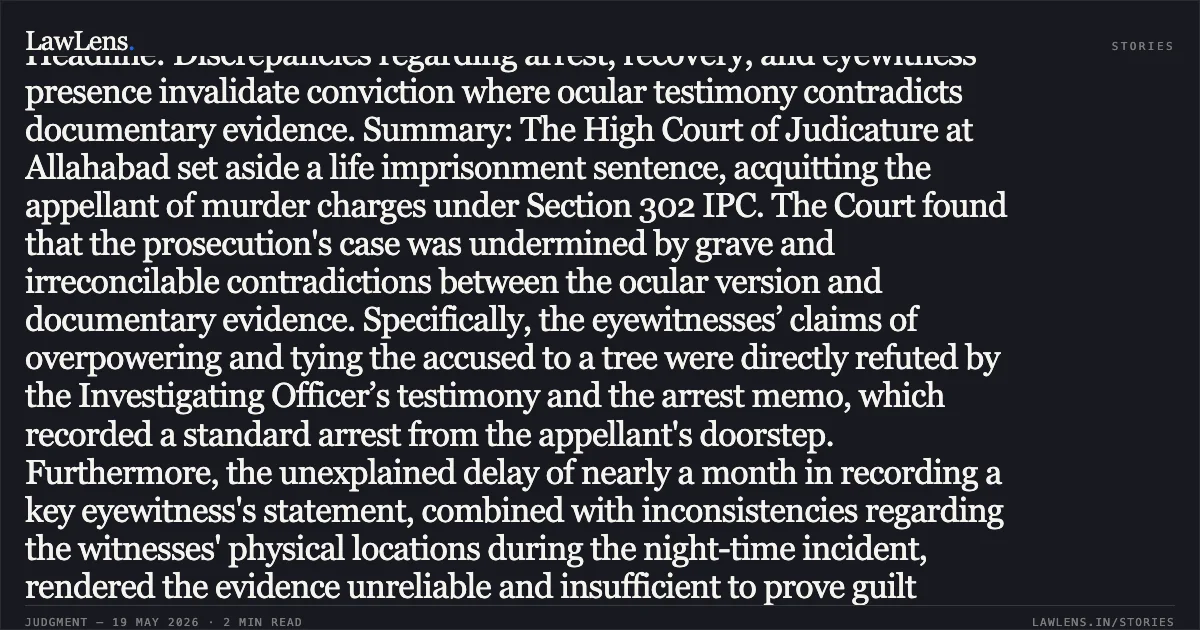
The Court answered the issues in the negative, holding that the prosecution failed to prove the charges beyond a reasonable doubt.
The High Court set aside the trial court’s judgment dated 09.11.2017, acquitted the appellant of all charges, and ordered his immediate release.
Source reference: para. 71-72The appeal was allowed.
Source reference: para. 71Acts & Sections Cited
2 provisions across 2 statutes referred to in this judgment. Each provision opens on LawLens.
Indian Penal Code, 18601
Code of Criminal Procedure, 19731
Original Court PDF
Summilal AhirwarvsState Of U.P.
Click to open original judgment
Original judgment, available to read, download and summarize on LawLens.in


