Facts
The applicant, C. Perumal, retired as a Tin Coppersmith from 515 Army Base Workshop.
Source reference: no citationHe initially served in the Indian Army for 20 years (25.08.1985 to 31.08.2005) and was re-employed as an artisan staff in the post of Blacksmith on 01.09.2005.
Source reference: p.3He subsequently transferred to the third respondent Workshop on 01.06.2007 and was promoted to TCS Highly Skilled HS-II/Skilled from 01.09.2021.
Source reference: p.3-4On 04.05.2024, the third respondent issued a show cause notice regarding the review of his promotion, making it effective from 12.10.2021 instead of 01.09.2021.
Source reference: p.4Another show cause notice dated 29.07.2024 stated that his pay was not fixed upon joining the 515 Army Base Workshop on 01.06.2007 and that he would be eligible for 2nd MACP in the Grade Pay of Rs.2000 w.e.f. 01.01.2016.
Source reference: p.4Following further show cause notices, a letter dated 29.10.2024 directed the applicant to remit Rs.4,61,156/- or submit willingness to recover the amount from his retirement gratuity.
Source reference: p.4-5The applicant, under protest, consented to the deduction to expedite his pension papers.
Source reference: p.5Consequently, Rs.4,61,156/- was recovered from his gratuity.
Source reference: p.5The applicant filed the present OA seeking refund of this recovered amount.
Source reference: p.3, p.5Issues
Whether the sum of Rs. 4,61,156 recovered from the applicant's gratuity is arbitrary, unjust, and illegal.
Source reference: p.3Whether the consent given by the applicant for deduction from his retirement gratuity, under protest, disentitles him from seeking a refund of the amount.
Source reference: p.5-6, p.10-11Law Applied
The court applied the principles established by the Supreme Court in State of Punjab & others vs. Rafiq Masih (White Washer) and others (2015) 4 SCC 334, which delineates situations where recovery of excess payments from employees is impermissible.
Source reference: p.5This judgment was subsequently codified by the DoPT Office Memorandum dated 02.03.2016, specifically para 4.
Source reference: p.5, p.8-9The court further referenced Thomas Daniel v. State of Kerala, 2022 SCC OnLine SC 536, and relied on its own previous orders in OA No. 371/2022 (DD 05.06.2024) and OA No. 592/2024 (DD: 24.09.2025), which address identical issues of pay refixation and recovery, especially concerning undertakings extracted at the time of retirement.
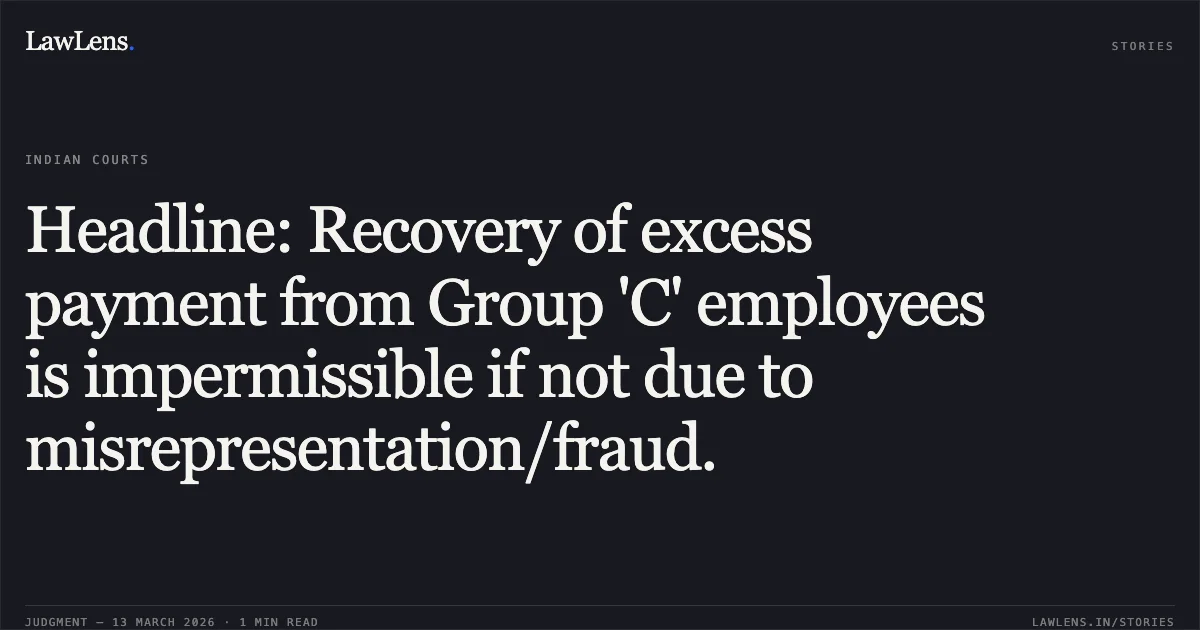
Source reference: p.5, p.7, p.10-11The core legal principle is that recovery of excess payments is impermissible from Group 'C' and 'D' employees, from retired employees or those due to retire within one year, and when excess payment has been made for over five years, unless there is misrepresentation or fraud by the employee.
Source reference: p.8-9Undertakings for recovery extracted under coercive circumstances at the verge of retirement lack sanctity.
Source reference: p.10-11Reasoning
The Tribunal noted that the revision of pay fixation was not under dispute, but the challenge was confined to the recovery action itself.
Source reference: p.7-8It found that the applicant's case squarely fell within the exceptions outlined in Rafiq Masih (White Washer) and the DoPT OM dated 02.03.2016.
Source reference: p.5, p.9Specifically, the applicant was a Group 'C' employee, the recovery was made from a retired employee, and the excess payment spanned from 2007 to 2024, exceeding five years.
Source reference: p.3-4, p.6, p.9Crucially, there was no dispute that the excess payment was not due to any misrepresentation or fraud by the applicant, but rather due to the respondents' failure to fix his pay upon joining the workshop.
Source reference: p.6, p.9The Tribunal further observed that the undertaking given by the applicant for deduction from his gratuity was under protest and in "coercive circumstances" to ensure the release of his retiral benefits.
Source reference: p.5, p.10-11Citing Subhash Nimba Chavan vs the State of Maharashtra, the Tribunal held that such an undertaking, extracted at the stroke of retirement, lacks the sanctity of a genuine consent, as it leverages the employee's helplessness.
Source reference: p.10-11Therefore, the undertaking did not exonerate the employer from their liability to refund, given the applicability of the principles from Rafiq Masih.
Source reference: p.11Holding
The Tribunal concluded that no recovery could be made from the retirement gratuity of the applicant as he was a Group 'C' employee, there was no misrepresentation or fraud on his part, and the excess payment ran for a period exceeding five years before the recovery order was issued.
The undertaking given by the applicant under protest at the time of retirement was deemed not to disentitle him from seeking a refund.
Source reference: p.5-6The Tribunal held the recovery of Rs. 4,61,156/- to be arbitrary, unjust, and illegal.
Source reference: p.3, p.9, p.11The respondents were directed to refund the recovered amount of Rs. 4,61,156/- to the applicant within eight weeks from the date of receipt of the certified copy of the order.
Source reference: p.13The OA was disposed of accordingly, with no order as to costs.
Source reference: p.14Acts & Sections Cited
1 provisions across 1 statute referred to in this judgment. Each provision opens on LawLens.
Administrative Tribunals Act, 19851
Original Court PDF
C. Perumalvs.Union of India and others O.A. No. 170/00247/2025/CAT/Bangalore
Click to open original judgment
Original judgment, available to read, download and summarize on LawLens.in


![Subsequent exoneration does not retrospectively invalidate a finalized promotion select list.. UNNIKRISHNAN M vs M/o Environment And Forests. CAT - ['Ernakulam']. LawLens](/stories/thumbnails/subsequent-exoneration-does-not-retrospectively-invalidate-a-finalized-promotion-select-li-ce80a0e84f2f4887857271e8b4341c42.webp)