Facts
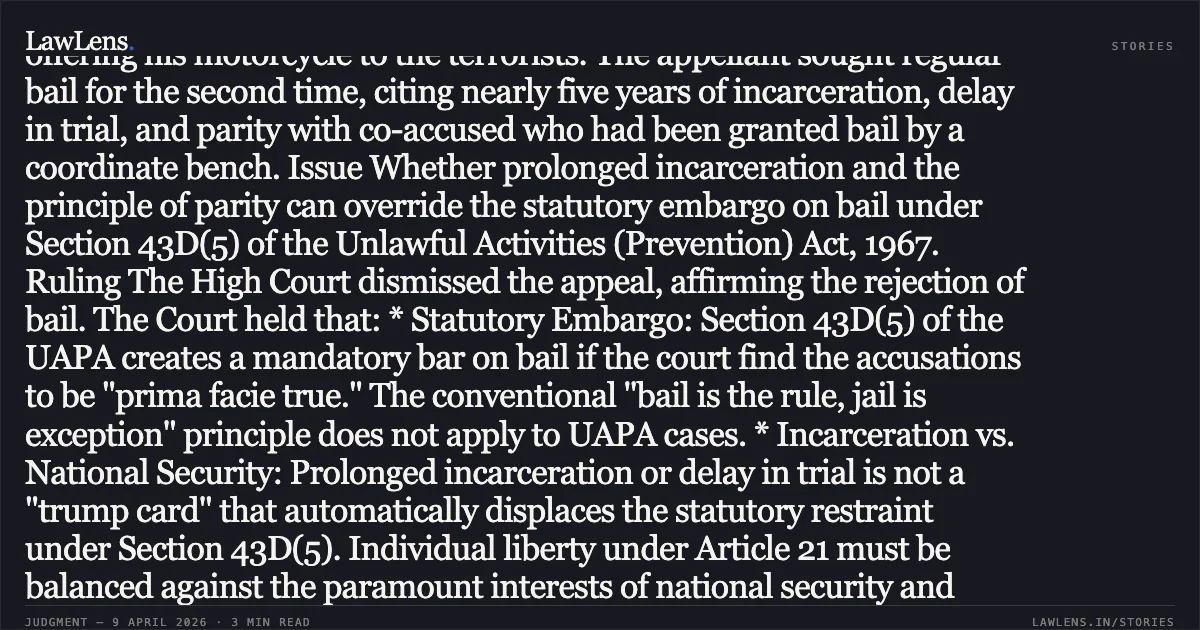
The Appellant (A-5) challenged the order dated 08.12.2025 passed by the Special Judge, NIA, Ranchi, which rejected his bail application in connection with RC Case No. 25/2020/NIA/DLI
Source reference: para. 1The case involves a 2019 attack by the banned CPI (Maoist) organization on a police patrolling party at Lukuiya More, resulting in the death of four police personnel and the looting of arms
Source reference: para. 3The NIA alleged the Appellant acted as an "Over Ground Worker" (OGW) providing logistical support, including food, motorcycle transport, and conveying messages for the extremist leader Ravindra Ganjhu (A-14)
Source reference: para. 8, 20, 26The Appellant has been in custody since 06.01.2020
Source reference: para. 9A previous bail prayer was dismissed on merits by the High Court in 2023
Source reference: para. 2The current appeal sought bail primarily on grounds of parity with co-accused Rajesh Ganjhu and Baijnath Ganjhu, who were granted bail in late 2025, and the prolonged period of incarceration
Source reference: para. 13-17Issues
1. Whether the Appellant is entitled to bail on the principle of parity with co-accused who were released due to prolonged incarceration and trial delay
Source reference: para. 13, 872. Whether the period of incarceration (since January 2020) and the slow progress of the trial entitle the Appellant to bail under Article 21 of the Constitution despite the restrictions of the UAPA
Source reference: para. 17, 763. Whether there are reasonable grounds for believing that the accusations against the Appellant are "prima facie true" as per the mandate of Section 43D(5) of the UAPA
Source reference: para. 42, 62Law Applied
The Court primarily applied Section 43D(5) of the Unlawful Activities (Prevention) Act, 1967 (UAPA), which mandates that bail must be refused if the accusations are "prima facie true"
Source reference: para. 42, 48It relied on National Investigation Agency v. Zahoor Ahmad Shah Watali, which established that "prima facie true" means materials collected by the agency must prevail unless disproved at the threshold
Source reference: para. 43, 46The Court further applied the "twin-prong test" from Gurwinder Singh v. State of Punjab, affirming that in UAPA cases, jail is the rule and bail is the exception
Source reference: para. 48-52, 54Regarding trial delay, it followed Gulfisha Fatima v. State (Govt. of NCT of Delhi), which held that delay is not a "trump card" where national security and sovereignty are implicated
Source reference: para. 76Parity principles were applied per Tarun Kumar v. Assistant Director, ED, requiring focus on the specific role of the accused
Source reference: para. 90-91Reasoning
The Court observed that the Appellant's role as an OGW was substantiated by the supplementary chargesheet, showing he provided vital logistics, such as food and motorcycle transport, and acted as a messenger for Maoist leaders
Source reference: para. 70-74The Court rejected the plea of parity, noting that the Appellant's previous bail application was dismissed on merits and his role was significantly more active than those granted bail on the basis of "peripheral" involvement
Source reference: para. 89-91, 100Regarding Article 21 and the delay in trial, the Court noted that 16 witnesses had already been examined and the trial was progressing
Source reference: para. 84, 104Citing Gurwinder Singh and Gulfisha Fatima, the Court reasoned that in grave offences involving terrorist acts and the killing of police personnel, prolonged incarceration alone cannot override the statutory bar of Section 43D(5) when the accusations appear prima facie true
Source reference: para. 75-80, 86Holding
The Court answered the issues in the negative, holding that the accusations against the Appellant are prima facie true based on his established nexus with the terrorist organization
The High Court found no change in circumstances or fresh grounds for bail, stating that parity cannot be claimed where the specific role and evidence indicate active support to a proscribed organization
Source reference: para. 100, 106The appeal was dismissed, and the order of the Special NIA Court was upheld
Source reference: para. 107Acts & Sections Cited
37 provisions across 5 statutes referred to in this judgment. Each provision opens on LawLens.
National Investigation Agency Act, 20083
Indian Penal Code, 1860
Arms Act, 19594
Unlawful Activities (Prevention) Act, 1967
Code of Criminal Procedure, 19735
Original Court PDF
NARESH GANJHUvsUNION OF INDIA THROUGH NATIONAL INVESTIGATING AGENCY, NEW DELHI
Click to open original judgment
Original judgment, available to read, download and summarize on LawLens.in


