Facts
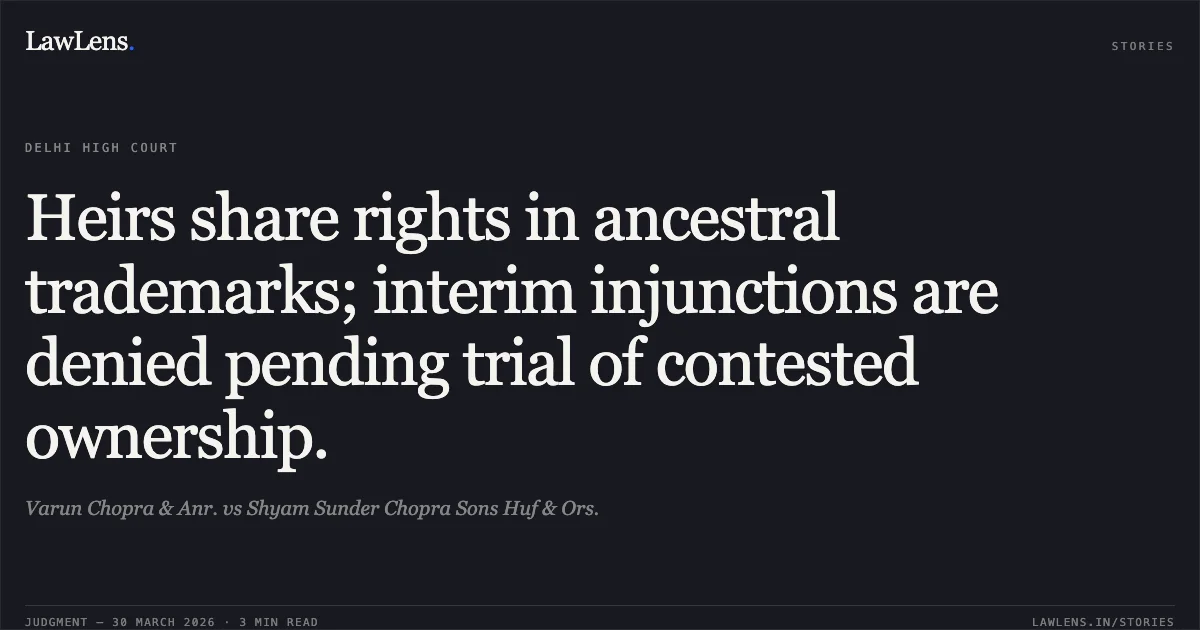
The Plaintiff filed a suit for permanent injunction to restrain the Defendants from using the marks ‘SV NATRAJ’, ‘SV RAJ’, ‘RAJNUT’, and ‘SRI NATRAJ JI’ (“Impugned Marks”), alleging infringement of the registered mark ‘NATRAJ BRAND’ and the ‘NATRAJ GOD’ device (“Subject Mark”).
Source reference: para. 1The Subject Mark was originally adopted in 1956 by a partnership firm, M/s Raja Traders, consisting of Mohan Lal Chopra and his son, J.K. Chopra.
Source reference: para. 4.1The Plaintiff (grandson of J.K. Chopra) claimed exclusive ownership via a 2020 Assignment Deed and a 2021 Will executed by J.K. Chopra.
Source reference: para. 4.14-4.15The Defendants (other descendants of J.K. Chopra) contended that the business and mark were ancestral assets governed by a 1971 Will of Mohan Lal Chopra and a 2019 family settlement (Apsi Samjhautanama), granting them shared rights.
Source reference: para. 5.6-5.8, 5.28Prior litigation in Bengaluru resulted in the return of the plaint for lack of jurisdiction.
Source reference: para. 4.9-4.10The Plaintiff sought an interim injunction under Order XXXIX Rules 1 and 2 of the CPC.
Source reference: para. 3Issues
1. Whether the Plaintiff established a prima facie case for trademark infringement and passing off regarding the Impugned Marks.
Source reference: para. 6, 92. Whether the name and device of a deity (“Natraj”) can be exclusively monopolized by one family member in a dispute involving shared ancestral goodwill.
Source reference: para. 12, 263. Whether the balance of convenience and the risk of irreparable injury favored the grant of an interim injunction.
Source reference: para. 26-27Law Applied
The court applied the "classical trinity" test for interim injunctions under Order XXXIX Rules 1 and 2 of the CPC: prima facie case, balance of convenience, and irreparable injury.
Source reference: para. 6It relied on the "anti-dissection rule" and the test of "holistic comparison" established in Pernod Ricard India (P) Ltd. v. Karanveer Singh Chhabra.
Source reference: para. 8Regarding the use of religious names, the court followed Vardhman Buildtech Pvt. Ltd. v. Vardhman Properties Ltd., holding that no monopoly can be claimed over the name of a deity unless it has acquired secondary distinctiveness.
Source reference: para. 14The court applied principles from Shri Ram Education Trust v. SRF Foundation and Sri Krishna Sweets Private Ltd. v. M. Murali, which stipulate that in family disputes, trademarks used by a common ancestor are generally viewed as shared family assets rather than the exclusive property of one heir.
Source reference: para. 5.18-5.20Reasoning
The court found that the Impugned Marks ‘SV RAJ’ and ‘RAJNUT’ were visually, phonetically, and structurally dissimilar to the Subject Mark when viewed holistically.
Source reference: para. 9Regarding the marks using ‘NATRAJ’, the court noted the Plaintiff held no registration for the word ‘NATRAJ’ per se, but only for a composite device mark.
Source reference: para. 12The court determined that ‘NATRAJ’, being the name of a deity, is a common term over which the Plaintiff failed to prove secondary meaning.
Source reference: para. 12-13The court observed that the Trademark Registry still reflected the original partnership as the proprietor, casting doubt on the validity of the Plaintiff’s claimed exclusive assignment.
Source reference: para. 25Since the dispute was between family members claiming rights through a common ancestor, the court held it was not a case of a "stranger" infringing a mark, but a question of ownership and inheritance that required a full trial.
Source reference: para. 26The court concluded that the Plaintiff’s consistent turnover suggested no imminent irreparable harm.
Source reference: para. 5.38, 27Holding
The court dismissed the Plaintiff’s application for an interim injunction (I.A. 7808/2024).
It held that the Plaintiff failed to establish a prima facie case as the exclusive ownership of the mark was disputed and the marks were not deceptively similar when viewed as a whole.
Source reference: para. 9, 25The court further held that the balance of convenience favored the Defendants, as an injunction would disrupt a legitimate family business based on shared ancestral goodwill, and any potential loss to the Plaintiff could be compensated monetarily after trial.
Source reference: para. 26-27Acts & Sections Cited
8 provisions across 3 statutes referred to in this judgment. Each provision opens on LawLens.
Code of Civil Procedure, 19085
Trade Marks Act, 19992
Indian Partnership Act, 19321
Original Court PDF
Varun Chopra & Anr.vsShyam Sunder Chopra Sons Huf & Ors.
Click to open original judgment
Original judgment, available to read, download and summarize on LawLens.in