Facts
The petitioner invoked Section 482 of the Code of Criminal Procedure, 1973, seeking quashing of FIR Crime No. 98/2014 registered at Police Station Ratibad, Bhopal, for offences under Sections 420, 409, 467, 468, 471 and 506 read with Section 34 IPC, along with the consequential criminal proceedings and the order passed by the JMFC, Bhopal.
Source reference: para. 1The prosecution arose from a complaint by respondent No. 2, Richa Singh, concerning alleged forgery, misappropriation of scholarship funds and related acts involving Chanakya Kautilya Shikshan Samiti and Acropolis Institute.
Source reference: paras. 2–5More than 24 prosecution witnesses had already been examined and the trial was at an advanced stage.
Source reference: paras. 4, 22, 25Issues
Whether the FIR and consequential criminal proceedings disclosed a prima facie case against the petitioner and therefore warranted quashing under Section 482 CrPC?
Source reference: paras. 6, 10, 19, 26Whether the petitioner’s defence that he had no specific role, had resigned from the society, was not an authorised signatory, and was not implicated by the enquiry reports could be adjudicated in proceedings under Section 482 CrPC?
Source reference: paras. 2, 16, 20–23Whether the advanced stage of the trial and examination of more than 24 prosecution witnesses constituted an additional reason to decline interference under Section 482 CrPC?
Source reference: paras. 22, 25–26Law Applied
The Court applied Section 482 CrPC, which permits the High Court to quash criminal proceedings to prevent abuse of process or secure the ends of justice, but only sparingly and with circumspection.
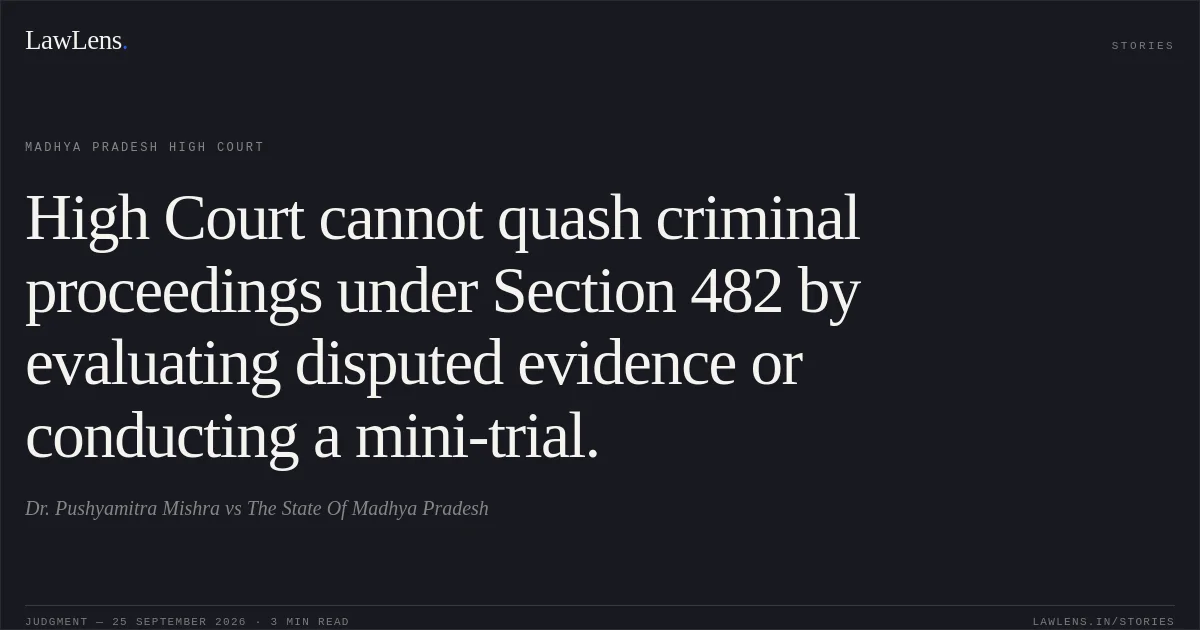
Source reference: paras. 7–10Relying on Amit Kapoor v. Ramesh Chander, as reiterated in Supriya Jain v. State of Haryana, and on State of Haryana v. Bhajan Lal, the Court held that quashing is justified where the allegations, taken at face value, do not constitute an offence, are inherently improbable, or disclose an express legal bar; the Court must not conduct a mini-trial or assess the reliability, sufficiency or admissibility of evidence.
Source reference: paras. 7–10The Court further relied on Mahendra K.C. v. State of Karnataka, State of Maharashtra v. Maroti, Rajeev Kourav v. Baisahab, and Manik B. v. Kadapala Sreyes Reddy, for the principle that the High Court cannot test the veracity of allegations or appreciate trial evidence in a Section 482 proceeding.
Source reference: paras. 13, 17–18An FIR is not required to contain every detail of the prosecution case, and absence of a specific role in the FIR is not by itself a ground for quashing.
Source reference: para. 19Reasoning
The Court held that the allegations in the FIR and the prosecution material disclosed a prima facie case involving forgery, cheating, misappropriation and conspiracy.
Source reference: paras. 2, 16, 20The petitioner’s assertions regarding his resignation from the society, lack of authority over the bank account, absence of handwriting evidence, and the contents of enquiry reports were matters of defence and involved disputed questions of fact.
Source reference: paras. 2, 16, 20These issues could not be conclusively determined by examining documents relied upon by the petitioner or by assessing the credibility of prosecution witnesses in a petition under Section 482 CrPC.
Source reference: paras. 16–18, 20–23The absence of a detailed attribution in the FIR was not decisive because an FIR is not an encyclopaedia and the investigating agency may collect further particulars during investigation.
Source reference: para. 19Since more than 24 witnesses had already been examined and the trial was nearing completion, quashing the proceedings would improperly interfere with the trial and require an impermissible assessment of evidence.
Source reference: paras. 22, 25Holding
The Court answered the issues against the petitioner. It held that no ground was made out for quashing the FIR or the consequential criminal proceedings under Section 482 CrPC, particularly because the allegations disclosed a prima facie case, the petitioner’s objections raised disputed factual matters, and the trial was at an advanced stage.
The petition was accordingly dismissed, with a direction that the Trial Court decide the matter independently and uninfluenced by the observations made in the quashing proceedings.
Source reference: paras. 27–28Acts & Sections Cited
20 provisions across 3 statutes referred to in this judgment. Each provision opens on LawLens.
Code of Criminal Procedure, 1973
Indian Penal Code, 1860
Prevention of Corruption Act, 19882
Original Court PDF
Dr. Pushyamitra MishravsThe State Of Madhya Pradesh
Click to open original judgment
Original judgment, available to read, download and summarize on LawLens.in