Facts
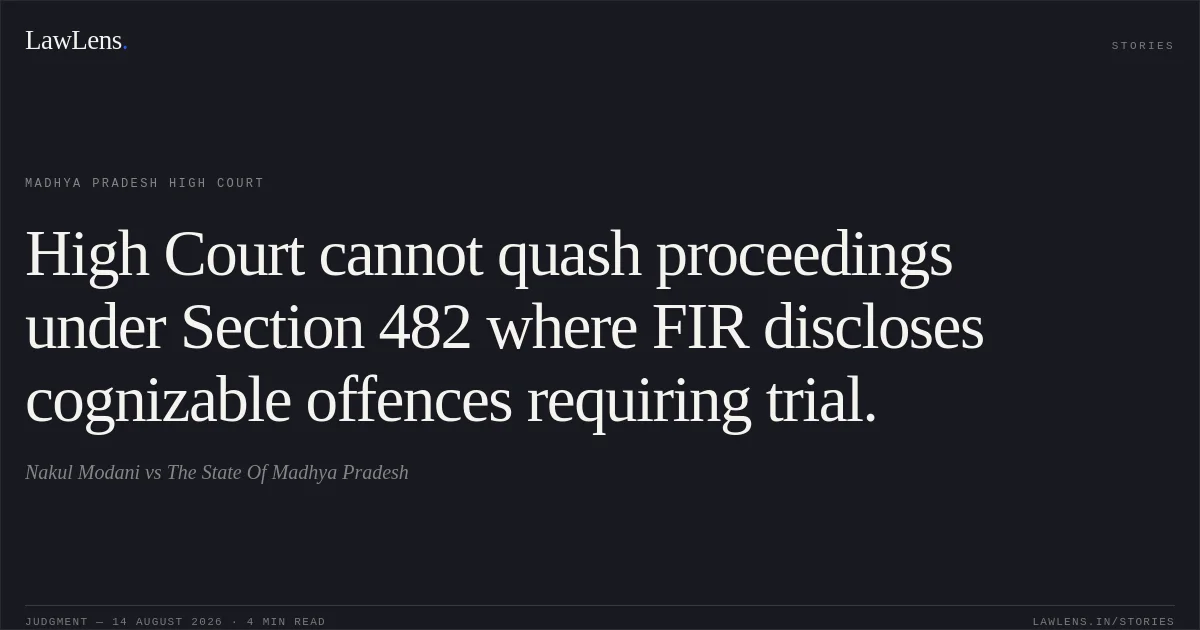
Respondent No. 2 awarded a sub-contract for road construction to the petitioner and co-accused Purushottam Madani and allegedly paid an advance of ₹50 lakh. The prosecution alleged that the petitioner and co-accused neither commenced the work nor returned the advance amount, resulting in registration of Crime No. 273/2018 at Police Station Ratibad, Bhopal, for offences under Sections 420, 406, 409, 506, 507 read with Section 120-B of the IPC
Source reference: para. 2, p. 2The petitioner claimed that he had no role in the agreement, that he was implicated merely because he was the nephew of the co-accused, and that the dispute was essentially contractual and civil in nature
Source reference: para. 3, pp. 2–3Following investigation, a charge-sheet was filed and charges were framed against the petitioner
Source reference: para. 4, pp. 3–4The petitioner invoked the inherent jurisdiction of the High Court under Section 482 CrPC/Section 528 BNSS seeking quashing of the FIR and all consequential proceedings
Source reference: para. 1, p. 1Issues
Whether the allegations in the FIR and the material collected during investigation disclosed the commission of cognizable offences against the petitioner so as to justify continuation of the criminal proceedings
Source reference: paras. 9–12, pp. 5–10Whether the alleged contractual dispute was purely civil in nature and therefore warranted quashing of the FIR and subsequent proceedings under the inherent jurisdiction of the High Court
Source reference: paras. 6–8, pp. 4–5Whether the High Court could examine the petitioner’s defence, assess the reliability of the prosecution material, or undertake appreciation of evidence at the stage of a petition under Section 482 CrPC
Source reference: paras. 13–15, pp. 9–11Law Applied
The Court applied the inherent jurisdiction under Section 482 CrPC, read with Section 528 BNSS, for preventing abuse of process and securing the ends of justice
Source reference: para. 1, p. 1It relied on State of Haryana v. Bhajan Lal, 1992 Supp (1) SCC 335, and Neeharika Infrastructure (P) Ltd. v. State of Maharashtra, (2021) 19 SCC 401, which establish that FIRs should ordinarily not be quashed where they disclose a cognizable offence; quashing is an exceptional remedy, and the Court should not assess the reliability or genuineness of allegations or conduct a detailed evidentiary inquiry at that stage
Source reference: para. 9, pp. 5–9Under Amit Kapoor v. Ramesh Chander, (2012) 9 SCC 460, the availability of a civil remedy does not bar criminal proceedings where the allegations also disclose a criminal offence
Source reference: para. 6, p. 4M/s Technofab Engineering Ltd. v. Bengal Mills Stores Supply Co., 2016 Criminal L.R. 887, recognizes that a contractual dispute may simultaneously constitute a civil wrong and a criminal offence, the relevant test being whether the allegations disclose a criminal offence
Source reference: para. 7, pp. 4–5The Court also relied on Teeja Devi v. State of Rajasthan, (2014) 15 SCC 221, against interference with a police investigation where the truth of the allegations requires examination, and Mohd. Akram Siddiqui v. State of Bihar, (2019) 13 SCC 350, regarding the limited consideration of defence documents in proceedings under Section 482 CrPC
Source reference: paras. 11, 13, pp. 9–10Reasoning
The Court held that the allegations that the petitioner and co-accused obtained ₹50 lakh as an advance pursuant to a sub-contract, failed to commence the construction work, and did not return the money were sufficient, at the prima facie stage, to disclose the alleged offences
Source reference: paras. 8, 14, pp. 5, 10Although the transaction arose from a construction contract and could give rise to civil remedies, that circumstance did not exclude criminal liability where the allegations suggested cheating, criminal breach of trust, conspiracy, and related offences
Source reference: paras. 6–8, pp. 4–5The charge-sheet and other material collected during investigation were found sufficient to connect the petitioner with the alleged offences
Source reference: para. 14, p. 10The petitioner’s assertions regarding his lack of involvement, delay in lodging the FIR, and the contractual nature of the dispute were treated as matters of evidence and defence, which could not be adjudicated by undertaking an appreciation of evidence in proceedings under Section 482 CrPC
Source reference: paras. 3, 14–15, pp. 2–3, 10–11Applying the restrictive principles governing quashing, the Court found that this was not a case in which the FIR was manifestly false, baseless, or incapable of disclosing any offence
Source reference: paras. 12, 15, pp. 9–11Holding
The High Court answered the issues against the petitioner. It held that the FIR and the investigation material disclosed a prima facie case, that the contractual character of the dispute did not justify quashing, and that the petitioner’s defence could be tested only at trial
The petition seeking quashing of Crime No. 273/2018, the charge-sheet, and all consequential criminal proceedings was dismissed as meritless
Source reference: para. 17, p. 11The Court clarified that its observations were confined to deciding the quashing petition and would not influence the trial court, which was directed to decide the matter independently in accordance with law
Source reference: para. 16, p. 11Acts & Sections Cited
9 provisions across 3 statutes referred to in this judgment. Each provision opens on LawLens.
Code of Criminal Procedure, 19733
Bharatiya Nagarik Suraksha Sanhita, 20231
Indian Penal Code, 18605
Original Court PDF
Nakul ModanivsThe State Of Madhya Pradesh
Click to open original judgment
Original judgment, available to read, download and summarize on LawLens.in