Facts
The petitioner, a registered dealer engaged in trading cement and allied goods, was subjected to scrutiny proceedings under Section 61 of the Bihar Goods and Services Tax Act, 2017 (“BGST Act”) for the period July 2017 to March 2018.
Source reference: p. 2, paras. 2–3A show-cause notice in Form GST DRC-01 was issued on 7 December 2022, followed by an assessment order and demand in Form GST DRC-07 dated 7 February 2023 under Section 73(9) of the BGST Act.
Source reference: p. 2, paras. 2–3The petitioner filed an appeal under Section 107 on 2 April 2024, challenging the order dated 7 February 2023.
Source reference: p. 2, para. 4The Appellate Authority rejected the appeal at the admission stage as being beyond the prescribed limitation period and beyond its power to condone delay under Section 107(4).
Source reference: p. 2, para. 5The writ petition was filed on 24 March 2026, approximately three years after the original assessment order.
Source reference: p. 4, para. 9Issues
Whether the writ petition should be rejected on the grounds of delay and availability of an alternative statutory remedy under the BGST Act?
Source reference: p. 4, para. 8(i)Whether the High Court, exercising jurisdiction under Article 226 of the Constitution, could condone delay beyond the further one-month period permitted under Section 107(4) of the BGST Act?
Source reference: p. 4, para. 8(ii)Law Applied
Section 107(1) and (4) of the BGST Act, under which an appeal must be filed within three months from communication of the order, with the Appellate Authority empowered to condone delay only for a further period of one month.
Source reference: p. 8, para. 9.1CIT v. Chhabil Dass Agrawal holds that a writ petition ordinarily should not be entertained where an efficacious statutory remedy exists.
Source reference: p. 4, para. 9Assistant Commissioner (CT) LTU, Kakinada v. Glaxo Smith Kline Consumer Health Care Ltd., (2020) 19 SCC 681, holds that statutory limitation provisions reflecting legislative policy cannot be bypassed through writ jurisdiction, and that what cannot be done even under Article 142 cannot ordinarily be achieved under Article 226.
Source reference: pp. 5–6, 9–11, paras. 9, 10Writ jurisdiction may nevertheless be invoked in exceptional cases involving breach of fundamental rights, violation of natural justice, lack of jurisdiction, or challenge to the vires of legislation.
Source reference: p. 8, para. 9.2Section 162 of the BGST Act and the appellate scheme under Sections 112 and 117 were considered indicative of the legislature’s intention to prescribe specific and limited periods for pursuing statutory remedies.
Source reference: pp. 11–12, paras. 10.1–10.2Reasoning
Even assuming the petitioner’s contention regarding delayed communication of the assessment order, the writ petition itself was filed after an unexplained delay of nearly three years.
Source reference: p. 6, para. 9.1Section 107 provided a specific appellate remedy within three months, extendable only by one further month; the petitioner’s appeal was filed substantially beyond that condonable period and was consequently rejected by the Appellate Authority.
Source reference: p. 2, paras. 4–5Permitting the petitioner to revive the time-barred statutory appeal through Article 226 would defeat the legislative scheme prescribing definite limitation periods and would render Section 107(4) ineffective.
Source reference: pp. 8–9, para. 9.2; pp. 12–13, para. 10.3Although Article 226 remains available in exceptional circumstances, the petitioner had not established breach of natural justice, excess of jurisdiction, violation of fundamental rights, or any challenge to the vires of the statute.
Source reference: p. 8, para. 9.2; p. 14, para. 12The Court also relied on the Patna High Court’s decisions in M/s Vishwanath Traders, M/s Adarsh Construction, and M/s D.K. Jamuar and Co., which disfavoured entertaining belated writ petitions against GST orders or appellate orders rejecting delayed appeals.
Source reference: p. 13, para. 11Holding
The Court answered both issues against the petitioner.
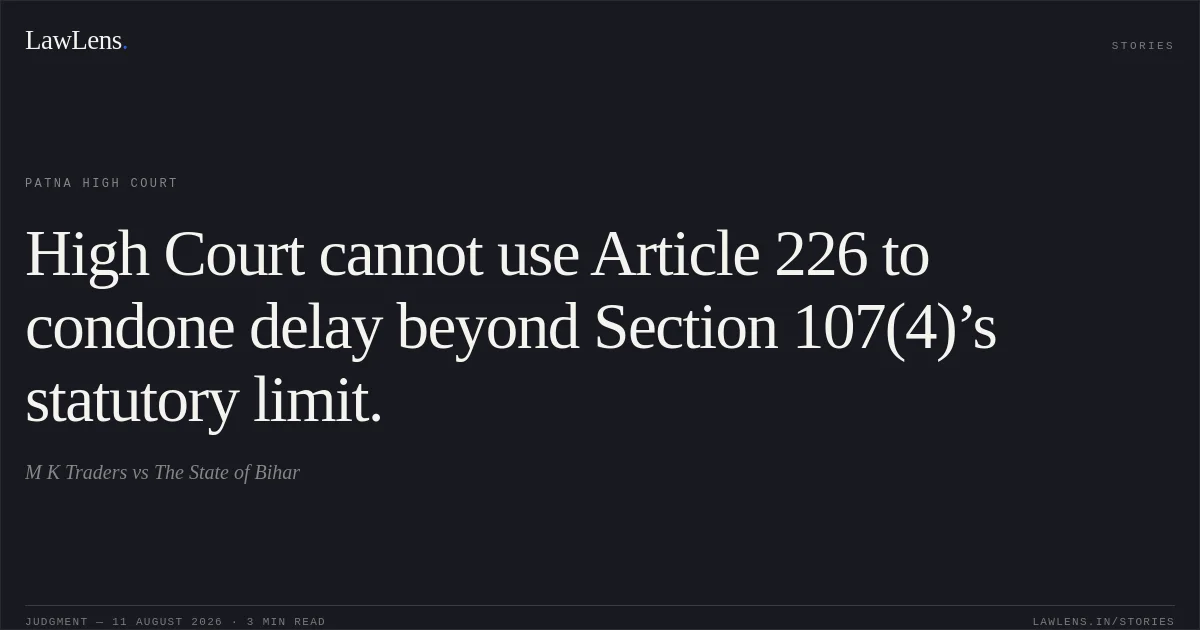
The High Court could not use Article 226 to condone delay beyond the period permitted by Section 107(4) of the BGST Act or to circumvent the statutory appellate scheme.
Source reference: p. 14, para. 12While writ jurisdiction remains maintainable in exceptional cases involving jurisdictional error, breach of natural justice, violation of fundamental rights, or challenge to statutory validity, the present petition—filed nearly three years after the assessment order and without sufficient explanation—was not entertainable.
Source reference: p. 14, para. 12The writ petition was accordingly dismissed.
Source reference: p. 14, para. 12Acts & Sections Cited
18 provisions across 3 statutes referred to in this judgment. Each provision opens on LawLens.
BIHAR GOODS AND SERVICES TAX ACT, 2017
Electricity Act, 20031
Limitation Act, 19633
Original Court PDF
M K TradersvsThe State of Bihar
Click to open original judgment
Original judgment, available to read, download and summarize on LawLens.in