Facts
The petitioner applied for allotment of a Public Distribution System (“PDS”) shop for Khutha Panchayat, Alauli Block, Khagaria, and was placed at Serial No. 3 in the provisional merit list.
Source reference: p. 2, para. 2Private respondent no. 9, placed at Serial No. 2, was allotted the PDS shop. The petitioner alleged that respondent no. 9 was ineligible because he held the post of Secretary of the Gram Panchayat and his mother held a post in a PACS.
Source reference: p. 2, para. 2The petitioner submitted an objection before the District Supply Officer, Khagaria, on 7 September 2018, and thereafter approached the District Collector seeking cancellation of the allotment. No action was taken on these representations, leading to the filing of the writ petition.
Source reference: p. 2, para. 2; p. 3, para. 4Issues
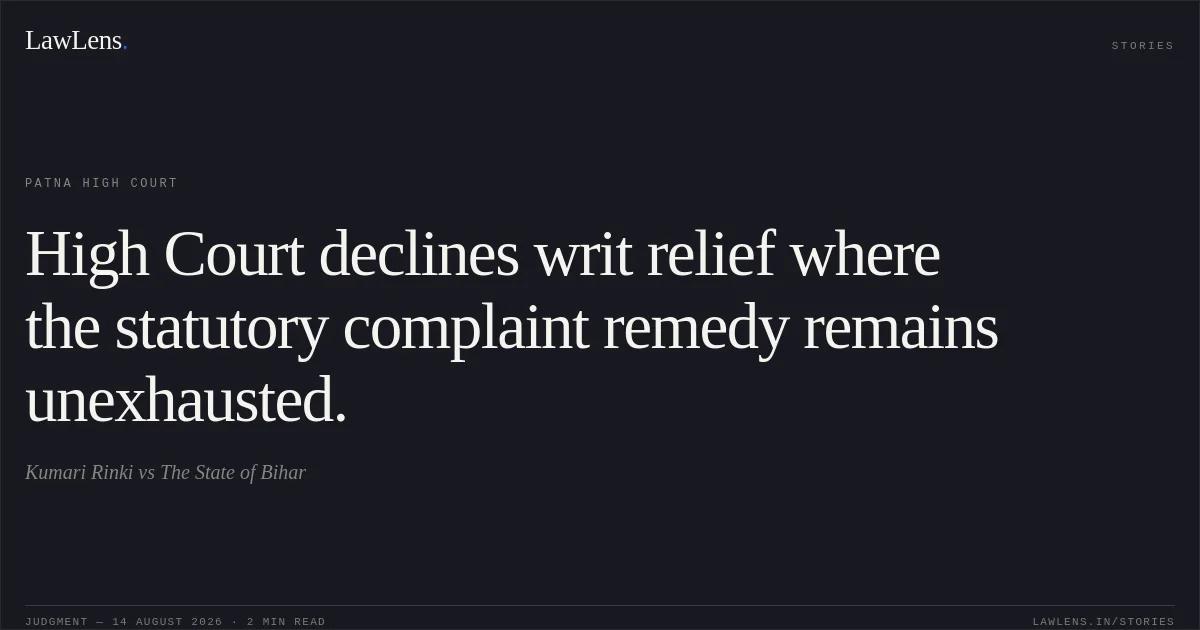
Whether the petitioner could directly invoke the writ jurisdiction of the High Court without first availing the statutory remedy of filing a complaint before the Divisional Commissioner under Rule 5 of the Bihar Targeted Public Distribution System (Control) Order, 2016.
Source reference: p. 6, para. 6–7Whether, after expiry of the prescribed limitation period, the petitioner could be permitted to file such a complaint, with the delay being condoned by the competent authority.
Source reference: p. 7–8, paras. 8–10Law Applied
The Court applied Rule 5 of the Bihar Targeted Public Distribution System (Control) Order, 2016. Under Rule 5, the District-Level Selection Committee prepares and publishes the merit list, and aggrieved applicants may submit claims or objections before the District Supply Officer within 15 days.
Source reference: pp. 3–7, para. 5Against the final merit list, an aggrieved applicant must file a complaint before the Divisional Commissioner within 15 days, stating clear reasons and supporting evidence; the Divisional Commissioner is required to decide the complaint within 30 days, and the decision is final.
Source reference: pp. 3–7, para. 5The Court further applied the principle that where an effective alternative statutory remedy is available, the writ petition ordinarily should not be entertained without exhaustion of that remedy.
Source reference: p. 7–8, paras. 6–8Reasoning
The Court held that the petitioner’s objection before the District Supply Officer did not constitute the remedy prescribed for challenging the final merit list.
Source reference: p. 7, para. 7Under Rule 5, the District Supply Officer had no adjudicatory role in deciding the petitioner’s grievance after the final merit-list stage; the appropriate forum was the Divisional Commissioner.
Source reference: p. 7, para. 7Since the petitioner had not pursued that statutory remedy, the writ petition seeking direct cancellation of respondent no. 9’s allotment and allotment of the shop to the petitioner was premature in view of the available alternative remedy.
Source reference: p. 7–8, paras. 8–9However, considering the petitioner’s submission that she intended to approach the competent authority but that the limitation period had expired, the Court afforded her an opportunity to file the complaint and directed that the delay be condoned.
Source reference: p. 8, paras. 9–10Holding
The writ petition was disposed of without adjudicating the merits of the petitioner’s allegations regarding respondent no. 9’s eligibility or the validity of the allotment.
The petitioner was directed to file a complaint before the Divisional Commissioner within one month from receipt of the order.
Source reference: p. 8, para. 10The competent authority was directed to condone the delay and decide the complaint, in accordance with law, within three months from its filing.
Source reference: p. 8, para. 10All pending interlocutory applications, if any, were also disposed of.
Source reference: p. 8, para. 12Acts & Sections Cited
1 provisions across 1 statute referred to in this judgment. Each provision opens on LawLens.
Limitation Act, 19631
Original Court PDF
Kumari RinkivsThe State of Bihar
Click to open original judgment
Original judgment, available to read, download and summarize on LawLens.in