Facts
During a 1971 survey for the 'Goregaon-Mulund Link Road' project, land bearing CTS No. 699 was inadvertently recorded as CTS No. 611.
Source reference: para. 3This error persisted in the final notification and award, creating a discrepancy where CTS No. 611 (actually 438.50 sq. meters) was recorded as 5580 sq. meters.
Source reference: paras. 3-4, 6The Petitioner faced hardships in slum rehabilitation proceedings, as the property card wrongly indicated that CTS No. 611 had been acquired.
Source reference: para. 7The City Survey Officer admitted the error in formal correspondence (Exhibit-P), but the District Superintendent of Land Records dismissed an appeal for rectification on 08.07.2025.
Source reference: paras. 8-10Issues
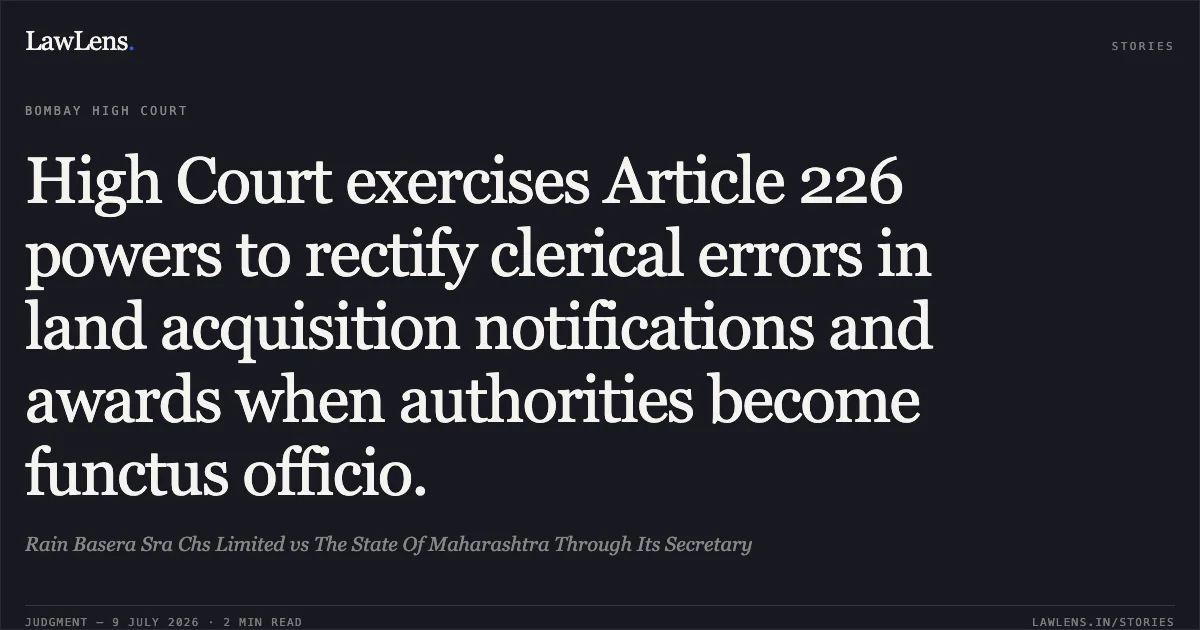
Whether the High Court, in the exercise of its jurisdiction under Article 226 of the Constitution of India, can rectify an inadvertent clerical error in a statutory notification and award after the authorities have become functus officio.
Source reference: para. 12Law Applied
The Court primarily applied Article 226 of the Constitution of India regarding the High Court's extraordinary writ jurisdiction to prevent injustice.
Source reference: para. 13Constitutional Courts' powers cannot be fettered by alternate remedies or statutory bars when an "anathema to the Rule of Law" occurs, as established in Neha Shroff v. The State of Maharashtra.
Source reference: para. 14The precedent in Smt. Sushila Shivram Patil & Ors. v. Deputy Collector held that while a Collector might be barred by limitation (e.g., Section 13A of the Land Acquisition Act, 1894 or Section 33 of the 2013 Act) from correcting awards, the High Court can exercise its power to correct obvious clerical/typographical errors to ensure a party is not left remediless.
Source reference: para. 14Reasoning
The Court noted that the error was a "genuine and bona-fide mistake" arising from oversight during the initial survey in 1971.
Source reference: para. 13The State argued that Respondent No. 2 was functus officio and lacked the statutory power to amend a decades-old award.
Source reference: para. 11The Court reasoned that the Petitioner could not be left "remediless" due to a technical bar of limitation or lack of statutory authority in the executive.
Source reference: para. 13By applying the logic from Sushila Shivram Patil, the Court determined that its extraordinary jurisdiction allows it to strike down administrative injustices and correct admitted clerical errors that result in "serious hardship".
Source reference: paras. 6, 14-15Holding
The Court allowed the petition, holding that clerical errors in land acquisition documents can be corrected under Article 226 despite the lapse of time.
The Court directed: (i) Respondent No. 1 to substitute CTS No. 699 for CTS No. 611 in the 1973 Notification; (ii) Respondent No. 2 to perform the same substitution in the 1975 Award; and (iii) Respondent No. 3 to delete the erroneous entry from the Revenue Records and Property Register Card within six weeks.
Source reference: para. 16Acts & Sections Cited
4 provisions across 4 statutes referred to in this judgment. Each provision opens on LawLens.
Maharashtra Regional and Town Planning Act, 1966.1
Maharashtra Slum Areas (Improvement, Clearance and Redevelopment) Act, 19711
Maharashtra Land Revenue Code, 19661
Right to Fair Compensation and Transparency in Land Acquisition, Rehabilitation and Resettlement Act, 20131
Original Court PDF
Rain Basera Sra Chs LimitedvsThe State Of Maharashtra Through Its Secretary
Click to open original judgment
Original judgment, available to read, download and summarize on LawLens.in