Facts
The applicants sought the quashing of a charge-sheet and a summoning order dated 07.04.2026 passed by the ACJM, Kashipur in Criminal Case No. 778 of 2026.
Source reference: para. 4The FIR was lodged by respondent no. 2 alleging that on 15.02.2025, the applicants entered his residence, abused his family, issued death threats, and fired shots from a licensed firearm.
Source reference: para. 5Following investigation, a charge-sheet was filed for offences under Sections 125, 351(2), and 352 of the Bharatiya Nyaya Sanhita (BNS), 2023, and Section 25(9) of the Arms Act.
Source reference: para. 4Subsequently, the parties settled the dispute amicably through a joint compounding application (I.A. No. 1 of 2026), stating the compromise was voluntary and the complainant no longer wished to prosecute.
Source reference: para. 6, 7Issues
1. Whether the High Court can exercise its inherent powers to quash criminal proceedings involving non-compoundable offences on the basis of an amicable settlement between the parties.
Source reference: para. 122. Whether the continuance of criminal proceedings in a private dispute, where a compromise has been reached and no physical injury occurred, amounts to an abuse of the process of law.
Source reference: para. 11, 13Law Applied
The Court applied the inherent powers of the High Court under Section 528 of the Bharatiya Nagarik Suraksha Sanhita (BNSS), 2023 (corresponding to Section 482 of the Cr.P.C.), which allows for the quashing of proceedings to secure the ends of justice.
Source reference: para. 12It relied on the landmark precedents of Gian Singh v. State of Punjab, Narinder Singh v. State of Punjab, and Parbatbhai Aahir v. State of Gujarat, which established that even in non-compoundable cases, the High Court may quash proceedings if the dispute is predominantly private/personal in nature and a settlement has been reached.
Source reference: para. 12Reasoning
The Court observed that the dispute between the parties arose from personal discord and was essentially private in nature.
Source reference: para. 11Upon interacting with respondent no. 2, the Court satisfied itself that the compromise was genuine, voluntary, and free from coercion.
Source reference: para. 8, 11Although the State counsel noted that some offences were non-compoundable, the Court emphasized that no person sustained injuries during the incident and the firearm involved had already been seized by authorities.
Source reference: para. 6, 9The Court reasoned that because the parties are now living peacefully and the complainant does not wish to pursue the matter, the possibility of conviction is remote; therefore, allowing the trial to continue would be a futile exercise and an abuse of the judicial process.
Source reference: para. 13Holding
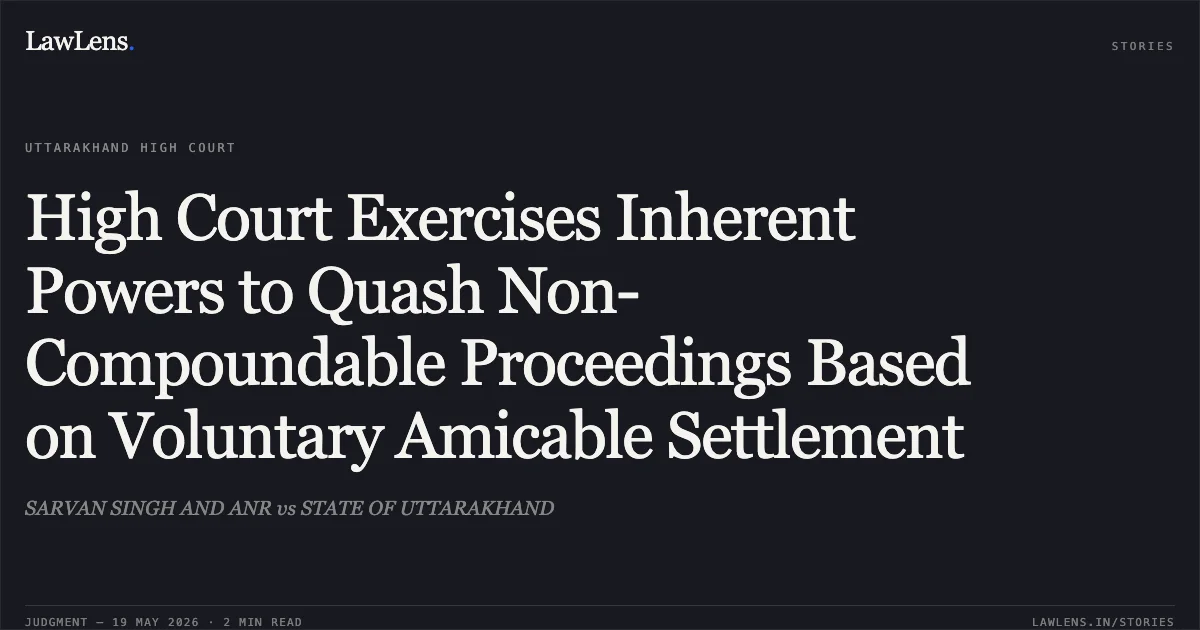
The Court allowed the compounding application (I.A. No. 1 of 2026) and quashed the charge-sheet, summoning order dated 07.04.2026, and the entire proceedings of Criminal Case No. 778 of 2026.
The Court clarified that this order does not influence administrative proceedings regarding the applicants' firearm license, leaving the District Magistrate free to decide on its status independently. The C-528 application was accordingly allowed.
Source reference: para. 17, 16Acts & Sections Cited
6 provisions across 4 statutes referred to in this judgment. Each provision opens on LawLens.
Bharatiya Nyaya Sanhita, 20233
Arms Act, 19591
Code of Criminal Procedure, 19731
Bharatiya Nagarik Suraksha Sanhita, 20231
Original Court PDF
SARVAN SINGH AND ANRvsSTATE OF UTTARAKHAND
Click to open original judgment
Original judgment, available to read, download and summarize on LawLens.in