Facts
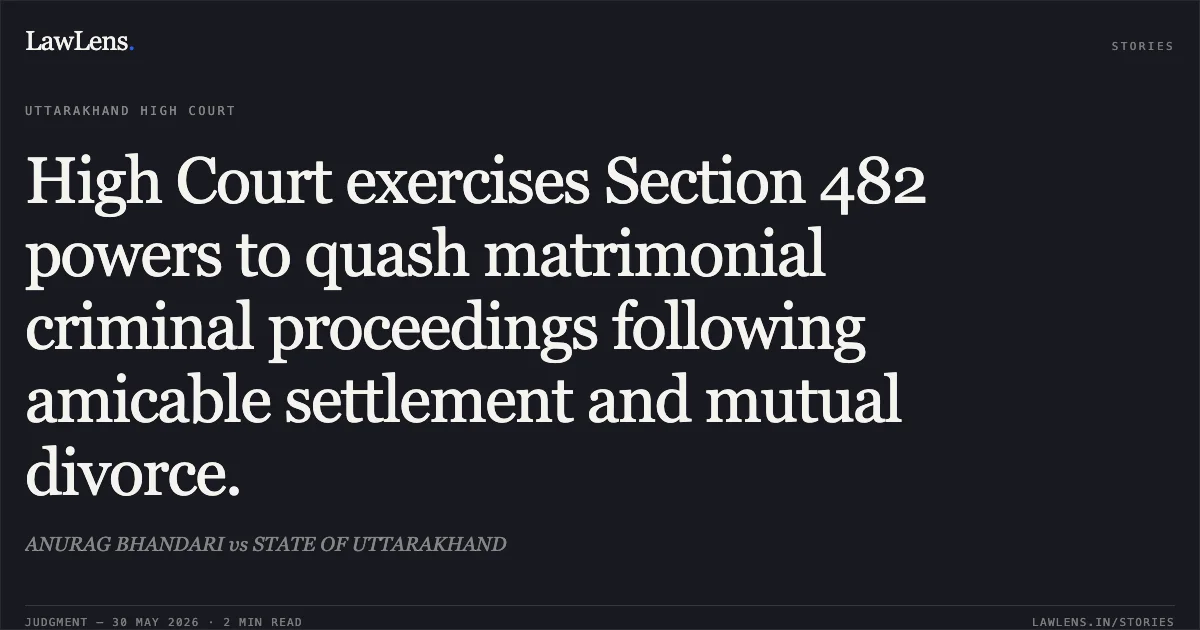
The applicant (husband) and respondent no. 3 (wife) were involved in a matrimonial dispute that led to the filing of an F.I.R. and a subsequent chargesheet under Section 498-A of the I.P.C.
Source reference: para. 4-5On 03.12.2025, the Additional Chief Judicial Magistrate, Dehradun, took cognizance and issued a summoning order in Criminal Case No. 7847 of 2025.
Source reference: para. 4During the pendency of the case, the parties reached an amicable settlement involving a total payment of ₹14,00,000 by the husband to the wife and the filing of a divorce petition under Section 27 of the Uniform Civil Code, Uttarakhand.
Source reference: para. 6The wife appeared via video conferencing, confirmed the voluntary nature of the settlement, and stated she had no objection to quashing the proceedings.
Source reference: para. 7Issues
1. Whether the High Court can exercise its inherent powers under Section 482 Cr.P.C. to quash criminal proceedings for a non-compoundable offence (Section 498-A I.P.C.) based on a private matrimonial settlement.
Source reference: para. 8-9Law Applied
Section 482 of the Code of Criminal Procedure (Cr.P.C.) regarding the inherent powers of the High Court to prevent abuse of the process of law.
Source reference: para. 9Gian Singh v. State of Punjab, which established that non-compoundable offences of a private nature can be quashed if settled amicably.
Source reference: para. 10Narinder Singh v. State of Punjab, which emphasized quashing cases of a "predominantly civil character" like matrimonial disputes.
Source reference: para. 11State of Madhya Pradesh v. Laxmi Narayan, which clarified that such power extends to family matters unless the offence involves "heinous and serious mental depravity".
Source reference: para. 12Parbatbhai Aahir v. State of Gujarat regarding the evaluation of whether quashing secures the "ends of justice".
Source reference: para. 12Reasoning
The Court observed that while Section 498-A is technically non-compoundable under Section 320 Cr.P.C., the dispute at hand was purely personal, arising from matrimonial discord with no adverse impact on public interest or society.
Source reference: para. 9The Court noted the parties' active steps toward resolving their legal ties through the Uniform Civil Code and the partial payment of the settlement amount (₹5,00,000 paid of ₹14,00,000).
Source reference: para. 6-7By applying the principles from Gian Singh and Narinder Singh, the Court reasoned that since the wife (the complainant) unequivocally consented to the quashing and the dispute was not "heinous," continuing the criminal trial would be a futile exercise and a waste of judicial resources.
Source reference: para. 13Holding
The Court answered the issue in the affirmative, holding that quashing the proceedings was necessary to secure the ends of justice.
The compounding application was allowed, and the chargesheet, cognizance order dated 03.12.2025, and the entire proceedings of Criminal Case No. 7847 of 2025 under Section 498-A I.P.C. were quashed.
Source reference: para. 14All pending applications were disposed of accordingly.
Source reference: para. 15Acts & Sections Cited
2 provisions across 1 statute referred to in this judgment. Each provision opens on LawLens.
Code of Criminal Procedure, 19732
Original Court PDF
ANURAG BHANDARIvsSTATE OF UTTARAKHAND
Click to open original judgment
Original judgment, available to read, download and summarize on LawLens.in