Facts
The appellant, Roshan, and the survivor, Anjali, were involved in a consensual romantic relationship while Anjali was a minor (approx. 14 years old).
Source reference: para 4, 11Their physical relationship resulted in two pregnancies (in 2017 and 2019), both reported to the police by hospital authorities as required by law, though neither Anjali nor her family lodged complaints.
Source reference: para 5, 7, 22Roshan was convicted in two separate trials under Section 6 of the POCSO Act and sentenced to ten years of rigorous imprisonment in each case.
Source reference: para 2, 3Upon attaining majority, Anjali married Roshan, and they currently live as a family with two children, aged 9 and 7.
Source reference: para 11, 28Anjali filed applications (CRAN/3/2026) seeking to quash the convictions to protect her matrimonial life and the children's welfare.
Source reference: para 27, 28Issues
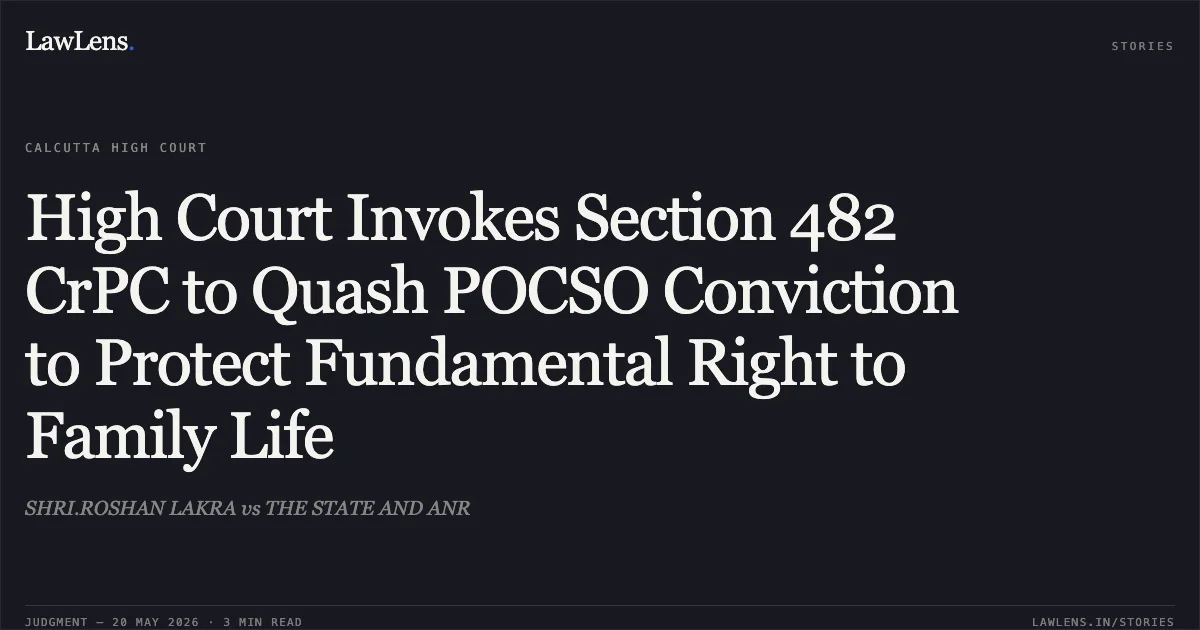
1. Whether the High Court can exercise its inherent powers under Section 482 of the Cr.P.C. to quash a conviction for a non-compoundable offence under the POCSO Act in the interest of justice and matrimonial harmony.
Source reference: para 29, 352. Whether the fundamental right to life and personal liberty under Article 21 of the Constitution overrides the statutory rigidity of the POCSO Act in cases of genuine adolescent relationships.
Source reference: para 34, 43Law Applied
The court applied Section 482 of the Cr.P.C., which saves the inherent powers of the High Court to prevent abuse of the process of law and secure the ends of justice.
Source reference: para 35, 39It relied on Article 21 of the Constitution, affirming the right to marry a person of one's choice as established in Shafin Jahan v. Asokan K.M. and Lata Singh v. State of U.P.
Source reference: para 34The court followed Ramgopal v. State of M.P., which allows quashing non-compoundable criminal proceedings of a private nature if parties have settled.
Source reference: para 40-41Furthermore, it cited Mahesh Mukund Patel v. State of U.P. and K. Kirubakaran v. State of Tamil Nadu, where the Supreme Court quashed POCSO proceedings to preserve family units in cases of consensual love rather than lust.
Source reference: para 38Reasoning
The court found that the relationship was rooted in mutual affection rather than carnal lust, noting that Anjali expressly testified to wanting to be the mother of the appellant's children.
Source reference: para 21, 24It observed that the Trial Courts were bound by the "rigidity" of the POCSO Act, which criminalizes all sex with minors regardless of consent.
Source reference: para 23, 31However, the High Court determined that strict adherence to the letter of the law would lead to the "annihilation" of a happy family and render the survivor and her children destitute.
Source reference: para 26, 32Applying Section 482 Cr.P.C., the court reasoned that because the survivor is now the appellant's wife and they have a stable family, continuing the prosecution would constitute an abuse of process.
Source reference: para 35, 43It held that the "final cause of law is the welfare of society" and that the court must strike a balance between deterrence and rehabilitation.
Source reference: para 37, 38Holding
The court answered the issues in the affirmative, holding that the interests of justice and the protection of the family unit under Article 21 must prevail over statutory technicalities.
The High Court quashed the entire proceedings in Special Case No. 18 of 2017 and Special (POCSO) Case No. 12 of 2019, including the convictions and sentences passed against Roshan.
Source reference: para 44The appellant’s bail bonds were discharged, and both appeals were disposed of in favor of the appellant.
Source reference: para 44, 45Acts & Sections Cited
6 provisions across 3 statutes referred to in this judgment. Each provision opens on LawLens.
Protection of Children from Sexual Offences Act, 20121
Code of Criminal Procedure, 19734
Narcotic Drugs and Psychotropic Substances Act, 19851
Original Court PDF
SHRI.ROSHAN LAKRAvsTHE STATE AND ANR
Click to open original judgment
Original judgment, available to read, download and summarize on LawLens.in


![Subsequent exoneration does not retrospectively invalidate a finalized promotion select list.. UNNIKRISHNAN M vs M/o Environment And Forests. CAT - ['Ernakulam']. LawLens](/stories/thumbnails/subsequent-exoneration-does-not-retrospectively-invalidate-a-finalized-promotion-select-li-ce80a0e84f2f4887857271e8b4341c42.webp)