01Facts
The revisionist, Sushil Mewar, was convicted under Section 138 of the Negotiable Instruments Act, 1881, by the A.C.J.M.-I (N.I. Act Special Court), Dehradun, on 29.06.2026 in Complaint Case No. 3846 of 2015. He was sentenced to six months' simple imprisonment and directed to pay compensation of Rs. 3,00,000.
¶ 2His appeal (Criminal Appeal No. 176 of 2026) before the Sessions Judge, Dehradun, was dismissed for default or want of prosecution on 22.10.2026.
¶ 2He was on bail during trial and appeal and had not misused that bail.
¶ 3The revisionist was exempted from surrender before the trial court for filing the revision, relying on the Division Bench decision in Subham Singhal v. High Court of Uttarakhand (WPMB No. 84 of 2023).
¶ 4–5The revisionist and the complainant (respondent no. 2) jointly filed a compounding application supported by affidavits.
¶ 6Both confirmed through video conferencing that the dispute was amicably settled. The complainant confirmed receipt of the full cheque amount and fine, and the revisionist confirmed payment of all dues.
¶ 8–9The State did not object, as the dispute was inter se the parties, but relied on Damodar S. Prabhu v. Sayed Babalal H., (2010) 5 SCC 663, for a costs condition.
¶ 10The revisionist undertook to deposit the costs within one month.
¶ 1002Issues
i.1. Whether the revisionist, who was on bail throughout, is exempt from surrendering before the trial court as a precondition to filing the criminal revision.
¶ 3–5ii.2. Whether the offence under Section 138 N.I. Act may be compounded at the revisional stage, and if so, on what conditions, including payment of costs under Damodar S. Prabhu.
¶ 6–1103Law Applied
The Court relied on the surrender requirement and its exemption as laid down by the Division Bench in Subham Singhal v. High Court of Uttarakhand (WPMB No. 84 of 2023), under which a convicted accused who was on bail may be exempted from pre-filing surrender.
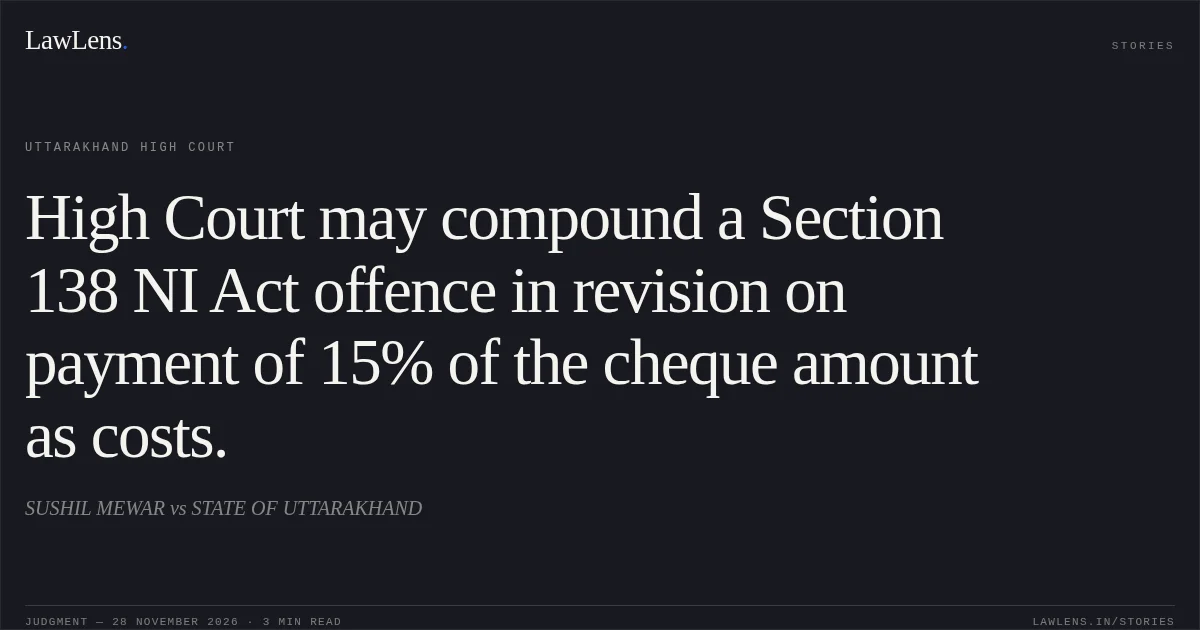
¶ 4For compounding, the Court relied on the Supreme Court's decision in Damodar S. Prabhu v. Sayed Babalal H., (2010) 5 SCC 663, which, as cited by the State, holds that where compounding of a Section 138 offence is sought before a Sessions Court or the High Court in revision or appeal, it may be allowed on the accused's payment of a percentage of the cheque amount as costs, stated in the judgment as 15%.
¶ 10Compounding was allowed under this framework, with the consent of both parties and the court's interaction with them.
¶ 8–9, 11Provisions in the judgment · 1 · Linked ones open on LawLens
Negotiable Instruments Act, 1881 Section 138
04Reasoning
The Court first accepted that the revisionist's conduct on bail, with no record of misuse, justified exemption from surrender, following Subham Singhal.
¶ 3–5Both parties confirmed a voluntary settlement and full payment of the cheque amount and fine, and the complainant stated he did not wish to prosecute.
¶ 8–9The State raised no objection because the dispute was between private parties.
¶ 10Because compounding was sought at the revisional stage after conviction, the Court applied the Damodar S. Prabhu costs condition and required the revisionist to pay 15% of the cheque amount, Rs. 22,500, to the State Legal Services Authority. The revisionist accepted this and undertook to deposit it within one month.
¶ 10–11Having found the settlement genuine and the costs condition satisfied in principle, the Court set aside the conviction and sentence.
¶ 1105Holding
The Court held that the revisionist is exempt from surrendering before the trial court for filing the revision.
¶ 5The compounding application was allowed. The judgment of conviction dated 29.06.2026 and the appellate order dated 22.10.2026 were set aside, subject to the revisionist depositing 15% of the cheque amount (Rs. 22,500) with the State Legal Services Authority within one month from 28.11.2026.
¶ 11The revision was disposed of accordingly.
¶ 12Original Court PDF
SUSHIL MEWARvsSTATE OF UTTARAKHAND
Click to open original judgment
Original judgment, available to read, download and summarize on LawLens.in