Facts
FIR No. 16/2016 was registered at Police Station Shahpura, District Jabalpur, against Applicant No. 1 for offences under Sections 354 and 323 of the Indian Penal Code. Following investigation, a charge-sheet was filed and the case proceeded as RCT No. 87/2016 before the JMFC, Patan. During trial, the accused and complainant entered into a compromise. The trial court accepted the compromise with respect to the compoundable offence under Section 323 IPC, but rejected it regarding Section 354 IPC, which is non-compoundable under Section 320 CrPC. By judgment dated 16 August 2023, Applicant No. 1 was convicted under Section 354 IPC and sentenced to one year’s simple imprisonment and a fine of ₹500
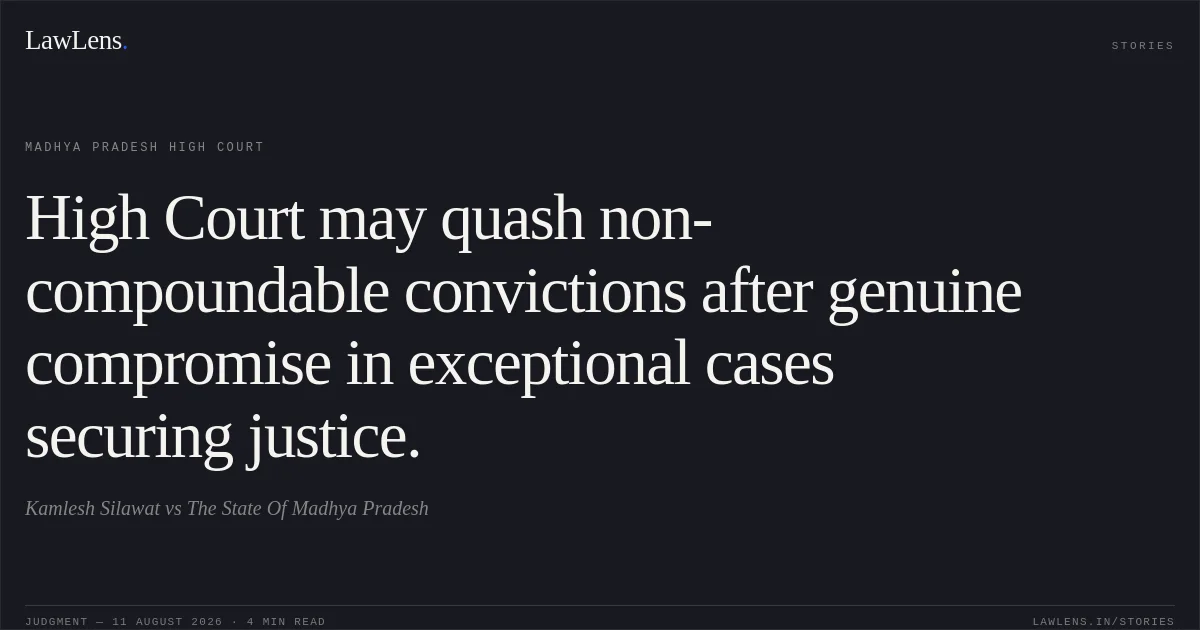
Source reference: p.1–2; paras. 1–2Applicant No. 1 filed Criminal Appeal No. 42/2023. During the appeal, the complainant again submitted that the dispute had been amicably resolved and that the compromise was voluntary and free from coercion. The appellate court rejected the application on 18 November 2025 solely on the ground that Section 354 IPC was non-compoundable. The accused and complainant thereafter jointly approached the High Court under Section 482 CrPC read with Section 528 of the Bharatiya Nagarik Suraksha Sanhita, 2023, seeking quashing of the conviction and criminal proceedings
Source reference: p.2; para. 3Issues
Whether the High Court may exercise its inherent jurisdiction under Section 482 CrPC/Section 528 BNSS to quash or set aside a conviction for a non-compoundable offence on the basis of a genuine and voluntary compromise between the accused and the complainant?
Source reference: p.3–5; paras. 7–10Whether, considering the age of the accused, the passage of time, the nature of the incident, and the complainant’s repeated consent to the compromise, continuation of the conviction under Section 354 IPC would amount to an abuse of process or fail to serve the ends of justice?
Source reference: p.5–7; paras. 11–13Law Applied
The Court held that the statutory power of compounding under Section 320 CrPC is distinct from the inherent jurisdiction preserved under Section 482 CrPC and continued under Section 528 BNSS; consequently, the non-compoundable character of an offence does not create an absolute bar to quashing where intervention is necessary to secure the ends of justice
Source reference: p.3; para. 7Relying on Gian Singh v. State of Punjab, (2012) 10 SCC 303, the Court applied the principle that proceedings involving non-compoundable offences may be quashed when the dispute is predominantly private and quashing would secure justice, subject to caution. Under Narinder Singh v. State of Punjab, (2014) 6 SCC 466, the Court considered the nature and gravity of the offence, the parties’ conduct, and the genuineness of the compromise
Source reference: p.3–4; para. 8Ishwar Singh v. State of Madhya Pradesh, (2008) 15 SCC 667 recognizes that a post-conviction compromise may be relevant to the relief granted
Source reference: p.4; para. 9Ramgopal v. State of Madhya Pradesh, (2022) 14 SCC 531 permits exercise of inherent jurisdiction beyond Section 320 CrPC, while requiring consideration of the offence’s effect on society, the seriousness of the injury, the voluntary nature of the compromise, and the accused’s conduct
Source reference: p.4–5; para. 9Reasoning
The Court found the compromise genuine and voluntary because it had been entered into during trial, reaffirmed by the complainant before the appellate court, and supported by the parties’ affidavits
Source reference: p.5–6; para. 11It also considered that the incident occurred in 2016, approximately ten years had elapsed, and Applicant No. 1 was about 18 years and 5 months old at the relevant time
Source reference: p.5; para. 11The dispute arose from a single incident and involved no allegation of organized crime, repeated criminal conduct, public corruption, or any overriding societal consequence
Source reference: p.6; para. 12Although the Court recognized that an offence under Section 354 IPC concerns a woman’s dignity and ordinarily should not be quashed merely because of a settlement, it held that the cumulative circumstances—including the accused’s age, the nature of the incident, the complainant’s consistent stand, and the prolonged litigation—placed the case within the exceptional category warranting interference under Section 528 BNSS
Source reference: p.6–7; para. 13Holding
The High Court answered the issues in the affirmative and allowed the joint petition. It set aside the judgment of conviction and order of sentence dated 16 August 2023 in RCT No. 87/2016 and acquitted Applicant No. 1 of the offence under Section 354 IPC on the basis of the voluntary compromise and in exercise of its inherent jurisdiction to secure the ends of justice
Any bail bonds were directed to stand discharged, the fine was to be dealt with according to law, and the pending criminal appeal, if still pending, was rendered infructuous
Source reference: p.8; para. 15Acts & Sections Cited
5 provisions across 3 statutes referred to in this judgment. Each provision opens on LawLens.
Code of Criminal Procedure, 19732
Bharatiya Nagarik Suraksha Sanhita, 20231
Indian Penal Code, 18602
Original Court PDF
Kamlesh SilawatvsThe State Of Madhya Pradesh
Click to open original judgment
Original judgment, available to read, download and summarize on LawLens.in