Facts
The petitioners, who were the complainant’s in-laws and other relatives, challenged the order dated 1 June 2016 by which the Sub-Divisional Judicial Magistrate, Saran at Chapra rejected their discharge application under Section 245 of the Code of Criminal Procedure, 1973, in Trial No. 1025 of 2016 arising from Complaint Case No. 596 of 2011.
Source reference: p. 2, para. 3The complainant alleged that, after her marriage on 5 June 2006, she was subjected to physical and mental cruelty and dowry demands of ₹3,00,000, ornaments, television, washing machine and other articles.
Source reference: pp. 3–4, para. 4She further alleged that the accused administered medicines to her, resulting in an abortion, and thereafter compelled her to leave the matrimonial home.
Source reference: pp. 3–4, para. 4The Magistrate had taken cognizance of offences under Sections 498-A and 323 of the Indian Penal Code against the accused on 8 May 2012.
Source reference: p. 4, para. 5An earlier challenge concerning territorial jurisdiction was disposed of by the High Court on 1 April 2015, with liberty to raise the issue before the trial court at the appropriate stage.
Source reference: p. 5, para. 5During the pendency of the present proceedings, the matrimonial dispute was referred to mediation. The complainant and her husband entered into a Memorandum of Agreement on 31 January 2020, agreeing to amicably resolve the dispute, part ways and withdraw the criminal cases, including the present complaint.
Source reference: pp. 6–9, paras. 10, 14Issues
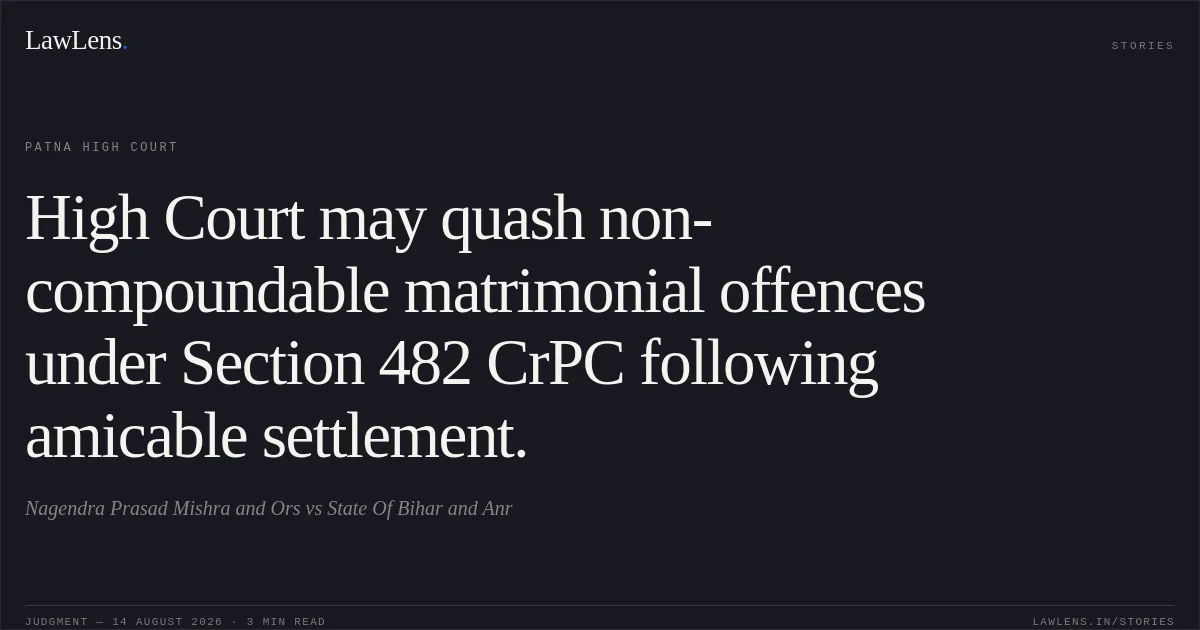
Whether the criminal proceedings arising from allegations under Sections 498-A and 323 IPC could be quashed under Section 482 Cr.P.C. on the basis of an amicable settlement between the parties, notwithstanding that Section 498-A IPC is non-compoundable?
Source reference: pp. 8–9, paras. 11–14Whether, in light of the settlement, continuation of the criminal proceedings and the order rejecting the petitioners’ discharge application would amount to an abuse of the process of the court?
Source reference: pp. 2, 8–10, paras. 3, 14–15Law Applied
The Court considered Section 482 Cr.P.C., which preserves the High Court’s inherent jurisdiction to prevent abuse of the process of any court and to secure the ends of justice.
Source reference: p. 8, para. 11It recognised that although an offence under Section 498-A IPC is non-compoundable, the High Court may, in an appropriate case, quash criminal proceedings involving such an offence when the parties have amicably settled their essentially matrimonial dispute.
Source reference: p. 8, para. 12The Court relied on Narinder Singh v. State of Punjab, (2014) 6 SCC 466, which distinguishes the statutory power of compounding under Section 320 Cr.P.C. from the inherent power under Section 482 Cr.P.C. and permits cautious exercise of the latter in non-compoundable cases after settlement.
Source reference: p. 8, para. 12It also relied on Naushey Ali v. State of U.P., (2025) 4 SCC 78, which holds that continuation of a criminal trial after an amicable resolution may be futile and may constitute an abuse of process when the ends of justice require quashing.
Source reference: p. 9, para. 13Reasoning
The Court treated the dispute as primarily matrimonial in nature and noted that the complainant and her husband had voluntarily resolved their differences through mediation and agreed to withdraw the criminal proceedings.
Source reference: pp. 6–9, paras. 10, 14Applying the principles in Narinder Singh, the Court held that the bar on statutory compounding under Section 320 Cr.P.C. did not prevent the High Court from exercising its inherent jurisdiction under Section 482 Cr.P.C.
Source reference: p. 8, para. 12In view of the settlement, the Court found that continuation of the prosecution against the petitioners would serve no useful purpose and would amount to an abuse of the process of the court.
Source reference: p. 9, para. 14The settlement therefore justified quashing the proceedings, irrespective of the non-compoundable character of Section 498-A IPC.
Source reference: no citationHolding
The High Court allowed the application under Section 482 Cr.P.C.
It quashed and set aside the Magistrate’s order dated 1 June 2016 rejecting the petitioners’ discharge application, as well as all proceedings emanating from Trial No. 1025 of 2016 arising out of Complaint Case No. 596 of 2011.
Source reference: p. 10, paras. 15–16Any pending interlocutory applications were also disposed of.
Source reference: p. 10, para. 17Acts & Sections Cited
4 provisions across 2 statutes referred to in this judgment. Each provision opens on LawLens.
Indian Penal Code, 18601
Code of Criminal Procedure, 19733
Original Court PDF
Nagendra Prasad Mishra and OrsvsState Of Bihar and Anr
Click to open original judgment
Original judgment, available to read, download and summarize on LawLens.in