Facts
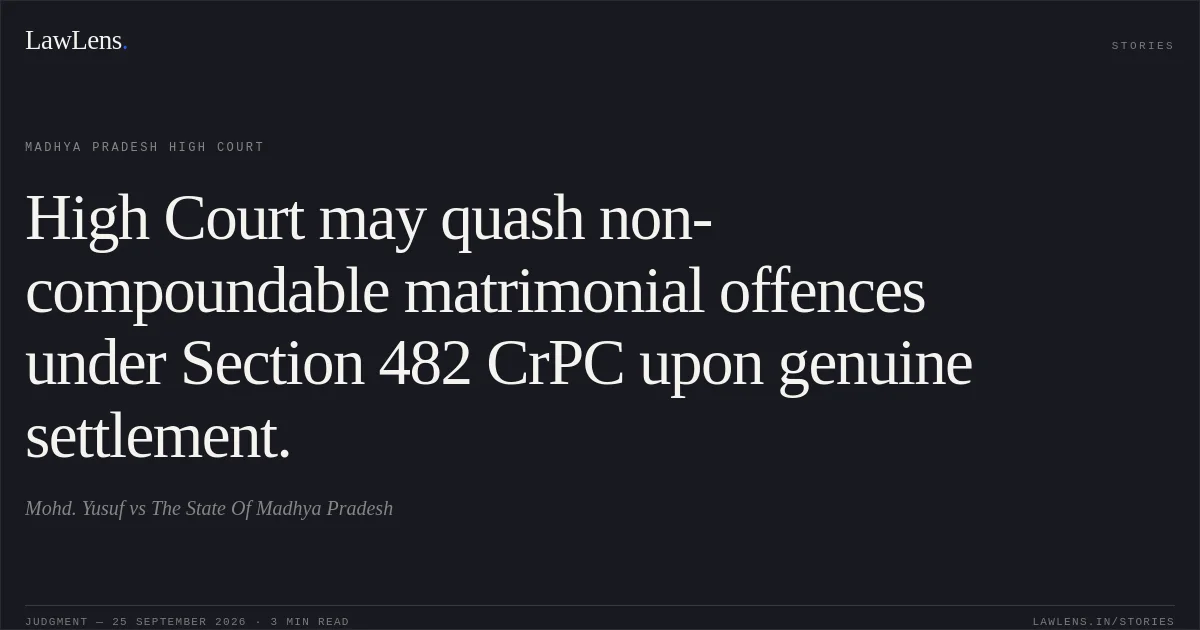
The petitioners invoked the inherent jurisdiction of the High Court under Section 482 of the Code of Criminal Procedure, 1973 (“CrPC”), seeking quashing of the order dated 6 February 2018 by which the Additional Sessions Judge, Jabalpur rejected their compromise application, and seeking quashing of criminal proceedings in Case No. ST/2100120/2015 for offences under Sections 498-A and 307 read with Section 34 of the Indian Penal Code, 1860 (“IPC”).
Source reference: p.1The prosecution arose out of a matrimonial dispute. During the proceedings before the High Court, the parties filed an application for compromise under Section 320(1) CrPC.
Source reference: p.1They appeared before the Registrar (J-II), affirmed that the settlement was voluntary and free from threat, inducement or coercion, and were duly identified by counsel. The Registrar reported that the compromise appeared genuine and authentic.
Source reference: p.1The complainant/respondent no. 2 supported quashing of the proceedings.
Source reference: p.5Issues
Whether the High Court could exercise its inherent power under Section 482 CrPC to quash non-compoundable criminal proceedings under Sections 498-A and 307/34 IPC on the basis of an amicable settlement in a matrimonial dispute.
Source reference: pp.1–4, 6Whether continuation of the criminal proceedings, despite the parties’ genuine and voluntary compromise, would constitute an abuse of the process of law or defeat the ends of justice.
Source reference: pp.4–6Law Applied
The Court applied Section 482 CrPC, which preserves the High Court’s inherent power to prevent abuse of the process of any court and to secure the ends of justice, distinct from the statutory power of compounding under Section 320 CrPC.
Source reference: pp.2–3Relying on B.S. Joshi v. State of Haryana, 2003 (4) SCC 675, the Court held that Section 320 CrPC does not bar quashing of proceedings involving matrimonial offences, including Section 498-A IPC, where the dispute has been amicably resolved.
Source reference: pp.2, 6Under Gian Singh v. State of Punjab, (2012) 10 SCC 303, and Narinder Singh v. State of Punjab, (2014) 6 SCC 466, proceedings may be quashed where the dispute is predominantly private or matrimonial, the settlement is genuine, the possibility of conviction is remote, and continuation of prosecution would cause injustice or abuse of process; however, heinous offences or offences having a serious impact on society ordinarily cannot be quashed merely on compromise.
Source reference: pp.2–4The power under Section 482 CrPC must be exercised sparingly, carefully and with caution.
Source reference: pp.5–6Reasoning
The Court verified that the parties had voluntarily and genuinely settled their matrimonial dispute, without threat, coercion, inducement or undue influence, and that the complainant consented to quashing.
Source reference: pp.1, 5Applying B.S. Joshi, Gian Singh and Narinder Singh, the Court treated the prosecution as arising from a predominantly private matrimonial dispute rather than an offence requiring continuation in the public interest.
Source reference: pp.4–6It found that the settlement had brought the dispute to an end, that the continuation of proceedings would serve no useful purpose, and that pursuing the prosecution would result in unnecessary delay, harassment and abuse of process.
Source reference: pp.4–6The Court further observed that the dispute did not involve moral turpitude and was not heinous in the circumstances presented.
Source reference: p.6Holding
The Court answered the issues in favour of the petitioners.
It allowed the Miscellaneous Criminal Case and, in exercise of its inherent jurisdiction under Section 482 CrPC, quashed the criminal proceedings in Case No. ST/2100120/2015 pending before the Additional Sessions Judge, Jabalpur, for offences under Sections 498-A and 307/34 IPC.
Source reference: p.6Acts & Sections Cited
5 provisions across 2 statutes referred to in this judgment. Each provision opens on LawLens.
Code of Criminal Procedure, 19732
Indian Penal Code, 18603
Original Court PDF
Mohd. YusufvsThe State Of Madhya Pradesh
Click to open original judgment
Original judgment, available to read, download and summarize on LawLens.in