01Facts
The petitioners sought quashing of FIR No. 6 dated 02.09.2019, registered at Police Station Punjab State Cyber Crime, SAS Nagar, under Sections 420 and 34 IPC and Section 66 of the Information Technology Act, 2000, together with all consequential proceedings.
¶ 1The allegation was that the accused contacted the complainant by telephone and induced him to part with money on the pretext of providing employment.
¶ 5The petition was filed under Section 528 BNSS on the basis of a compromise deed dated 28.09.2026 (Annexure P-3).
¶ 1On 06.10.2026 the Court issued notice and directed the parties to appear before the trial/duty Magistrate to record their statements on the compromise.
¶ 3The report of the Additional Chief Judicial Magistrate, SAS Nagar, Mohali dated 16.11.2026 records that the parties had settled amicably, had no objection to quashing, and that the compromise was genuine and free from undue influence or coercion.
¶ 4The private respondent (respondent No. 2) raised no objection to quashing.
¶ 6(ix)02Issues
i.1. Whether the High Court may quash an FIR and consequential proceedings, including for offences that the judgment describes as non-compoundable, on the basis of a compromise between the parties under its inherent power.
¶ 7–8ii.2. Whether, on the facts of this case, quashing is warranted to secure the ends of justice or prevent abuse of process.
¶ 6 · ¶ 9 (first)03Law Applied
Section 528 BNSS preserves the High Court's inherent power to secure the ends of justice or prevent abuse of process.
¶ 1 · ¶ 8In Kulwinder Singh v. State of Punjab, 2007 (3) RCR (Criminal) 1052, the Full Bench held that the High Court may compound non-compoundable offences and quash proceedings where necessary to prevent abuse of process or secure justice, and that this power is not confined to matrimonial disputes.
¶ 7In Gian Singh v. State of Punjab, 2012 (4) RCR (Criminal) 543, the Supreme Court held that the inherent power to quash on compromise is distinct from the compounding power under Section 320 CrPC, is exercised within the twin guidelines of securing the ends of justice and preventing abuse of process, and extends to proceedings where a compromise has been effected.
¶ 8The Court applied its own enumerated factors (i) to (xiii) for assessing whether quashing is appropriate, including the private nature of the dispute, absence of criminal antecedents, absence of heinous or socially harmful conduct, voluntariness of settlement, and the victim's consent.
¶ 6Provisions in the judgment · 6 · Linked ones open on LawLens
Bharatiya Nagarik Suraksha Sanhita, 2023 Section 528
Indian Penal Code, 1860 Section 420Section 34
Information Technology Act, 2000 Section 66
Code of Criminal Procedure, 1973 Section 482Section 320
04Reasoning
The Court verified the compromise through the trial Magistrate's report, which confirmed that the settlement was genuine and voluntary.
¶ 4The Court characterised the allegations, a telephonic employment-fraud inducement resulting in monetary loss, as predominantly personal and without wider societal impact.
¶ 5Applying the factors at para. 6, the Court found the occurrence private, the petitioners without criminal history, the offence not heinous or of mental depravity, public peace and the administration of criminal justice unaffected, and the settlement free of coercion or inducement.
¶ 6The Court noted that the complainant consented and that continuing the trial would affect the petitioners' career and promote ill will.
¶ 6 · ¶ 9 (first)Under Kulwinder Singh and Gian Singh, the Court held that quashing would give a quietus to the disputes and that continuing the proceedings would serve no useful purpose.
¶ 9 (first)05Holding
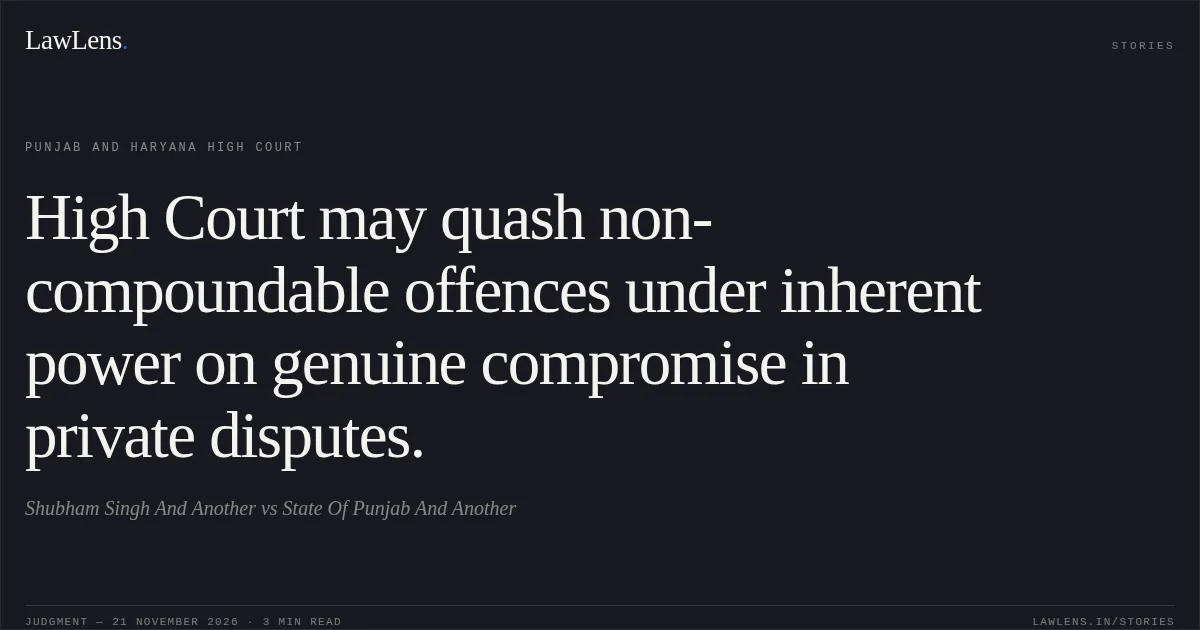
Where the compromise is genuine, voluntary, and the dispute is personal and does not affect public interest, the High Court may quash an FIR and consequential proceedings under inherent power, even for offences treated as non-compoundable.
¶ 6–9The petition was allowed. FIR No. 6 dated 02.09.2019 under Sections 420 and 34 IPC and Section 66 of the IT Act, 2000, registered at Police Station Punjab State Cyber Crime, SAS Nagar, along with all consequential proceedings, was quashed on the basis of the compromise deed dated 28.09.2026 (Annexure P-3).
¶ 9 (second/operative)Original Court PDF
Shubham Singh And AnothervsState Of Punjab And Another
Click to open original judgment
Original judgment, available to read, download and summarize on LawLens.in