Facts
The applicant sought the quashing of a charge-sheet and the cognizance/summoning order dated 21.08.2023 issued by the Special Judge POCSO, Udham Singh Nagar, in Session Trial No. 679 of 2023
Source reference: para. 4The proceedings arose from an F.I.R. lodged by the mother of the victim (Respondent No. 2) alleging misbehavior, leading to charges under Sections 341, 354-D, and 506 of the IPC, and Sections 11/12 of the POCSO Act
Source reference: para. 4-5During the pendency of the case, the applicant and the complainant reached an amicable settlement and filed a joint compounding application (I.A. No. 1 of 2026) supported by affidavits
Source reference: para. 7Both parties appeared before the Court to confirm that the dispute, which originated from a personal altercation, was settled and that the complainant did not wish to prosecute further
Source reference: para. 8, 11Issues
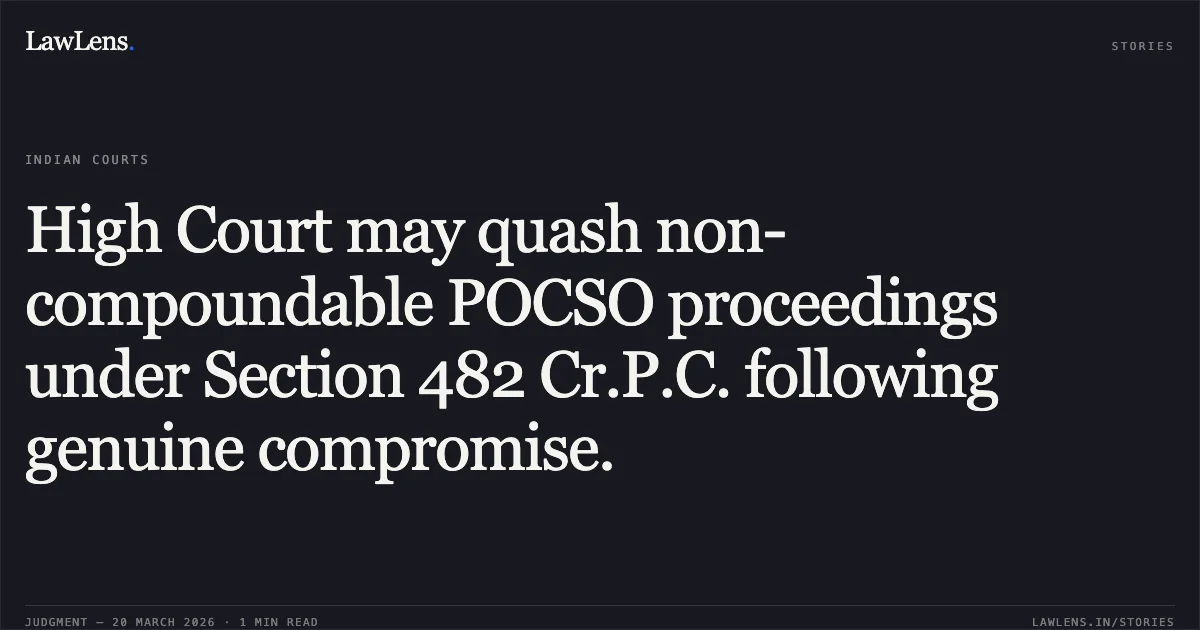
1. Whether the High Court can exercise its inherent powers under Section 482 Cr.P.C. to quash criminal proceedings involving non-compoundable offences under the POCSO Act on the basis of an amicable settlement
Source reference: para. 122. Whether the continuation of proceedings is warranted when the complainant refuses to prosecute and the allegations lack essential ingredients of the charged POCSO offences
Source reference: para. 6, 13-14Law Applied
The Court primarily exercised its inherent jurisdiction under Section 482 of the Cr.P.C. to secure the ends of justice and prevent the abuse of the process of law
Source reference: para. 12, 15It relied on the landmark precedents of Gian Singh vs. State of Punjab (2012) 10 SCC 303 and Narinder Singh vs. State of Punjab (2014) 6 SCC 466, which established that the High Court may quash non-compoundable criminal proceedings if they have an overwhelmingly personal or civil flavor and if a genuine settlement renders further trial an exercise in futility
Source reference: para. 13The Court also considered the statutory definitions of sexual harassment under Section 11 of the Protection of Children from Sexual Offences (POCSO) Act, 2012
Source reference: para. 6, 12Reasoning
The Court examined the material on record and noted that the dispute arose from a personal altercation rather than a deep-rooted sexual crime
Source reference: para. 11Regarding the POCSO charges, the Court observed that the F.I.R. lacked specific allegations of sexually coloured remarks or intimidation necessary to attract Section 11
Source reference: para. 6Although the State Counsel opposed the application on the grounds that POCSO offences are non-compoundable, the Court found that the settlement was voluntary, genuine, and free from coercion following a personal interaction with the parties
Source reference: para. 9, 14Applying the principles from Gian Singh and Narinder Singh, the Court reasoned that because the complainant no longer supported the prosecution, the possibility of conviction was remote, and continuing the trial would serve no useful purpose and would result in an unnecessary burden on the judicial system
Source reference: para. 13, 15Holding
The Court answered the issues in the affirmative, holding that this was a fit case to exercise inherent powers to secure the ends of justice
The Court allowed the compounding application (IA No. 1 of 2026) and quashed the charge-sheet, the cognizance/summoning order dated 21.08.2023, and the entire criminal proceedings in Session Trial No. 679 of 2023
Source reference: para. 16-17All pending applications were disposed of accordingly
Source reference: para. 18Acts & Sections Cited
5 provisions across 3 statutes referred to in this judgment. Each provision opens on LawLens.
Indian Penal Code, 18602
Code of Criminal Procedure, 19731
Protection of Children from Sexual Offences Act, 20122
Original Court PDF
SHOBHIT KUMAR ALIAS GOLUvsSTATE OF UTTARAKHAND
Click to open original judgment
Original judgment, available to read, download and summarize on LawLens.in


