Facts
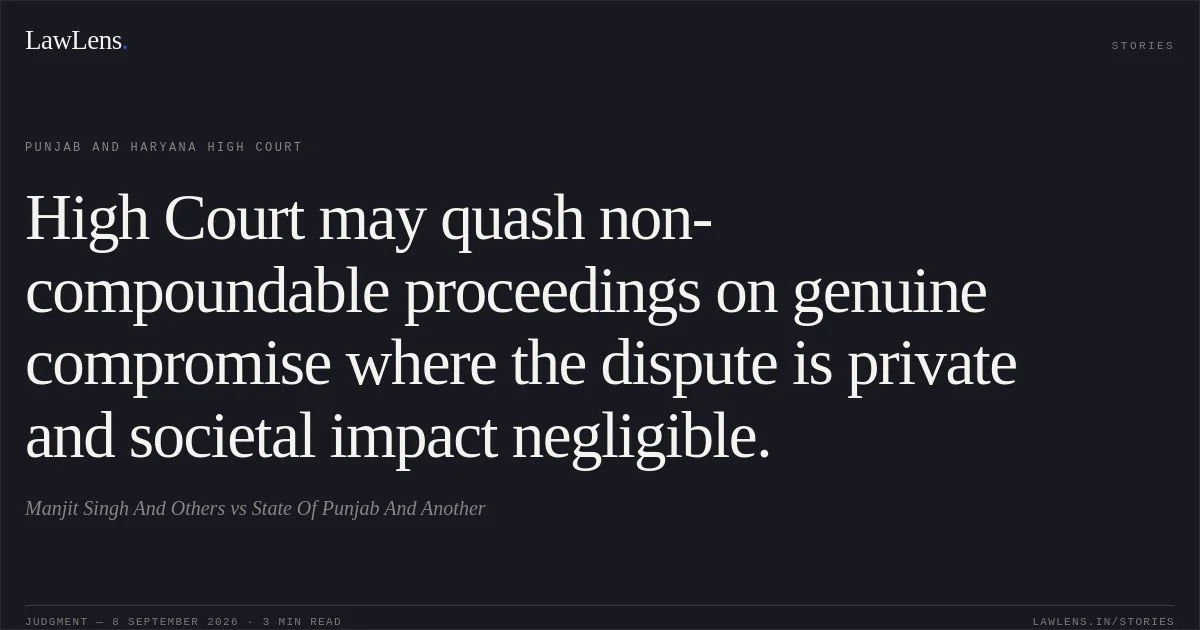
The petitioners invoked Section 528 of the Bharatiya Nagarik Suraksha Sanhita, 2023, seeking quashing of FIR No. 215 dated 23.08.2019, registered under Sections 420, 467, 468, 471 and 120-B IPC at Police Station City Tarn Taran, District Tarn Taran, along with all consequential proceedings.
Source reference: p.1The relief was sought on the basis of a compromise entered into between the petitioners and respondent No. 2.
Source reference: p.1Pursuant to the Court’s directions, the parties appeared before the Additional Chief Judicial Magistrate, Tarn Taran, and recorded their statements.
Source reference: p.2The Magistrate’s report dated 15.11.2025 stated that the compromise was genuine, voluntary, amicable, and free from coercion or undue influence, and that the complainant had no objection to quashing of the FIR.
Source reference: p.2Issues
Whether the High Court should exercise its inherent jurisdiction under Section 528 of the Bharatiya Nagarik Suraksha Sanhita, 2023 to quash the FIR and consequential proceedings on the basis of a genuine compromise between the parties.
Source reference: pp.1–2Whether continuation of the criminal proceedings, concerning offences under Sections 420, 467, 468, 471 and 120-B IPC, would serve any useful purpose when the dispute was private in nature and the complainant had consented to its settlement.
Source reference: pp.2–4Law Applied
The Court applied Section 528 of the Bharatiya Nagarik Suraksha Sanhita, 2023, which preserves the High Court’s inherent power to prevent abuse of the process of law and secure the ends of justice.
Source reference: p.1Relying on Kulwinder Singh and Others v. State of Punjab, 2007 (3) RCR (Criminal) 1052, the Court held that the High Court may quash proceedings involving non-compoundable offences where such intervention is necessary to prevent abuse of process or secure justice.
Source reference: p.3It further relied on Gian Singh v. State of Punjab, 2012 (4) RCR (Criminal) 543, which distinguishes the High Court’s inherent power to quash criminal proceedings from the statutory power of compounding under Section 320 CrPC; the inherent power is broad but must be exercised in accordance with the ends-of-justice and abuse-of-process principles.
Source reference: p.3Reasoning
The Court accepted the Magistrate’s report that the compromise was genuine, voluntary and free from coercion, and that the private respondent had no objection to quashing the FIR.
Source reference: p.2In applying the governing principles, the Court found that the dispute was personal and private, the petitioners had no criminal antecedents, and the alleged offences did not constitute heinous offences involving serious mental depravity or a substantial impact on society.
Source reference: p.2It further observed that the settlement did not affect public peace, public policy, morality or the social fabric, and that there was no material indicating that the petitioners were professional or incorrigible offenders.
Source reference: pp.2–3Since continuation of the prosecution would not advance the administration of criminal justice and rejection of the compromise could perpetuate hostility between the parties, quashing the proceedings was considered necessary to secure the ends of justice.
Source reference: pp.2–4Holding
The Court answered the issues in favour of the petitioners. It held that the compromise was genuine and that continuation of the criminal proceedings would serve no useful purpose.
Accordingly, the petition was allowed, and FIR No. 215 dated 23.08.2019 under Sections 420, 467, 468, 471 and 120-B IPC, registered at Police Station City Tarn Taran, District Tarn Taran, together with all consequential proceedings, was quashed on the basis of the compromise.
Source reference: p.4Acts & Sections Cited
7 provisions across 3 statutes referred to in this judgment. Each provision opens on LawLens.
Bharatiya Nagarik Suraksha Sanhita, 20231
Indian Penal Code, 18604
Code of Criminal Procedure, 19732
Original Court PDF
Manjit Singh And OthersvsState Of Punjab And Another
Click to open original judgment
Original judgment, available to read, download and summarize on LawLens.in