Facts
The petitioner sought quashing of FIR No. 0015/2024 dated 25 March 2024, registered at Police Station Dharchula, District Pithoragarh, under Section 323 of the Indian Penal Code and Section 3(1)(x) of the Scheduled Castes and Scheduled Tribes (Prevention of Atrocities) Act, and consequential protection from arrest
Source reference: p.1During the proceedings, the petitioner and respondent nos. 3 and 4 appeared through video conferencing and were identified by their respective counsel.
Source reference: p.2They stated that the dispute had been amicably settled voluntarily and without pressure, and filed a compounding application, affidavits, and a compromise memo.
Source reference: p.2Respondent no. 3, Naresh Singh, stated that he did not wish to prosecute the petitioner further.
Source reference: p.2The State did not oppose the application, acknowledging that the dispute was private in nature despite the offence under the SC/ST Act being non-compoundable.
Source reference: p.3Issues
Whether the High Court could exercise its jurisdiction under Article 226 of the Constitution to quash the FIR alleging offences under Section 323 IPC and Section 3(1)(x) of the SC/ST Act on the basis of an amicable settlement between the parties.
Source reference: pp.1, 3–4Whether continuation of the criminal proceedings, in view of the voluntary compromise and the private nature of the dispute, would serve any useful purpose.
Source reference: p.3Law Applied
The Court considered Section 323 of the Indian Penal Code and Section 3(1)(x) of the Scheduled Castes and Scheduled Tribes (Prevention of Atrocities) Act, the latter being treated as a non-compoundable offence.
Source reference: p.3It relied on the principles recognized in Gian Singh v. State of Punjab, 2012 (10) SCC 303; Dimpey Gujral v. Union Territory, Chandigarh, (2013) 11 SCC 497; B.S. Joshi v. State of Haryana, (2003) 4 SCC 675; and Nikhil Merchant v. CBI, (2008) 9 SCC 677, under which constitutional or inherent jurisdiction may be exercised to terminate criminal proceedings involving predominantly private disputes where the parties have genuinely settled and continuation of the prosecution would amount to a futile exercise.
Source reference: p.3The Court applied this principle notwithstanding the formal non-compoundable character of the offence under the SC/ST Act.
Source reference: pp.3–4Reasoning
The Court verified the compromise through the parties’ personal statements, affidavits, and compromise memo, and noted that the settlement had been entered into voluntarily and without coercion.
Source reference: p.2Since respondent no. 3 expressly stated that he did not wish to pursue the prosecution, and the State raised no objection, the Court characterized the dispute as personal and private.
Source reference: pp.2–3Applying the Supreme Court’s precedents permitting quashing of non-compoundable criminal proceedings in appropriate cases, the Court concluded that continuing the prosecution would be a futile exercise and that the ends of justice would be served by accepting the compromise.
Source reference: p.3Holding
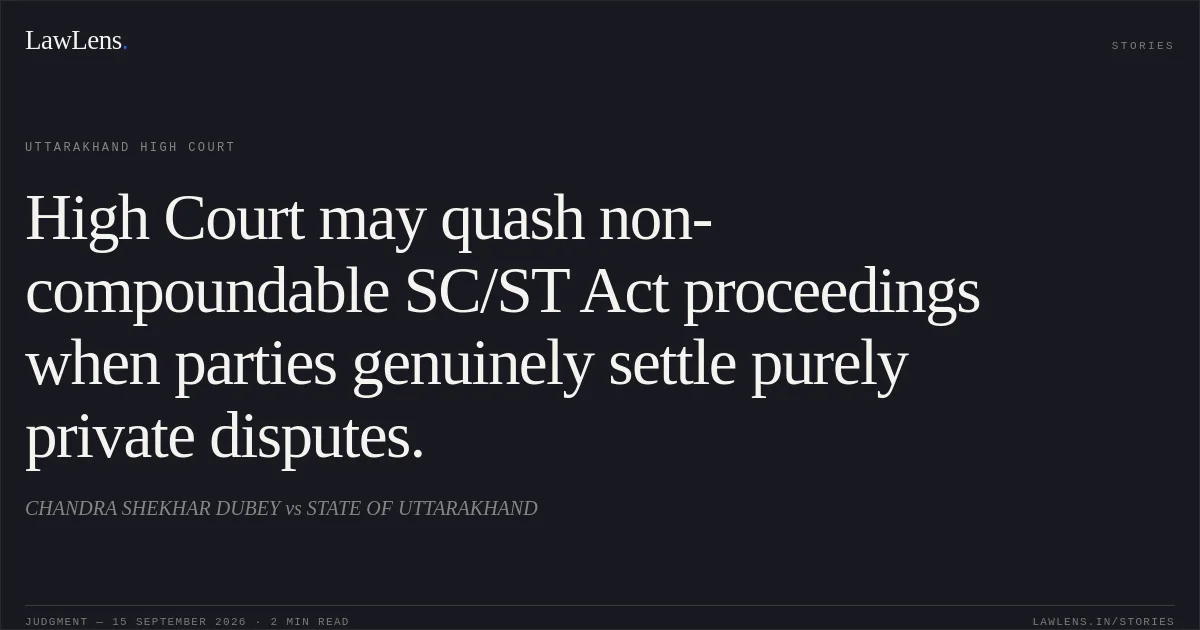
The Court allowed the compounding application and quashed FIR No. 0015/2024 dated 25 March 2024, Police Station Dharchula, District Pithoragarh, registered under Section 323 IPC and Section 3(1)(x) of the SC/ST Act.
The criminal writ petition was accordingly disposed of, and the compounding application and compromise memo were directed to form part of the order.
Source reference: paras. 14–15, p.4Acts & Sections Cited
2 provisions across 2 statutes referred to in this judgment. Each provision opens on LawLens.
Indian Penal Code, 18601
Scheduled Castes and the Scheduled Tribes (Prevention of Atrocities) Act, 19891
Original Court PDF
CHANDRA SHEKHAR DUBEYvsSTATE OF UTTARAKHAND
Click to open original judgment
Original judgment, available to read, download and summarize on LawLens.in


