Facts
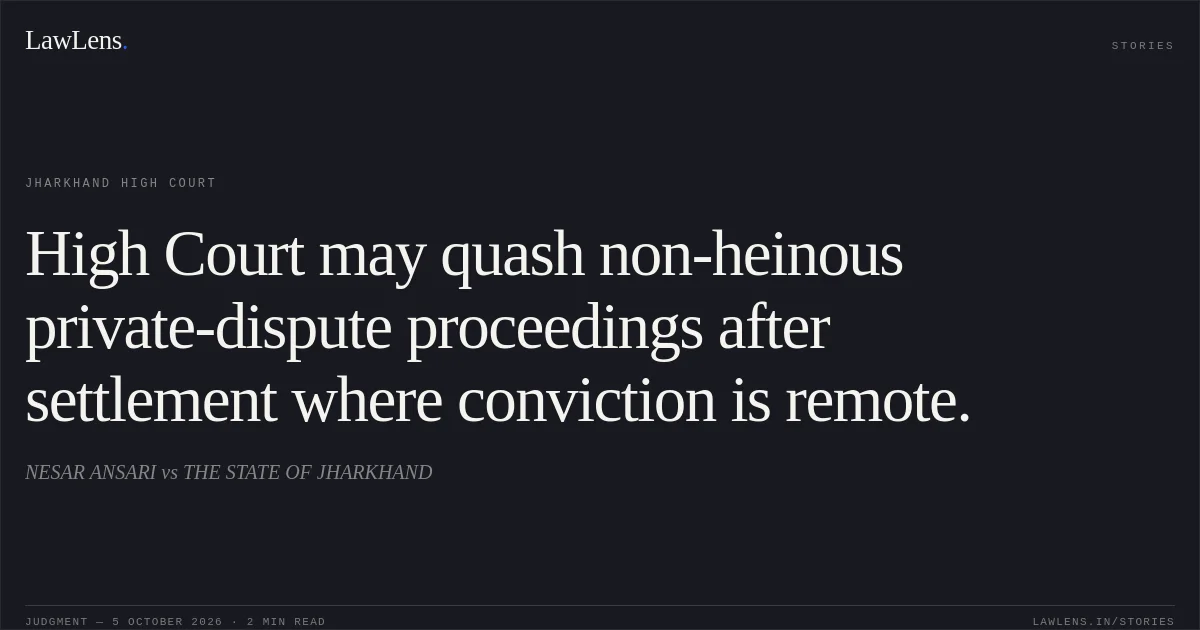
The petitioners invoked Section 528 of the Bharatiya Nagarik Suraksha Sanhita, 2023 (BNSS), seeking to quash Chanho P.S. Case No. 32 of 2026, the connected G.R. Case No. 1317 of 2026, and the cognizance order dated 16 May 2026.
Source reference: para. 2The case was registered under Sections 126(2), 115(2), 118(1), 117(2), 109/352, 351(3) and 3(5) of the Bharatiya Nyaya Sanhita, 2023; a charge-sheet had been submitted against petitioner nos. 1 to 4.
Source reference: para. 2The informant, who was also the injured victim’s mother, and the petitioners filed affidavits stating that the parties had settled the dispute voluntarily, without pressure or coercion, and that the FIR had been lodged on mistaken facts.
Source reference: para. 3The State did not oppose quashing in view of the settlement.
Source reference: para. 4Issues
1. Whether the High Court should exercise its inherent jurisdiction under Section 528 BNSS to quash the criminal proceedings on the basis of the parties’ settlement.
Source reference: paras. 2–52. Whether the nature of the alleged offences and the prospects of conviction justified quashing the proceedings despite the offences being non-compoundable.
Source reference: paras. 5–8Law Applied
Section 528 BNSS, corresponding to Section 482 of the Code of Criminal Procedure, preserves the High Court’s inherent power to quash criminal proceedings, including in non-compoundable cases, to secure the ends of justice or prevent abuse of process; the power must be exercised sparingly and with caution.
Source reference: para. 5, citing Narinder Singh v. State of Punjab, (2014) 6 SCC 466, para. 29.1–29.2Under Narinder Singh, proceedings involving heinous or serious offences ordinarily should not be quashed merely because of a settlement, while the court may consider the offence’s nature, the evidence and injury, the likelihood of conviction, the stage of proceedings, and whether settlement may restore harmony between the parties.
Source reference: para. 5, citing Narinder Singh, para. 29.3–29.7Reasoning
The Court treated the dispute as private, finding that no public policy was implicated and that the offences were not heinous or of serious mental depravity.
Source reference: para. 6It relied on the parties’ complete settlement and the affidavits supporting its voluntariness, and concluded that the possibility of conviction was remote and bleak. It further held that continuing the proceedings would cause the petitioners oppression, prejudice and injustice.
Source reference: paras. 3, 7Applying the principles in Narinder Singh, the Court therefore considered quashing appropriate.
Source reference: paras. 5–8Holding
The Court allowed the petition and quashed, as against the named petitioners, the FIR and entire criminal proceedings in Chanho P.S. Case No. 32 of 2026, corresponding to G.R. Case No. 1317 of 2026, including the cognizance order dated 16 May 2026.
The connected interlocutory application was disposed of accordingly.
Source reference: para. 11Acts & Sections Cited
12 provisions across 4 statutes referred to in this judgment. Each provision opens on LawLens.
Bharatiya Nagarik Suraksha Sanhita, 20231
Bharatiya Nyaya Sanhita, 20238
Indian Penal Code, 18601
Code of Criminal Procedure, 19732
Original Court PDF
NESAR ANSARIvsTHE STATE OF JHARKHAND
Click to open original judgment
Original judgment, available to read, download and summarize on LawLens.in