Facts
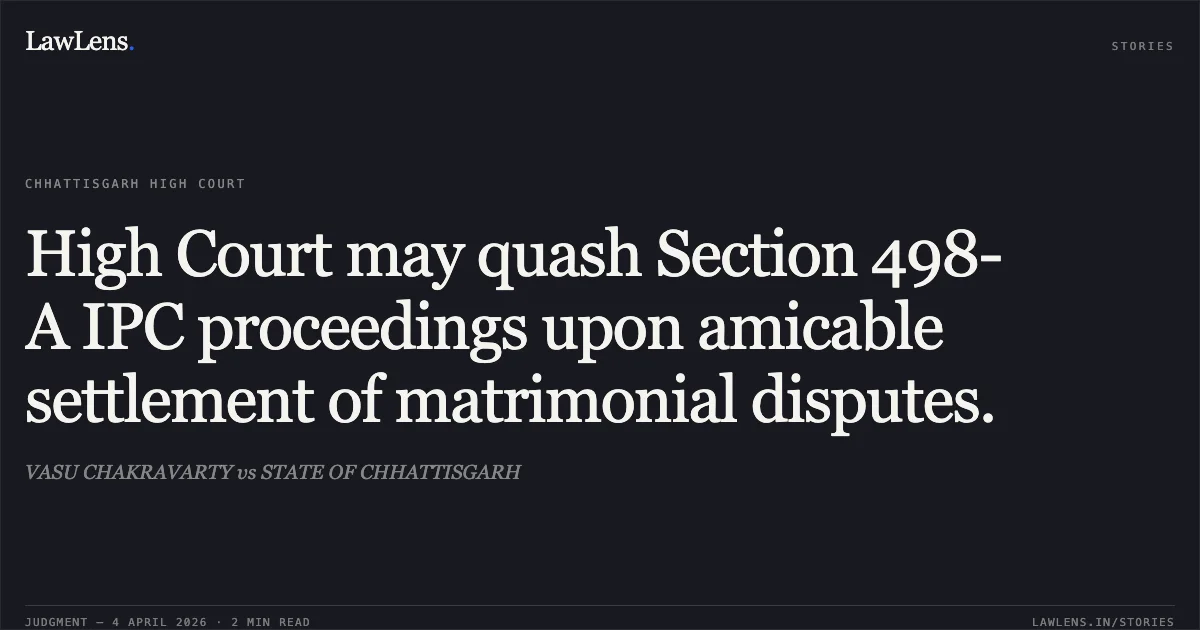
The petitioners (the husband and his parents) sought the quashing of Criminal Case No. 13938/2024, registered under Section 498-A of the IPC, following a matrimonial dispute with Respondent No. 2
Source reference: para 2-3While a divorce was granted by the Family Court on grounds of cruelty, the court found the wife's allegations regarding alimony to be baseless
Source reference: para 3During the pendency of a matrimonial appeal (F.A.(MAT) No. 182/2024), the parties underwent mediation and reached a settlement
Source reference: para 3Under the agreement, Petitioner No. 3 (husband) paid a one-time settlement of ₹25,00,000, and Respondent No. 2 agreed to withdraw all pending cases, including the impugned criminal proceedings
Source reference: para 3The petitioners moved the High Court under Section 528 of the BNSS (formerly Section 482 CrPC) on the grounds that the dispute was amicably resolved
Source reference: para 2-3Issues
1. Whether the High Court should exercise its inherent power under Section 528 of the BNSS to quash criminal proceedings for non-compoundable matrimonial offences based on a compromise between the parties.
Source reference: para 2, 6Law Applied
The court primarily applied Section 528 of the Bharatiya Nagarik Suraksha Sanhita (BNSS), which grants the High Court inherent powers to prevent abuse of the process of any court or to secure the ends of justice
Source reference: para 2, 9It relied on the landmark decision in Gian Singh v. State of Punjab (2012), which held that criminal cases arising out of matrimony or family disputes that are private in nature may be quashed if the parties have resolved their entire dispute and conviction is remote
Source reference: para 6The court further cited B.S. Joshi & Ors. v. State of Haryana & Anr. (2003), affirming that the High Court's power to quash Section 498-A proceedings is not limited by the compounding restrictions of Section 320 of the Code
Source reference: para 7Additionally, it referenced Jitendra Raghuvanshi v. Babita Raghuvanshi (2013), emphasizing that matrimonial proceedings should be quashed when they become an abuse of process due to a settlement
Source reference: para 8-9Reasoning
The court noted that the dispute was matrimonial and private in nature, rather than a heinous crime impacting society
Source reference: para 6, 10It observed that the parties had voluntarily entered into a mediation settlement where the husband complied with his obligation to pay ₹25,00,000
Source reference: para 3, 10Relying on the principles in Gian Singh, the court reasoned that since the parties had settled their differences, the possibility of conviction was "remote and bleak"
Source reference: para 6The court concluded that continuing the criminal trial would subject the petitioners to "great oppression and prejudice" and would constitute a futile exercise of the court's time, thus amounting to an abuse of the legal process
Source reference: para 3, 10Holding
The court allowed the petition and held that quashing the proceedings was necessary to secure the ends of justice given the full and complete settlement between the parties
It ordered the quashing of the charge-sheet dated 31.12.2022 and all further criminal proceedings in Criminal Case No. 13938/2024 pending before the Judicial Magistrate First Class, Raipur
Source reference: para 11Acts & Sections Cited
4 provisions across 3 statutes referred to in this judgment. Each provision opens on LawLens.
Bharatiya Nagarik Suraksha Sanhita, 20231
Hindu Marriage Act, 19551
Code of Criminal Procedure, 19732
Original Court PDF
VASU CHAKRAVARTYvsSTATE OF CHHATTISGARH
Click to open original judgment
Original judgment, available to read, download and summarize on LawLens.in